Domestic Meal Kit Market Growth... 2019: 101.7 Billion KRW → 2021: 258.7 Billion KRW
Experts "Affordable Prices Must Guarantee High Quality"
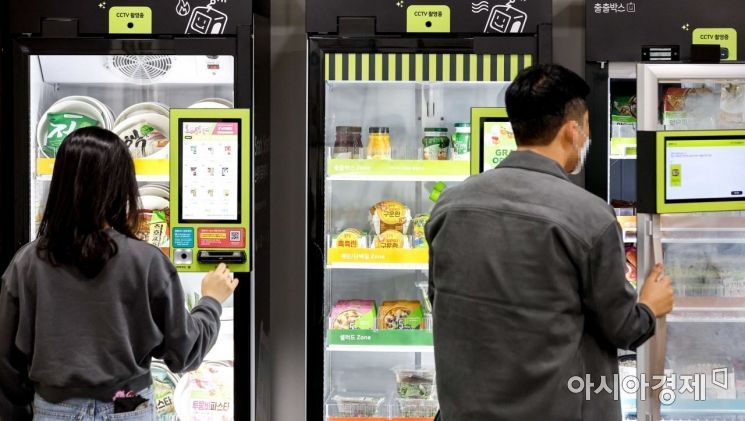 Consumers are selecting meal kit products. The photo is unrelated to specific expressions in the article. Photo by Asia Economy DB.
[Asia Economy Reporter Heo Midam] 'Meal kit' specialty stores, which gained popularity as startup items during the COVID-19 pandemic, are now facing a wave of closures in the post-endemic era. As social distancing measures have eased and dining-out demand gradually recovers, customer visits to meal kit specialty stores have declined.
Recently, on the self-employed online community 'Apeunikka Sajangida' (Because It's Painful, I'm a Boss), posts inquiring about closing meal kit stores have been increasing. One self-employed person said, "I put my meal kit unmanned store up for sale after four months because my health deteriorated," adding, "Those planning to start a meal kit store should think carefully. The meal kit market is now in its final phase."
During the COVID-19 pandemic, as single-person households increased and opted to eat at home instead of dining out, the meal kit market size exploded. According to the market research firm Euromonitor, the domestic meal kit market size grew from 101.7 billion KRW in 2019, before the pandemic, to 188.2 billion KRW in 2020, and 258.7 billion KRW last year. Consequently, meal kit specialty stores displaying and selling meal kits also rapidly increased.
In particular, meal kit specialty stores attracted prospective entrepreneurs because, unlike other food service businesses, they require no cooking effort and can be operated unmanned, reducing labor costs. They also have the advantage of enabling low-capital startups.
However, after the lifting of social distancing, increased outdoor activities have caused meal kit stores to face headwinds. Additionally, the lack of significant differentiation from meal kit products distributed through supermarkets, department stores, and online malls is cited as a factor in declining sales. According to the commercial property brokerage firm 'Jeompo Line,' as of the 10th, about 70 meal kit specialty stores in the metropolitan area have been listed for sale. Some business owners who opened stores earlier this year have already decided to close them.
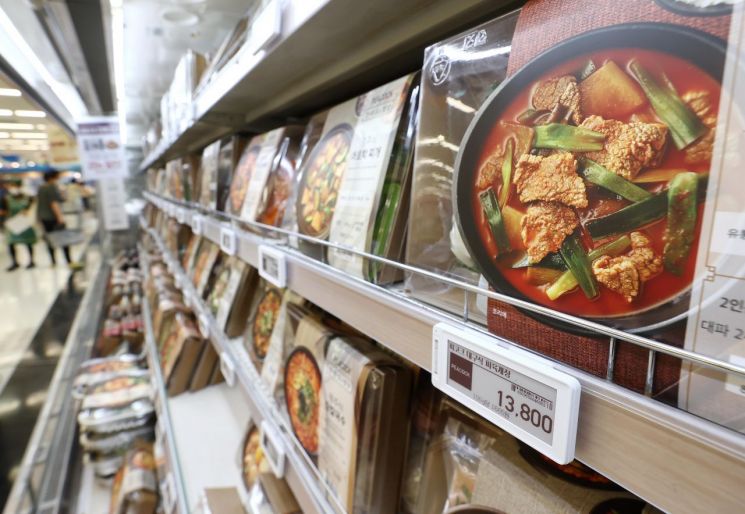 Meal kit display at a large supermarket in Seoul. The photo is unrelated to specific expressions in the article. [Image source=Yonhap News]
In the United States, where the meal kit industry developed earlier than in Korea, demand has also decreased as the country enters the endemic phase. According to retail market analysis firm 'Coresight Research,' the U.S. meal kit market was valued at ▲$3.4 billion in 2019, ▲$5.8 billion in 2020, and ▲$6.8 billion in 2021. While the market grew approximately 70% year-over-year in 2020, growth slowed to 17% in 2021.
Some consumers have also expressed dissatisfaction with meal kit products, citing high prices relative to quality and excessive waste generated from plastic and vinyl packaging.
Kim Seon-kyung (26), who lives alone in Yeongdeungpo-gu, Seoul, said, "It's good that unnecessary food waste can be reduced, but meal kits still require some labor, like cutting ingredients myself," adding, "Considering this, I think the market prices are relatively expensive."
Experts point out that for the meal kit market to grow, affordable prices and high quality must be guaranteed. Professor Lee Eun-hee of Inha University's Department of Consumer Studies said, "Young people do not want to spend time and energy cooking, so if meal kits are offered at relatively low prices with guaranteed quality, the market is expected to continue growing," adding, "From the consumer's perspective, meal kit prices may feel comparable to dining out, which can cause dissatisfaction regarding price."
© The Asia Business Daily(www.asiae.co.kr). All rights reserved.
![User Who Sold Erroneously Deposited Bitcoins to Repay Debt and Fund Entertainment... What Did the Supreme Court Decide in 2021? [Legal Issue Check]](https://cwcontent.asiae.co.kr/asiaresize/183/2026020910431234020_1770601391.png)
















