Japan Plans Fukushima Contaminated Water Ocean Discharge After Next Spring
International Atomic Energy Agency (IAEA) Collects Fish and Seawater Samples at Fukushima Port
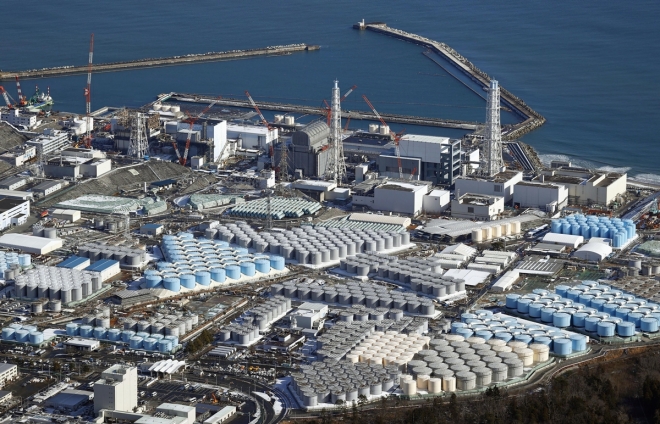 Large amounts of radioactive contaminated water stored in tanks near the Fukushima Daiichi Nuclear Power Plant. Photo by AP Yonhap News
[Asia Economy Reporter Yoon Seul-gi] As the Japanese government is pushing for the ocean discharge of contaminated water from the Fukushima Daiichi Nuclear Power Plant next spring, an International Atomic Energy Agency (IAEA) inspection team collected samples of fish, seawater, and marine sediments at the port of Iwaki City, Fukushima Prefecture.
According to Japan's Kyodo News on the 10th, the IAEA inspection team collected marine samples for experiments and analysis assuming the contaminated water discharge scenario. The IAEA team collected about 200 kg of six types of fish, including flounder and conger eel, as well as seawater and marine sediments from the coastline around the Fukushima Daiichi Nuclear Power Plant, where the contaminated water discharge is expected. The collected samples will be transported to a research facility in Chiba Prefecture for analysis of tritium (a radioactive substance) concentration and other factors.
The team visiting Japan consisted of two researchers from the IAEA Environmental Research Laboratory and two invited experts from South Korea and Finland. Kyodo News reported, "The purpose is to enhance the reliability and transparency of radioactive material monitoring through measurements of seawater and other samples," adding, "Researchers from South Korea and Finland also participated to ensure objectivity."
Since the explosion accident caused by the Great East Japan Earthquake on March 11, 2011, the Fukushima Daiichi Nuclear Power Plant has been generating about 130 to 150 tons of contaminated water daily, containing radioactive materials from groundwater and rainwater.
Until now, Tokyo Electric Power Company (TEPCO) has been storing this contaminated water, purified by the Advanced Liquid Processing System (ALPS), in storage tanks on the plant site. However, due to a shortage of storage tank capacity, TEPCO announced plans to dilute the contaminated water to about 1/40th of its concentration and discharge it into the seabed. The Japanese government currently states that it plans to discharge "treated water," from which radioactive materials have been removed and diluted, into the ocean, and that it will take measures in accordance with international standards.
However, controversy continues over the ocean discharge of "treated water," as it is known that tritium, a radioactive material contained in the contaminated water, is not completely removed even after purification by ALPS.
The IAEA is objectively reviewing Japan's claim that the "treated water" is safe. The IAEA task force is verifying whether the various data claimed by TEPCO, the plant operator, appear when the nuclear power plant contaminated water is treated according to Japan's plan. Experiments and verifications are also being conducted under conditions similar to Japan's marine environment to assess the impact of contaminated water discharge.
The Japanese government plans to dilute the purified contaminated water with seawater and discharge it into the ocean after next spring. TEPCO began construction work in August on facilities such as an underwater tunnel necessary for the contaminated water discharge. It is reported that TEPCO is carrying out excavation of the underwater tunnel extending to the sea about 1 km from the plant site and installing pipelines connecting the storage tanks to the underwater tunnel.
© The Asia Business Daily(www.asiae.co.kr). All rights reserved.

















