F-4E, Aircraft Introduced in the 1970s
Military: "Difficult to Conclude Due to Aging Issues"
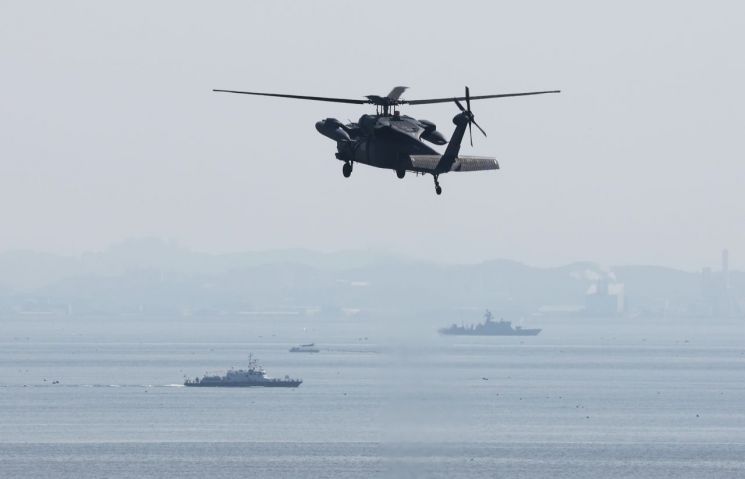 On the afternoon of August 12, a military helicopter was busy flying back and forth over the sea off Seosin-myeon, Hwaseong-si, Gyeonggi Province, where an Air Force F-4E fighter jet crashed. The aircraft took off from Suwon Base in Gyeonggi at around 11:41 a.m. that day, was returning after completing its mission, and both pilots successfully ejected and were confirmed to be unharmed.
 [Image source=Yonhap News]
[Asia Economy Reporter Jang Hee-jun] The cause of the crash of the Air Force F-4E Phantom fighter jet near Hwaseong City, Gyeonggi Province last August was found to be a defect in the nozzle that injects fuel into the engine, according to investigation results.
The Air Force formed an accident countermeasure committee and disclosed the investigation results identified so far on the 9th.
According to the Air Force, the aircraft involved in the accident caught fire in the right engine while returning to Suwon base after completing its mission. The pilot broadcasted an emergency situation and turned the aircraft's nose toward the West Sea, away from densely populated areas. Subsequently, the fire spread to both engines, and the pilot chose a route without fishing boats at sea and ejected while maintaining the aircraft's nose direction.
After recovering and investigating the wreckage of the aircraft, it was found that abnormal fuel injection in the right engine caused partial damage to the combustion chamber, and high-temperature and high-pressure flames reaching 1950 degrees Celsius and 190 psi (pounds per square inch) leaked out.
The leaked flames spread not only inside the engine but also outside, reaching the fuel tank. Although there are supplementary devices such as double insulation between the engine and the fuel tank, an investigation participant explained that it is difficult to block flames and combustion chamber explosions of such high temperature and pressure.
It was suggested that the abnormal fuel injection was likely caused by carbon or other foreign substances clogging the nozzle, the device that injects fuel. Due to the foreign substances, fuel was injected unevenly to one side, weakening the combustion chamber walls and ultimately causing flames due to heat.
An Air Force official explained, "Flames surged up to the lower part of the fuel tank, causing continuous fuel leakage," adding, "As a result, the pilot could see the flames behind during flight, making it an uncontrollable situation."
The problematic nozzle was inspected on March 23 last year and used for 116 hours thereafter. The Air Force explained that since disassembling and inspecting the part takes about a week, it is not an item that can be checked before every flight.
Although the fighter jet was introduced in April 1979 and is over 40 years old, the Air Force drew a line, stating that the accident was not caused by aging issues.
An Air Force official said, "There was one fire caused by engine part defects in a Phantom in 2010, and similar incidents occasionally occur in other new models," adding, "It cannot be concluded that the accident happened because the aircraft is old." He further stated, "We will conduct a special full inspection of all F-4E aircraft engines and provide training to all pilots and maintenance personnel, then gradually resume flights starting with aircraft that have completed inspections."
Earlier, at around 12:20 p.m. on August 12, an F-4E fighter jet crashed about 9 km south of Jeongok Port in Hwaseong City, Gyeonggi Province. The two pilots recognized the engine fire, turned the aircraft toward a coastal area without houses, ejected, and were rescued in good health. The F-4E Phantom is a derivative of the F-4Ⅱ released in 1959 and was introduced to Korea from the 1970s. It has a length of 19.17 m, a wingspan of 11.76 m, a maximum armament load of 7.25 tons, and a maximum speed of Mach 2.27.
© The Asia Business Daily(www.asiae.co.kr). All rights reserved.

















