Protecting Fishery Environments and Increasing Fishermen's Income Achieve Twofold Benefits
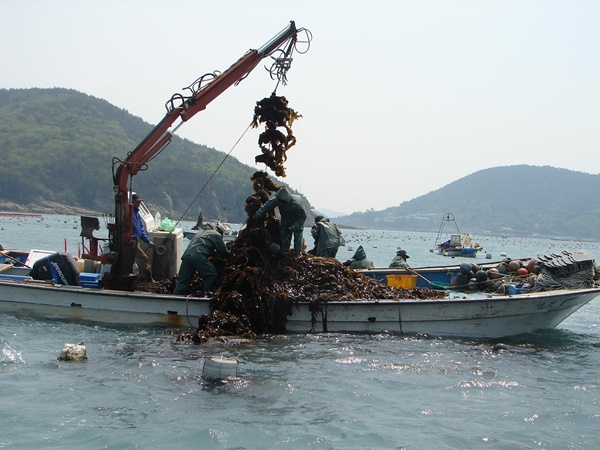 Wando County promotes the recycling project of seaweed by-products every year. (Photo by Wando County)
[Wando=Asia Economy Honam Reporting Headquarters Reporter Choi Kyung-pil] Jeonnam Wando-gun announced on the 9th that its annual seaweed byproduct recycling project is receiving high praise from fishermen as it achieves a twofold effect of protecting fishery environments and increasing fishermen's income.
Wando-gun's seaweed byproduct recycling project was first launched nationwide in 2008 and is currently being promoted with an annual investment of about 820 million KRW.
Wando cultivates seaweed in 6,990 fishing households (26,559 hectares), with an annual seaweed production of 511,000 tons, of which sea mustard (miyeok) and kelp (dashima) account for 42 tons.
When roots and stems left over from the production of miyeok and dashima are discarded into the sea, they accumulate on the seabed, increasing dissolved oxygen concentration and causing marine pollution.
To prevent marine pollution, the county purchases non-commercial miyeok and dashima tails, stores them, and supplies them to fishing households during the fall season (September to October), when abalone feed is scarce.
This year, applications for seaweed byproduct support were accepted from each town and township fishing cooperative from the 18th to the 21st of last month, and the supply is planned to be evenly distributed until the end of November.
The project is operated on a consignment basis through a consultative body formed with related organizations such as the Fisheries Cooperative and the Korea Abalone Industry Association, linking purchase, processing, and supply.
Shin Woo-cheol, Wando County Governor, said, “The seaweed byproduct recycling project not only prevents marine pollution but also helps reduce operating costs for abalone farming households by providing seaweed byproducts free of charge,” adding, “We will expand the project going forward.”
Meanwhile, from May to June last year, 2,544 tons of miyeok and dashima were purchased and 627 tons supplied to 1,711 fishing households, and 75 tons of dashima tails were purchased and supplied to 378 fishing households.
Wando=Asia Economy Honam Reporting Headquarters Reporter Choi Kyung-pil alwatros@asiae.co.kr
© The Asia Business Daily(www.asiae.co.kr). All rights reserved.

















