[Asia Economy Sejong=Reporter Kim Hyewon] The scope of historical and cultural environment preservation areas will be reduced from a 500m radius around cultural assets to 200m (in residential, commercial, and industrial areas). Special exemptions for development and commercialization will be introduced, such as waiving the application of individual laws during test operations of autonomous and eco-friendly vessels. Additionally, the distribution of frequencies for electric vehicle wireless charging will establish a foundation for the commercialization of electric vehicle wireless charging devices.
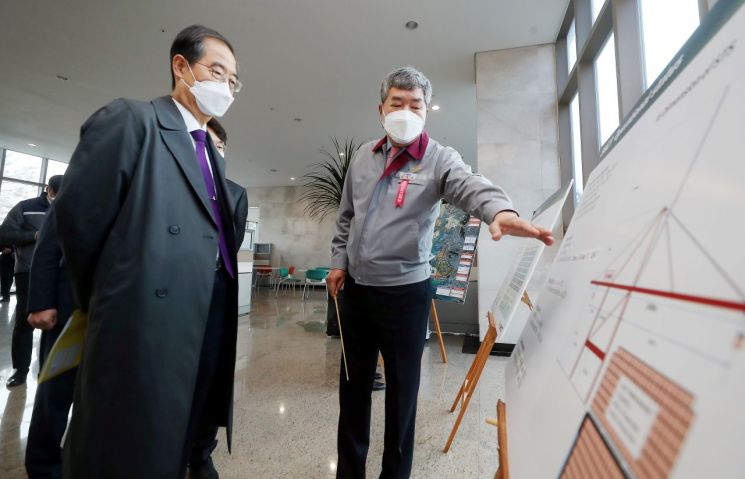
Prime Minister Han Duck-soo chaired the '2nd Regulatory Innovation Strategy Meeting' on the 9th at Sungrang Co., Ltd.'s new container terminal in Incheon Port, where he unveiled key regulatory improvement tasks with these contents. The Regulatory Innovation Strategy Meeting is the highest decision-making body for government regulatory innovation established under the Yoon Seok-yeol administration. This second meeting was held at Incheon Port with a focus on discussing regulatory relaxation to revitalize private investment in port areas.
In his opening remarks, Prime Minister Han pointed out, "In a situation where global economic recession and inflation concerns are intensifying, the dynamism of our industries and companies may continue to weaken." He added, "To overcome the crisis we face and leap forward to a better Republic of Korea, close cooperation between the government and the private sector is more important than ever." He explained, "Since the launch of the Yoon government, each ministry has identified 1,010 regulations that need improvement, of which 275 have been completed."
The meeting reported on easing restrictions on private investment in cultural assets and marine/port sectors and reducing regulations in the digital industry. In the cultural heritage sector, the uniform regulation of a 500m radius around cultural assets will be reduced to 200m in residential, commercial, and industrial areas, minimizing the regulatory zones requiring Cultural Heritage Administration approval by considering the characteristics of each cultural asset. The area subject to re-examination is 2,577 km², which is 4.3 times the area of Seoul and 2.6% of the entire national territory. Furthermore, nationwide large-scale indicator surveys led by the Cultural Heritage Administration and local governments will exempt developers from mandatory indicator surveys in those areas, shortening project periods by 40 to 50 days. The 'Ancient Capital (Godo) Image Finding Resident Support Project' will expand its target from traditional Hanok houses to modern and contemporary buildings, and regulations will be revised to allow local governments to handle minor matters such as groundwater development independently.
In the marine and fisheries sector, regulations on supply and use will be eased by diversifying the supply of port hinterland complexes (industrial complexes, inland sites, etc.), allowing combined logistics and manufacturing operations, and improving marine space use regulations such as permitting camping sites and management buildings along the coast. The Office for Government Policy Coordination expects economic effects including a 1.5-fold increase in hinterland complex cargo handling volume by 2027 (from 3.67 million TEU to 5.45 million TEU), a 76% increase in resident companies (from 233 to 409), and cumulative private investment of 1.6 trillion KRW. Special provisions for development and commercialization, such as exemption from individual laws during test operations of autonomous and eco-friendly vessels and simplification of new technology certification procedures, are also expected to generate an economic effect of 12.5 trillion KRW related to eco-friendly and advanced ship equipment.
In the digital industry sector, the allocation of an 85 kHz frequency, which can serve as a foundation for the commercialization of electric vehicle wireless charging, was decided. A regulatory framework will also be established to apply ultra-wideband wireless technology (UWB) to smartphones, enabling low-power and precise functions such as smart door locks and lost item tracking. To improve semiconductor process efficiency, the inspection method for radio wave-utilizing equipment will be changed to allow inspections without process interruption, reducing the duration from about 7 days to 1 day, and the burden of electromagnetic compatibility evaluation for LED lighting equipment in the industry will also be eased.
Regarding the cultural heritage sector, Prime Minister Han said, "Concerns have been raised that some preservation-focused regulations excessively restrict citizens' property rights and corporate development," adding, "We will firmly protect cultural assets that must be preserved while resolving public inconvenience and enabling community development." Concerning the marine and fisheries sector, he stated, "On this occasion, we will boldly remove compartmentalized regulations that hinder fostering port hinterland complexes as regional economic hubs and establish a foundation for nurturing future marine new industries."
© The Asia Business Daily(www.asiae.co.kr). All rights reserved.

















