Estimated to be from 2nd century BC to 1st century AD
"Important Evidence of the Transition Period between Etruria and the Roman Era"
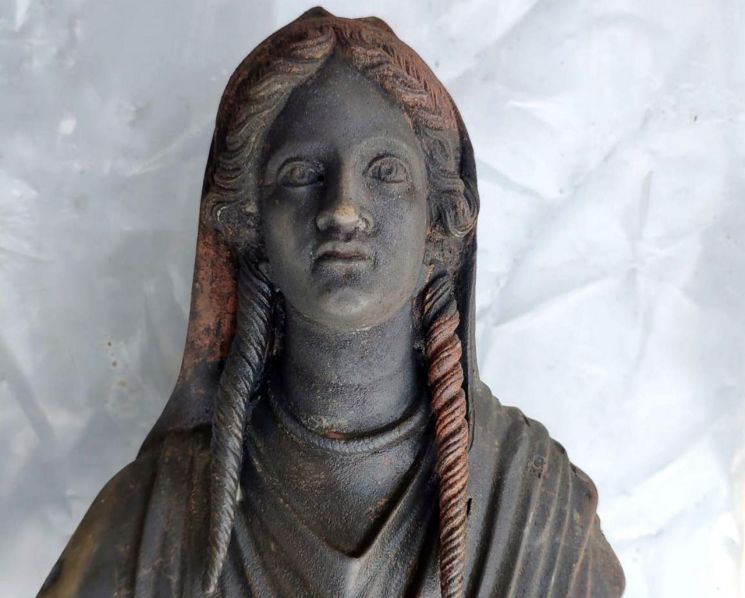 Bronze statue discovered at the hot spring ruins in San Casciano dei Bagni near Siena, Italy. Photo by EPA Yonhap News
[Asia Economy Reporter Kim Sung-wook] A large number of ancient artifacts estimated to date from the 2nd century BC to the 1st century AD have been unearthed after 2,300 years in Siena, Tuscany, central Italy.
According to The Guardian and others on the 8th (local time), archaeologists discovered 24 ancient bronze statues during excavation work at the hot spring site in San Cassiano dei Bagni near Siena. The ancient hot spring where the artifacts were found is believed to have been built during the Etruscan civilization era in the 3rd century BC, before the Roman period. The hot spring includes fountains and altars, and it is presumed that the Roman Empire, including Emperor Augustus, used the hot springs for health and healing purposes.
The statues include depictions of gods from Greek and Roman mythology such as Apollo and Hygieia. The statues are thought to have originally been used to decorate sanctuaries by elite families, landowners, regional lords, and Roman emperors of Etruscan and Roman origin. Notably, five of the statues are about 1 meter tall and have been preserved close to their original form thanks to being buried in mud for a long time. Etruscan and Latin inscriptions, along with some 6,000 coins, were also discovered. There is a modern hot spring nearby that attracts tourists, and it appears that coins were thrown as acts of wishing for health.
The San Cassiano dei Bagni excavation project has been led since 2019 by Italian archaeologist Professor Jacopo Tabolli of the University for Foreigners of Siena. He has been leading the excavation work with over 60 experts from around the world. In August, artifacts presumed to be offerings to the gods were also found at the site. Professor Tabolli said, "The hot spring, rich in minerals including calcium and magnesium, was used until the 5th century before being closed in the Christian era, but it was not destroyed."
Archaeologists regard the artifacts as "important evidence of the transitional period between the Etruscan and Roman eras," and view the hot spring as a sanctuary of peace. The Etruscan civilization flourished for 500 years in central Italy’s Tuscany and Umbria before the advent of the Roman Republic, strongly influencing Roman culture and artistic traditions. Professor Tabolli stated, "Even during historical periods when the most terrible external conflicts raged, it seems that the Etruscan and Roman worlds coexisted peacefully at this pool and altar."
Massimo Osanna, director of the Italian Ministry of Culture’s museums, said, "This is the most important discovery since the Riace Bronzes and one of the most significant bronze statue finds in ancient Mediterranean history." The two Riace Bronzes were discovered underwater off the coast of Calabria near Riace, Italy, in 1972 and are considered one of the greatest archaeological finds in history.
Archaeologists plan to carry out restoration and further research on the artifacts for the time being, and excavation at the site will resume around next spring. Italian Minister of Culture Gennaro Sangiuliano emphasized, "This has once again confirmed that Italy is a country full of vast and unique treasures."
© The Asia Business Daily(www.asiae.co.kr). All rights reserved.

















