Unions of Each Company Preparing Additional Lawsuits
"Must Consider Difficult Global Economic Conditions"
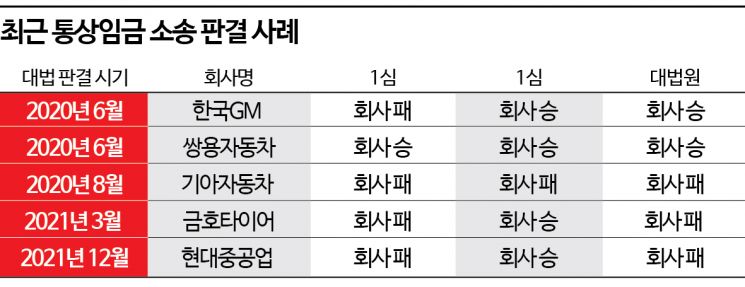
[Asia Economy Reporter Kiho Sung] The attention on Kumho Tire's lawsuit regarding ordinary wages stems from the fact that the outcome of this ruling could significantly impact other companies currently involved in similar lawsuits and cause widespread repercussions across the industry. Given the already challenging business environment due to the global economic downturn, funding shortages triggered by Legoland, and the 'three highs' (high inflation, high interest rates, and high exchange rates), a ruling favoring workers again could become a negative factor by increasing labor costs.
According to business and legal circles on the 9th, Hyundai Heavy Industries, which is awaiting the result of the ordinary wage retrial, had the Supreme Court overturn the previous ruling in December last year that favored the company and sent the case back to the Busan High Court with a ruling in favor of the plaintiff.
Industry insiders estimate that while the exact amount will be calculated once the retrial concludes, if Hyundai Heavy Industries loses the lawsuit, the retroactive ordinary wage payment could amount to approximately 600 billion to a maximum of 700 billion KRW.
The labor sector is either pursuing or preparing new ordinary wage lawsuits. The Renault Korea Motors union filed an ordinary wage lawsuit at the Western Branch of the Busan District Court in August. It is reported that the union listed 17,000 members as plaintiffs. The lawsuit demands the company compensate between 2 million KRW and up to 10 million KRW per employee.
POSCO, which recently lost a status confirmation lawsuit filed by subcontractor workers, is also facing the threat of an ordinary wage lawsuit. The Metalworkers' Union POSCO branch is currently proceeding with an ordinary wage lawsuit against the company. The branch claims that bonuses amounting to 400%, performance bonuses and other bonuses totaling 200%, allowances for resident and maintenance personnel, and self-development support funds should be included in the ordinary wage. They recruited the first group of plaintiffs for the ordinary wage lawsuit until July.
At Hyundai Steel, 3,384 production workers filed a lawsuit in March 2013 and won in the first trial. Subsequently, excluding those who settled after the first trial, 704 workers won the second trial in January this year. In the case of SeAH Besteel, the first trial favored the company, while the second trial favored the union. The Supreme Court referred this matter to a full bench in 2020, and a conclusion has yet to be reached.
There are also cases where unions and retirees are in conflict over ordinary wage lawsuits. Retirees from Hyundai Motor Company recently won a first trial lawsuit against the Hyundai Motor Union, demanding that the encouragement money received from the company in exchange for withdrawing the ordinary wage lawsuit be paid to retirees as well.
The Hyundai Motor Union withdrew the ordinary wage lawsuit ahead of the Supreme Court ruling in 2019. Instead, each union member received 15 shares of employee stock ownership and encouragement money (settlement money) ranging from 2 million to 6 million KRW. Later, after six years since the lawsuit was filed, labor and management reached an agreement to withdraw related lawsuits and include regular bonuses as ordinary wages. Retirees then filed a lawsuit against the company and union, claiming that the 2019 settlement money paid only to active union members constituted an illegal act.
The business community expresses concern that the Kumho Tire ordinary wage lawsuit will influence the numerous pending lawsuits at other companies. Hwang Yong-yeon, head of the Labor Policy Division at the Korea Employers Federation, stated, "Kumho Tire's lawsuit is occurring while the company is facing significant difficulties, and depending on the outcome, it will have considerable effects on the regional economy and future lawsuits," adding, "We hope the court will carefully consider the company's business situation and the current economic conditions when making its judgment."
Experts worry that if union risks resurface amid the worst business conditions, it could trigger a severe management crisis. Ji-soon Park, director of the Labor Graduate School at Korea University, pointed out, "The court should take into account the weakening competitiveness of our companies due to domestic and international economic conditions such as the current exchange rate and interest rate hikes," and emphasized, "Both labor and management need to be provided with detailed and stable standards for the 'principle of good faith' (Shinui Principle) that can be objectively predicted."
© The Asia Business Daily(www.asiae.co.kr). All rights reserved.

















