The 3rd Advanced Regenerative Medicine Development Strategy Forum
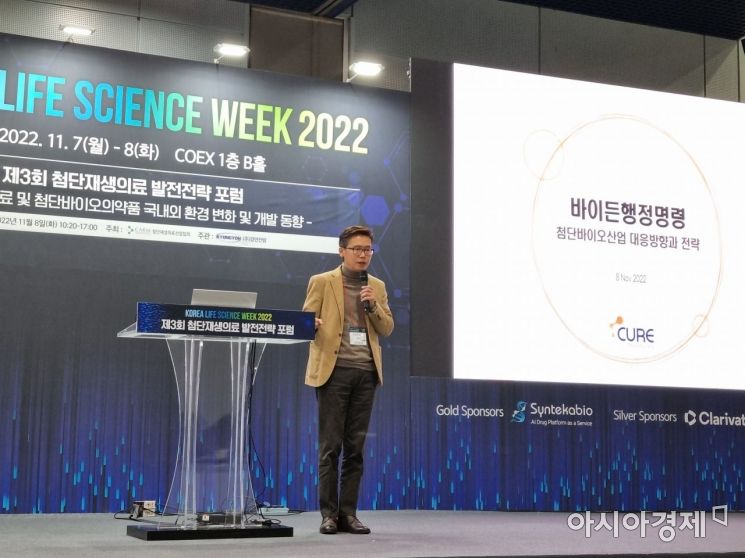 Kim Tae-ho, CEO of Cure Therapeutics, is giving a presentation at the "3rd Advanced Regenerative Medicine Development Strategy Forum" held on the 8th at COEX, Seoul.
 Photo by Kim Young-won
[Asia Economy Reporter Kim Young-won] Regarding U.S. President Joe Biden's bio manufacturing executive order, opinions have emerged that the domestic cell and gene therapy (CGT) industry should respond with bio foundries and distributed production.
At the '3rd Advanced Regenerative Medicine Development Strategy Forum' held on the 8th at COEX, Seoul, hosted by the Advanced Regenerative Medicine Industry Association, Tae-ho Kim, CEO of Cure Therapeutics, spoke about the response strategy to President Biden's bio executive order. Earlier, on September 12, President Biden signed the 'National Biotechnology and Biomanufacturing Initiative' executive order emphasizing domestic production in the bio sector.
CEO Kim explained, "The most actively discussed fields in the U.S. are synthetic biology and the concept of bio foundries," adding, "From this perspective, CGT has significant connectivity and will greatly impact the domestic industry."
Unlike the traditional method of gene editing that modifies existing organisms' functions, synthetic biology designs, manufactures, and assembles genes and components to create and utilize new organisms. A bio foundry is a platform that uses synthetic biology combined with artificial intelligence (AI) and other technologies to design and manufacture biological systems, enabling rapid product development.
CEO Kim emphasized that the U.S. bio foundry concept focuses on 'distributed production.' He said, "The U.S. bio foundry concept moved with the perspective that if the industry develops only in concentrated regions, balanced development across the country will not occur, as experienced during COVID-19," adding, "It involves placing many small-scale factories in various regions."
Furthermore, CEO Kim elaborated that the distributed production method is suitable for the characteristics of CGT, such as chimeric antigen receptor (CAR)-T therapies. He stated, "Since CGT is especially made targeting patients, whether autologous or allogeneic, it should pursue small-scale production targeting specific patient populations," and "Those small-scale patient groups fit well with distributed production."
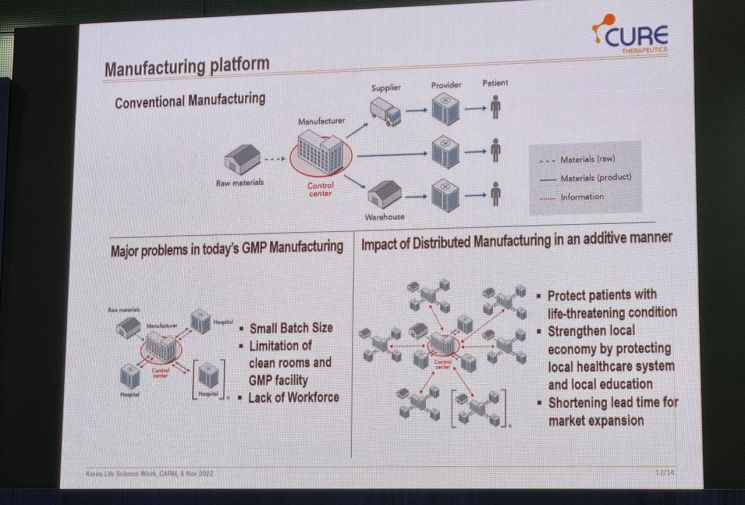
However, CEO Kim diagnosed that the current domestic CGT industry remains in traditional manufacturing methods. He pointed out problems with traditional manufacturing, such as CGT having smaller batch sizes than synthetic drugs, lack of process automation, and a shortage of CGT production personnel requiring many workers. CEO Kim said, "Distributed regional production can solve many issues," adding, "Producing locally and resolving locally can reduce patient waiting times and strengthen the local economy."
Additionally, Kim Hyun-soo, team leader at the Korea Research Institute of Bioscience and Biotechnology, who gave a presentation on 'Key Issues in U.S. Bio Policy and Our Tasks' that day, also emphasized the importance of synthetic biology. Team leader Kim said, "Looking at U.S. policy, there is a hidden strong promotion of synthetic biology," adding, "It is quite rare for a single technology to have a ripple effect across the entire bio industry. I want to vividly emphasize the importance of this technology."
© The Asia Business Daily(www.asiae.co.kr). All rights reserved.
![User Who Sold Erroneously Deposited Bitcoins to Repay Debt and Fund Entertainment... What Did the Supreme Court Decide in 2021? [Legal Issue Check]](https://cwcontent.asiae.co.kr/asiaresize/183/2026020910431234020_1770601391.png)
















