Government's 2-Year Grace Period Proposal "Sounds Like They Might Not Implement It Depending on Election Results"
Financial Investment Income Tax to Be Enforced Next January as Originally Planned
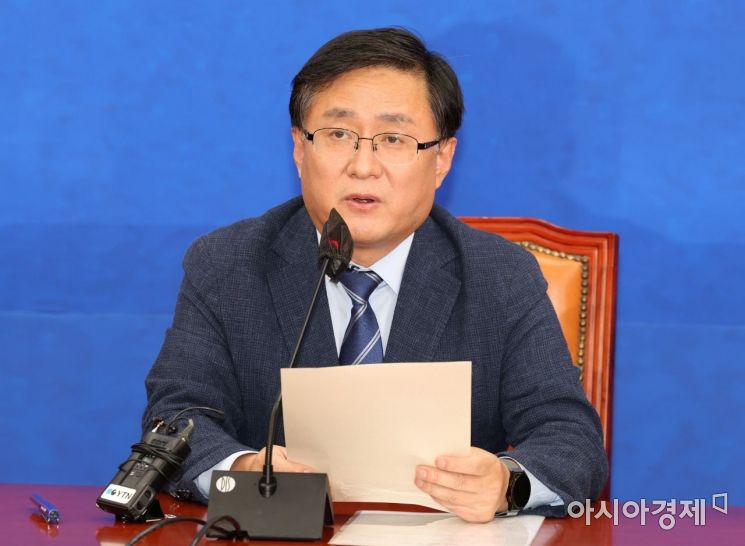 Kim Seong-hwan, Chairman of the Policy Committee of the Democratic Party of Korea, is attending the floor strategy meeting held at the National Assembly on the 13th and delivering opening remarks. Photo by Yoon Dong-joo doso7@
[Asia Economy Reporter Koo Chae-eun] The Democratic Party of Korea has reaffirmed its intention to implement the Financial Investment Income Tax (FIIT), which taxes profits earned from financial investments such as stocks, funds, and bonds, starting January next year. While the government intends to postpone the FIIT for two years, a fierce debate is expected as the main opposition party strongly opposes it, calling it a ‘tax cut for the rich.’
On the 8th, Kim Sung-hwan, chairman of the Policy Committee, said at a press conference, “The FIIT was agreed upon by both ruling and opposition parties two years ago, and even then-member Choo Kyung-ho agreed to it. It is not right to try to shake the fundamental framework now.”
He added, “Income is concentrated among the ultra-high earners in our society, and this (tax exemption) should be corrected now,” and mentioned, “Those who incur losses during financial investments can carry forward those losses and be compensated later, so this system is actually favorable to retail investors even during stock downturns.” Chairman Kim emphasized, “The Democratic Party’s position is to implement it as scheduled and as agreed.”
The FIIT refers to a capital gains tax imposed at a rate of 22-27.5% (including local tax) on investors who earn more than 50 million KRW annually from capital gains on financial products such as stocks and funds. The FIIT law passed the National Assembly in 2020 and was scheduled to be implemented in January 2023. However, following President Yoon Suk-yeol’s policy stance opposing the enactment itself, the government decided in June to postpone the implementation by two years. Nevertheless, the Democratic Party rejects the government’s proposal and insists on proceeding with the original bill passed in 2020.
Chairman Kim said, “Financial investment products were taxed individually because they were created at different times, but there have been consistent criticisms that this is not socially just,” and added, “The purpose of taxing financial investment income was agreed upon by both ruling and opposition parties, and it has already been comprehensively designed to help reduce economic polarization.”
Chairman Kim also stated, “The ruling party and government’s proposal to postpone for two years sounds like they might not implement it depending on the general election results. Is it just to exempt income tax for the top 0.01% ultra-wealthy in Korea? This question cannot be left unanswered.”
© The Asia Business Daily(www.asiae.co.kr). All rights reserved.
![Clutching a Stolen Dior Bag, Saying "I Hate Being Poor but Real"... The Grotesque Con of a "Human Knockoff" [Slate]](https://cwcontent.asiae.co.kr/asiaresize/183/2026021902243444107_1771435474.jpg)











