Q3 Operating Profit of Secondary Batteries Expected to Increase by About 48% Year-on-Year
Film Business Sale... Securing Investment Funds for Copper Foil
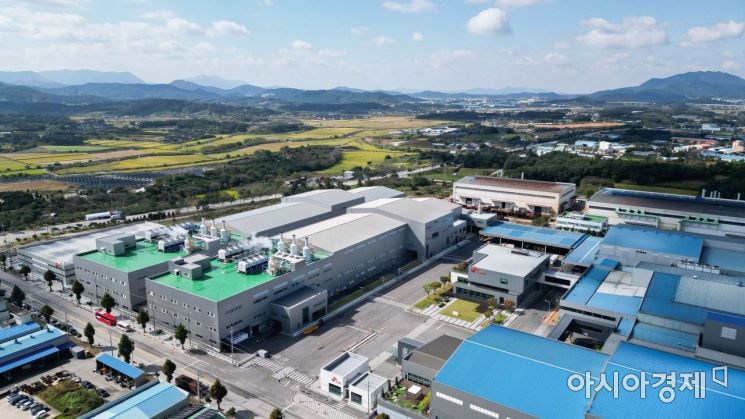 A view of SK Nexilis' Jeongeup plant, an investment company in SKC's copper foil business for secondary batteries. The two buildings with gray roofs on the left are the 5th and 6th plants, respectively completed after SKC acquired the copper foil business in 2020.
[Asia Economy Reporter Choi Seoyoon] Despite a decline in operating profit in the third quarter of this year due to the global economic downturn, SKC is expected to achieve favorable results solely in its core business segment, the secondary battery materials division, among its five business sectors. This reflects the company's rapid transformation from a chemical company to a battery and semiconductor materials enterprise.
According to financial information provider FnGuide on the 9th, SKC's operating profit forecast for the third quarter of this year was estimated at 67 billion KRW, a 54% decrease compared to a year ago. This is attributed to the downturn in the chemical business caused by the global economic recession and accounting issues arising from classifying the Industrial Materials Division (film) as a discontinued operation starting in the third quarter.
By business segment, among SKC's secondary battery materials, industrial materials, chemical, electronic materials (semiconductor components), and other divisions, only the secondary battery materials division is expected to see an increase in operating profit compared to the previous year, continuing profit growth. The market anticipates SKC's operating profit from secondary battery materials in the third quarter to reach around 34 billion KRW, approximately a 48% increase from a year earlier. The volume of copper foil shipments is estimated to have increased by more than 20% from about 9,000 tons in the second quarter to 11,000 tons, driven by increased sales volume to Korean customers. Operating rates have risen following the completion of domestic plants 5 and 6.
The sales proportion of secondary battery materials is expected to increase from 27% this year to 55% by 2025. Juminwoo, a researcher at NH Investment & Securities, analyzed, “Among top-tier copper foil manufacturers, SKC is the largest (projected 100,000 tons by 2025) and is preparing to enter the North American market. There is a high possibility of securing a leading position in the North American market, which will open following the Inflation Reduction Act (IRA).” SKC secured part of the investment funds for its copper foil business by selling its traditional core Industrial Materials Division for about 1.6 trillion KRW in June.
SKC began its copper foil business in January 2020 by acquiring SK Nexilis (formerly KCFT) for 1.2 trillion KRW and announced plans to transform into a battery and semiconductor materials company within 1 year and 9 months, aiming to increase its corporate value fivefold from the current level.
As part of its five-year growth strategy, “Promise and Deep Change,” SKC is accelerating the restructuring of its semiconductor materials business. On the 7th, SKC announced that its wholly owned semiconductor materials subsidiary, SK Solmix, will absorb and merge SK Telesys, which sells semiconductor component materials. SKC stated, “By integrating the capabilities of both companies, we will accelerate growth across all areas of semiconductor materials, components, and equipment, enhance management efficiency, and increase shareholder value.” The merged entity will be launched on February 1 next year.
Meanwhile, the chemical business is expected to see operating profit decline by about 25% to around 69 billion KRW due to sluggish chemical industry conditions caused by weakened upstream demand. Researcher Joo advised, “It is necessary to focus on the performance and competitiveness enhancement strategies of the three divisions driving growth?copper foil, silicon anode materials, and glass substrates?rather than on already reflected concerns.”
© The Asia Business Daily(www.asiae.co.kr). All rights reserved.

















