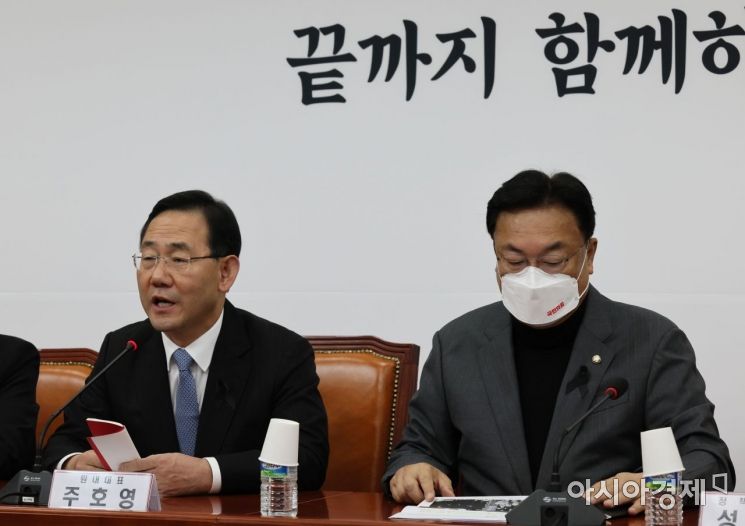
 Joo Ho-young, floor leader of the People Power Party, is attending the Emergency Response Committee meeting held at the National Assembly on the 7th and delivering opening remarks. Photo by Yoon Dong-joo doso7@
[Asia Economy reporters Lee Ji-eun and Kwon Hyun-ji] Kim Jin-tae, Governor of Gangwon Province, claimed that the real cause of the 'Lego Land-triggered financial crisis' was the Moon Jae-in administration's nuclear phase-out policy. However, the ruling party distanced itself from this claim, stating that Lego Land did play a role in triggering the crisis.
On the 7th, Ryu Seong-geol, Special Committee Chair for Economic Stability of the People Power Party, told reporters at the National Assembly regarding Governor Kim's claim, "Of course, there is clearly a part of this issue that was triggered by Lego Land."
He added, "Regarding the statements made by the parties involved, I will not comment individually," drawing a clear line.
Earlier, Governor Kim sent a message to reporters saying, "Lately, I have been blamed as the main culprit of the Lego Land-triggered financial crisis. But I have never said that Gangwon Province would not fulfill its guarantee obligations," and argued, "Rather, Korea Electric Power Corporation (KEPCO), which issued large-scale bonds to cover deficits caused by the Moon Jae-in administration's nuclear phase-out policy and disrupted the market, is the fundamental cause of this situation."
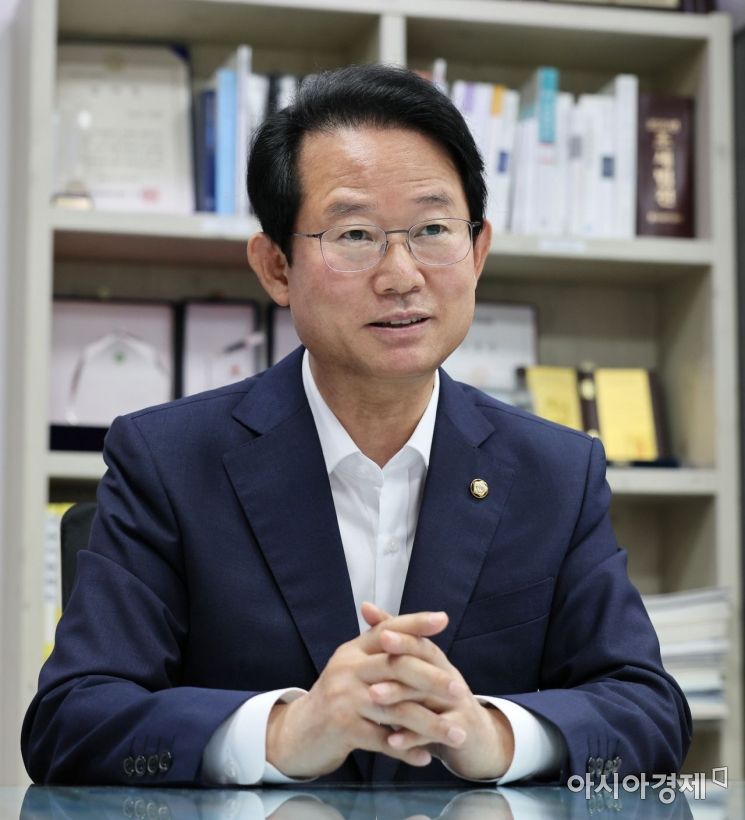
On the same day, the Economic Stability Special Committee agreed that the central and local governments would communicate smoothly to reduce financial market risks. Chairman Ryu said, "There was a discussion about enabling communication between the central and local governments on issues that could act as risks to the financial market," adding, "We also requested such measures from the Ministry of Economy and Finance."
In particular, given that the real estate market, weakened by the continued decline in property prices and an increase in unsold homes, could act as a source of instability for both the financial market and the real economy, they requested the identification and prompt relaxation of abnormal and excessive regulations. Banks were urged to refrain from raising loan interest rates and to avoid excessive competition that causes an overconcentration of funds.
Chairman Ryu noted that although the financial market's severe tightening atmosphere somewhat eased after the government's market stabilization measures, the situation is still not reassuring. He stated, "We requested the Ministry of Economy and Finance to closely monitor market conditions and, if necessary, immediately implement market stabilization measures to establish an overall stable financial market environment."
The Special Committee plans to review household debt and low-income financial conditions next week. Chairman Ryu said, "The Special Committee will continue to communicate with related ministries and financial authorities to manage financial market risks stably," and added, "The next meeting (on the 15th) will discuss matters related to household debt and low-income finance."
© The Asia Business Daily(www.asiae.co.kr). All rights reserved.
!["The Woman Who Threw Herself into the Water Clutching a Stolen Dior Bag"...A Grotesque Success Story That Shakes the Korean Psyche [Slate]](https://cwcontent.asiae.co.kr/asiaresize/183/2026021902243444107_1771435474.jpg)

















