Germany's First Unit Waits in Incheon, Not Beijing... Backup Aircraft Also on Standby at Incheon International Airport
China Buys 140 Airbus Planes as State Visit Gift, Allows BioNTech Vaccine Administration
[Asia Economy Senior Reporter Cho Young-shin] The German Air Force One (German Air Force One, hereinafter referred to as No. 1) entered Korean airspace around 1 p.m. on the 4th.
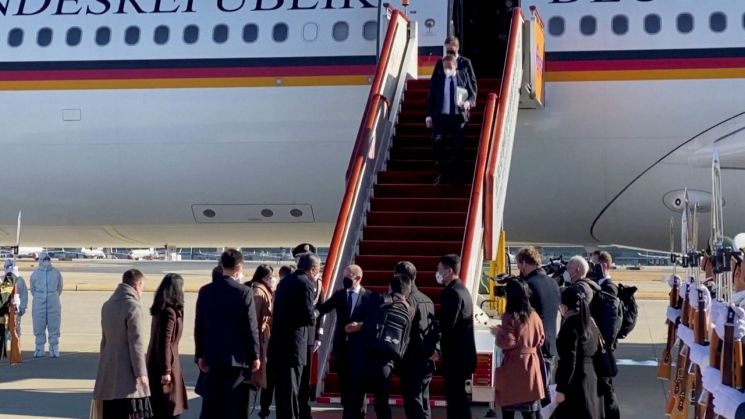
On that day, the German No. 1, which took off from Beijing Capital International Airport at 12:10 p.m., landed at Incheon International Airport at 1:30 p.m. Usually, the No. 1 carrying foreign heads of state uses Seoul Airport, a military airport, for safety and security reasons. Frank-Walter Steinmeier, the German president who visited Korea for a 2-night, 3-day schedule on the 3rd, used Seoul Airport.
The German No. 1 that landed at Incheon International Airport was reportedly an empty plane. After waiting for three hours at Incheon International Airport, the German No. 1 headed back to Beijing at 4:40 p.m.
The reason the German No. 1 carrying Chancellor Olaf Scholz stayed in Korea instead of Beijing is interpreted as due to China’s COVID-19 quarantine policy (isolation). Chancellor Scholz stayed in China for 12 hours. This means the German No. 1 pilot’s stay time in China was 12 hours.
The German No. 1 pilot’s stay time in China exceeded China’s quarantine policy, so it appears that the German No. 1 used the Incheon International Airport apron while leaving Chancellor Scholz in Beijing. Usually, for scheduled flights (short-distance scheduled flights), the 'quick turn' method of departing immediately upon arrival is used, so this is not an issue.
Another German aircraft also landed at Incheon International Airport on the same day. The A343 aircraft, which departed Berlin at 1 a.m. (local time) on the 4th, landed at Incheon International Airport at 12:18 p.m. This irregular flight is presumed to be a backup for the German No. 1. It seems to have used Korea’s Incheon International Airport as an emergency standby location to avoid China’s quarantine policy.
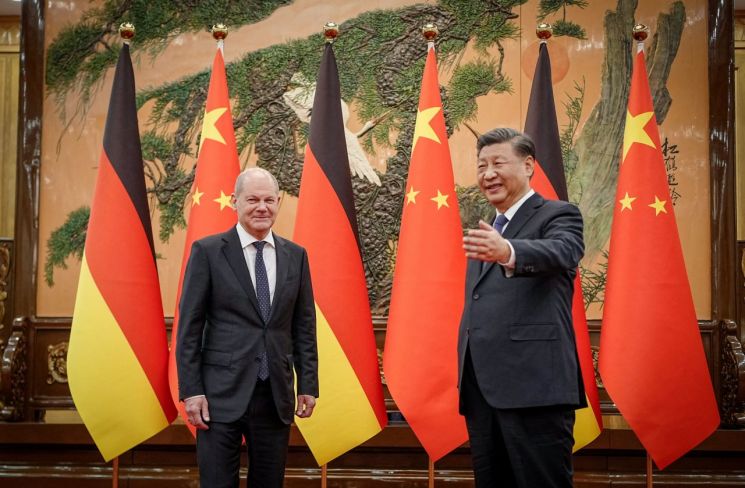
The Chinese authorities, who adhere to the 'zero COVID' quarantine policy, did not grant diplomatic exceptions to the German chancellor’s delegation, the first among the Group of Seven (G7) leaders to visit China.
Chancellor Scholz could not avoid China’s COVID-19 testing either. Scholz underwent a COVID-19 test under the supervision of Chinese personnel wearing protective suits, and after testing negative, he was able to meet Chinese President Xi Jinping and Premier Li Keqiang. It was fortunate that the German economic delegation, including Chancellor Scholz, was exempted from the 10-day quarantine.
Meanwhile, China purchased 140 Airbus aircraft as a gift for Chancellor Scholz’s visit. The contract amount is $17 billion (24 trillion KRW). In addition, China allowed the administration of the COVID-19 vaccine developed by the German pharmaceutical company BioNTech within China. This is the first time China has permitted foreign vaccines since the COVID-19 pandemic began.
© The Asia Business Daily(www.asiae.co.kr). All rights reserved.
![Clutching a Stolen Dior Bag, Saying "I Hate Being Poor but Real"... The Grotesque Con of a "Human Knockoff" [Slate]](https://cwcontent.asiae.co.kr/asiaresize/183/2026021902243444107_1771435474.jpg)

















