Q3 Sales 4.0133 Trillion KRW, Operating Profit 150.1 Billion KRW
Strong Performance in Non-Department Store Divisions, Exceeding Market Consensus
"Additional Momentum Secured Through Normalization of Overseas Business Environment"
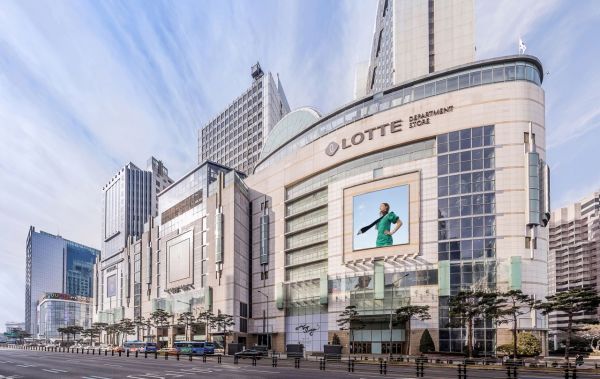
[Asia Economy Reporter Yuri Kim] Lotte Shopping received a performance report for the third quarter of this year that exceeded market estimates (consensus). This result was achieved as not only department stores but also marts, supermarkets, and e-commerce showed steady improvements in performance.
On the 4th, Lotte Shopping announced that its operating profit for the third quarter of this year was 150.1 billion KRW, an increase of 418.6% compared to the same period last year. Sales during the same period rose by 0.2% to 4.0133 trillion KRW. The third-quarter operating profit exceeded the consensus of 134.1 billion KRW compiled by FnGuide by 16 billion KRW. This marked the second consecutive quarter surpassing the consensus following the previous quarter. The cumulative operating profit from the first to third quarter increased by 198.3% to 293.2 billion KRW, while sales decreased by 0.9% to 11.686 trillion KRW.
Department stores saw a significant increase in same-store sales centered on domestic fashion in the third quarter as well. Marts experienced growth in both sales and operating profit, driven by processed foods and alcoholic beverages, while supermarkets saw a slight decline in sales due to store efficiency improvements but an increase in operating profit due to SG&A expense efficiency. E-commerce reduced operating losses as governance integration effects were resolved during the third quarter (August) along with a reduction in SG&A expenses.
Over the past two years, the operating environment of Lotte Shopping's overseas business locations, which had been depressed due to COVID-19, has rapidly normalized, leading to the start of profit generation. In Vietnam alone, operating profits of 4.8 billion KRW from marts and 1.2 billion KRW from department stores were recorded in the third quarter. Marts and department stores in Vietnam and Indonesia all returned to profitability.
On the 1st, Lotte Shopping signed a partnership agreement with Ocado, a UK-based global retail tech company, for cooperation in the domestic online grocery business. Lotte Shopping plans to introduce the integrated solution 'Ocado Smart Platform (OSP),' which covers the entire process of online grocery ordering and delivery, and to significantly strengthen its competitiveness in the domestic online grocery market, which is expected to continue growing.
Department stores recorded sales of 768.9 billion KRW and operating profit of 108.9 billion KRW in the third quarter, representing increases of 17.3% and a return to profitability, respectively. Domestic department stores saw a 16.5% increase in same-store sales due to strong sales in the fashion product category, and department stores in Indonesia and Vietnam also saw overseas department store sales increase by 62.9%, reflecting the base effect of temporary closures due to COVID-19 last year. This strong sales trend led to an improvement of 130.1 billion KRW in operating profit compared to the previous year, turning profitable.
Marts recorded sales of 1.5596 trillion KRW (+5.3%) and operating profit of 32.5 billion KRW (+178.6%) in the third quarter. Domestically, sales of eight stores renovated last year increased by 10.5%, and sales of five stores renovated this year rose by 15.2%, indicating the full effect of renovations. Vietnam marts also saw a high sales growth of 78.5% in the third quarter, driven by the base effect of some store closures during the same period last year and the economic boom in Vietnam, which recorded a GDP growth rate of over 13% in the third quarter, contributing to overall performance improvement.
Supermarkets recorded sales of 351.5 billion KRW (-7.5%) and operating profit of 5.6 billion KRW (+82.2%) in the third quarter. The number of stores decreased by 20 compared to the same period last year, resulting in a sales decline, but efforts in structural innovation reduced SG&A expenses by 7.3%, leading to an increase in operating profit.
E-commerce recorded sales of 25.1 billion KRW (+4.2%) and an operating loss of 37.8 billion KRW in the third quarter. The deficit narrowed by 8.5 billion KRW compared to the same period last year. Sales increased by 4.2% by strengthening specialized businesses such as mobile gift certificates and affiliate website operations. The governance integration effect from August last year was resolved during the third quarter, and active management of SG&A expenses also contributed to reducing the deficit by 8.5 billion KRW.
Culture Works posted sales of 188.5 billion KRW (+139.0%) and operating profit of 21.3 billion KRW (returning to profitability) in the third quarter. Although severely impacted by COVID-19, the full-scale endemic phase this year led to a cumulative return to profitability within the third quarter, with the summer peak season blockbuster releases and the box office success of investment and distribution works such as 'Top Gun 2' and 'Hansan' cited as major reasons for the return to profit.
Hi-Mart struggled with sales of 873.8 billion KRW (-16.0%) and operating profit of 700 million KRW (-98.7%) in the third quarter. Hi-Mart's sales and operating profit declined due to the base effect from last year's surge in home appliance demand and the overall slump in the home appliance market. Home shopping recorded sales of 256.2 billion KRW (-5.3%) and operating profit of 21.2 billion KRW (-10.5%). Although total handling volume increased by 4.4% due to rising travel demand, net sales decreased due to an increased proportion of low-margin products such as travel and rentals. Operating profit also declined due to continued increases in transmission fees and other factors.
Meanwhile, Lotte Shopping recorded a net loss of 95.1 billion KRW in the third quarter. In the third quarter, the liquidation of Hong Kong Holdings and deferred tax income generated 450.4 billion KRW, resulting in a total net profit of 305.8 billion KRW, but in this year's third quarter, impairment losses including Hi-Mart goodwill (-231.5 billion KRW) amounting to -259.4 billion KRW were proactively reflected, turning net profit into a loss. Lotte Shopping stated, "The reflection of Hi-Mart impairment losses was a result of considering the trend in the home appliance market, which was directly hit by the economic downturn."
Choi Young-jun, head of Lotte Shopping's Finance Division, said, "The performance exceeding the third-quarter operating profit forecast was mainly due to the balanced recovery of other business divisions such as marts, supermarkets, and e-commerce, in addition to the core department store business," adding, "Although concerns about a domestic economic downturn remain, additional performance improvements are expected from overseas stores full of potential such as Vietnam, and the introduction of OSP is evaluated as having secured long-term growth momentum in the online market."
© The Asia Business Daily(www.asiae.co.kr). All rights reserved.

















