US 4 Consecutive Giant Steps
Profits Increase as Interest Rates Fall
High Trading Volume in Inverse ETF Products
[Asia Economy Reporter Myung-hwan Lee] On the 3rd, when the U.S. Federal Reserve (Fed) made an unprecedented decision to raise interest rates by a giant step (a 0.75 percentage point increase in the benchmark interest rate) for the fourth consecutive time, investors appeared to have bet on a decline in the index.
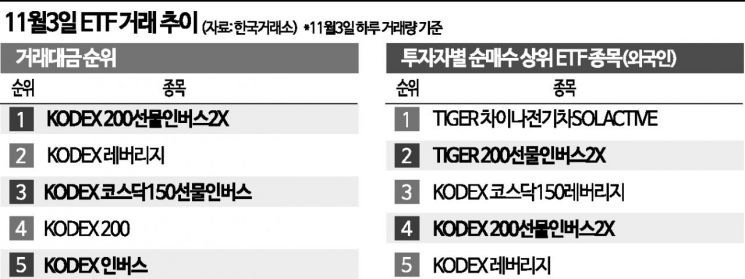
On the 4th, Asia Economy reviewed the trading trends of domestic exchange-traded funds (ETFs) listed on the 3rd and found that the largest trading volume was concentrated in inverse ETF products, which generate profits as the index falls. On that day, the ‘KODEX 200 Futures Inverse 2X’ attracted a trading volume of 733.6 billion KRW.
This product is a so-called ‘double inverse’ product that tracks twice the inverse of the daily return of the KOSPI 200 futures index. In addition, inverse products such as ‘KODEX KOSDAQ 150 Futures Inverse’ (3rd place) and ‘KODEX Inverse’ (5th place) were also ranked high in ETF trading volume that day. However, due to high volatility, the increase in trading volume can also be interpreted as a result of the leveraged and inverse characteristics used for short-term returns.
On the 2nd (local time), the Fed decided again on a giant step due to persistent inflation, which is interpreted as investors betting on a decline in the index. This is because as interest rates rise, the preference for risk assets tends to weaken. However, Fed Chair Jerome Powell hinted that the pace of rate hikes could be adjusted at the Federal Open Market Committee (FOMC) meeting scheduled for December. Nevertheless, on the 3rd (local time), the U.S. stock market, including the Nasdaq index, which fell 1.73% compared to the previous trading day, showed signs of not recovering from the FOMC shockwave.
However, the impact of the giant step on the domestic stock market was limited. On the 3rd, the KOSPI fell more than 1% in early trading, briefly breaking below the 2300 level. But in the afternoon session, it temporarily turned upward and shifted to a sideways movement. The KOSPI eventually closed down 0.33% (7.70 points) at 2329.17. As the index decline was limited, the daily price increase rate of inverse ETF products remained in the 1% range. On the 4th, as of 9:20 a.m., the KOSPI was moving sideways, up 0.25% (5.74 points) from the previous trading day at 2334.91.
Looking at the investors by type, foreign investors appeared to have concentrated their purchases on inverse products. On that day, among the top net purchase ETF stocks by foreigners, two double inverse products ranked 2nd and 4th in net purchases. Individual investors also had inverse products ranked 5th, 6th, 10th, and 11th in net purchases. However, the top net purchases by individual investors were ETFs focused on the U.S. stock market. On the other hand, institutional investors did not include inverse products in their portfolios. Instead, secondary battery-themed ETF products ranked high.
The securities industry advised that, given the possibility of increased volatility until the next FOMC, a trading strategy following leading stocks is necessary. Jae-hyuk Han, a researcher at Hana Securities, advised, "Since market difficulties are expected, rather than holding a large position and being exposed to market volatility for a long time, a strategy of short-term trading that rides the market themes will be effective."
© The Asia Business Daily(www.asiae.co.kr). All rights reserved.