Sales of Packaged Kimchi at Three Major Marts Up 10-20% Year-on-Year
Cabbage Prices Still High Compared to Average Despite Decline
Radish and Green Onion Prices Continue to Soar
[Asia Economy Reporter Jeon Jinyoung] Ahead of the winter kimchi-making season, the price of napa cabbage has been fluctuating wildly and the prices of related ingredients have risen, leading to an increase in sales of packaged kimchi at supermarkets. This is analyzed to be because the number of 'Gimpo-jok'?people who have given up making kimchi at home due to rising kimchi-making costs caused by poor harvests?has increased.
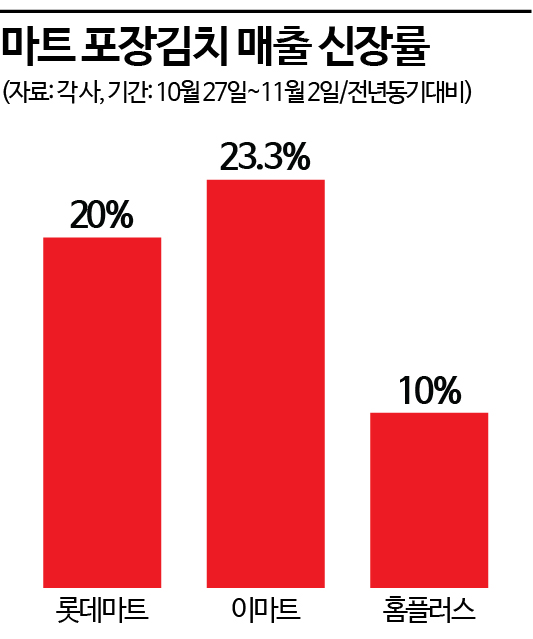
According to Lotte Mart on the 4th, sales of packaged kimchi increased by 20% compared to the same period last year during the week from the 27th of last month to the 2nd. Similarly, Emart saw a 23.3% growth in packaged kimchi sales during the same period, and Homeplus experienced about a 10% increase in sales.
The reason consumers are turning their attention to packaged kimchi is analyzed to be because kimchi-making costs are still soaring. As the prices of kimchi-making ingredients rise, naturally, consumers are turning to packaged kimchi as a substitute. In fact, the price of a head of napa cabbage, which had soared to 10,000 won, began to drop to less than half within a month. This is because the autumn cabbage harvest is better than last year, increasing the supply. Nevertheless, the overall kimchi-making costs remain higher than last year.
According to the Korea Agro-Fisheries & Food Trade Corporation's Agricultural Products Distribution Information (KAMIS), the average price of a head of napa cabbage at retail stores nationwide was 4,162 won the day before. Although this is half the price from a month ago (8,285 won), it is still 21% higher than the average price over the past five years (3,710 won) and 5% higher compared to last year (3,961 won).
The price of radish, another main ingredient for kimchi-making, also rose. This is due to reduced production caused by lower temperatures and insufficient rainfall during the growing season. The price of radish was 3,073 won, an 81% increase compared to last year (1,695 won). Green onions were priced at 3,259 won, up 17% from last year (2,778 won), and ginger was 10,219 won per kilogram, a 25% increase from last year (8,144 won).
The prices of kimchi seasoning ingredients also increased compared to last year. Anchovy fish sauce was 5,424 won per kilogram, 15% higher than the average price of 4,691 won. Coarse salt used for salting napa cabbage was 11,882 won for 5 kilograms, about 16% higher than last year (10,251 won), and 58% higher compared to the average price of 7,508 won. The price of dried red chili peppers was 16,141 won for 600 grams, a 5% increase compared to last year’s 15,304 won.
A supermarket official said, "Since napa cabbage, the main ingredient for kimchi-making, experienced a significant price shock this year, consumption is shifting toward ready-made products with relatively less price fluctuation," adding, "The industry is also making various efforts to ensure stable supply of ingredients such as half-price cabbage."
© The Asia Business Daily(www.asiae.co.kr). All rights reserved.
![Clutching a Stolen Dior Bag, Saying "I Hate Being Poor but Real"... The Grotesque Con of a "Human Knockoff" [Slate]](https://cwcontent.asiae.co.kr/asiaresize/183/2026021902243444107_1771435474.jpg)











