'La Ni?a' Emerges as International Oil Price Factor
US Winter Temperatures Expected Below Average
Increased Demand for Natural Gas, Kerosene, and Other Energy Sources
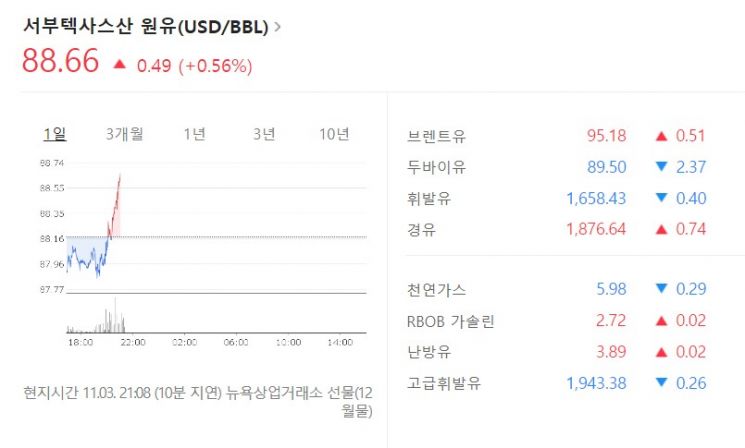
[Asia Economy Reporter Hwang Yoon-joo] Following the large-scale production cuts by the Organization of the Petroleum Exporting Countries Plus (OPEC+), along with Middle East conflicts and an expected winter cold wave, international oil prices are projected to rise in the short term.
According to the Korea National Oil Corporation on the 4th, West Texas Intermediate (WTI) crude oil in the United States rose 14.9% from $76.71 per barrel on September 26 to $88.17 per barrel on November 3.
The recent upward trend in international oil prices began last month when OPEC+ decided on large-scale production cuts. Since then, stronger-than-expected U.S. economic indicators, rumors of China easing COVID-19 restrictions, reports of an imminent Iranian attack on Saudi Arabia, and forecasts of a winter cold wave have supported the rise in oil prices.
The issue that had the greatest short-term impact on oil prices was the report of an imminent Iranian attack on Saudi Arabia. When The Wall Street Journal (WSJ) reported on November 1 that Iran’s attacks on Saudi Arabia and Iraq were imminent, international oil prices rose, with WTI reaching $90.00 per barrel.
Jae-young Oh, a researcher at KB Securities, pointed out, "On September 14, 2019, when Iran attacked Saudi Aramco oil fields, production facilities capable of processing 5 million barrels per day were shut down, causing international oil prices to rise 14% in a single day. Other incidents, such as the Saudi attack in March 2021 and the assault on key UAE oil facilities in 2020, resulted in only slight increases." Although the Iranian Ministry of Foreign Affairs immediately denied the reports, international oil prices have maintained the $89 range without significant decline, indicating that caution remains.
The biggest variable is identified as ‘La Ni?a.’ This year, La Ni?a is expected to cause winter temperatures in the United States to be lower than average. When La Ni?a occurs, the likelihood of hurricanes in the U.S. also increases.
The World Health Organization (WHO) estimates the probability of La Ni?a continuing through this winter at over 50%. Since 1950, La Ni?a has occurred 16 times in total. It has occurred for two consecutive years three times, and a ‘triple dip’ lasting three consecutive years is happening for the second time, including this instance. The U.S. Climate Prediction Center also forecasts an 80% chance that La Ni?a will persist until January next year.
Researcher Oh said, "The cold wave increases demand for natural gas and kerosene," adding, "The U.S. Energy Information Administration (EIA) also projected in its October outlook that excess demand of 20,000 barrels per day in the fourth quarter and 1.23 million barrels per day in the first quarter of 2023 will occur."
© The Asia Business Daily(www.asiae.co.kr). All rights reserved.
!["The Woman Who Threw Herself into the Water Clutching a Stolen Dior Bag"...A Grotesque Success Story That Shakes the Korean Psyche [Slate]](https://cwcontent.asiae.co.kr/asiaresize/183/2026021902243444107_1771435474.jpg)
















