Unit Quantity (Water Volume) Quality Inspection to be Implemented on December 1
Major Ready-Mix Concrete Companies Face Emergency in Securing 'Measuring Devices' vs Small and Medium Ready-Mix Concrete Companies Say "No Problem Without Measuring Devices"
"There May Be Supply Issues for Measuring Devices at the Beginning of Implementation, but Construction and Ready-Mix Concrete Companies Must Actively Participate"
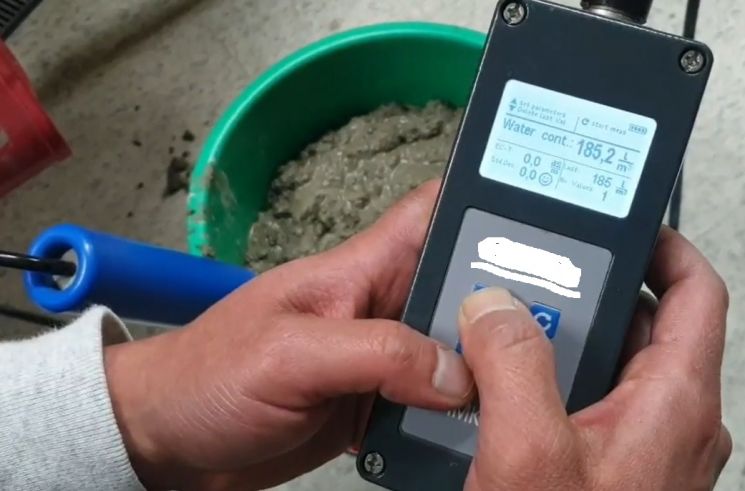 An employee is measuring unit quantities at a construction site using a product from the German company I.
 [Photo by D]
[Asia Economy Reporter Kim Jong-hwa] The cause of the apartment collapse accident in Seo-gu, Gwangju Metropolitan City last January was poor-quality ready-mixed concrete (Remicon) with an excessive amount of water. The increase in the amount of mixing water to reduce costs and facilitate work lowered the concrete strength, directly causing the building collapse. An investigation revealed that most of the concrete samples taken from the collapsed apartment fell short of 85% of the design strength standard.
As water-added concrete emerged as a social issue, the government introduced the 'Unit Water Content Quality Inspection' to eradicate it. 'Unit water content' refers to the amount of water contained in 1m³ of unset concrete (excluding the amount in aggregates), which directly affects concrete quality such as strength and durability.
On September 1, the Ministry of Land, Infrastructure and Transport established the 'Unit Water Content Quality Inspection Standard' and announced the 'Standard Specification for Concrete Work' (KCS 14 20 00) based on this standard. However, considering equipment supply and testing periods to prevent confusion at construction sites, the ministry postponed the enforcement date to December 1.
According to this standard, starting next month, the moisture content must be measured for every 120㎥ of concrete delivered to construction sites or whenever the mix changes. The allowable unit water content is 185㎏/㎥ or less, meaning the amount of water in 1㎥ of concrete must not exceed 185㎏. However, it has been confirmed that many related companies have not yet secured equipment to measure moisture content, indicating inadequate preparation at actual sites.
Major Remicon Companies Also Struggling to Secure Measuring Devices: "Products Won't Be Available Until May Next Year"
As the enforcement date for the unit water content quality inspection approaches, the Remicon industry is actively working to secure measuring devices. Construction companies receiving concrete at sites are responsible for deciding the test method and preparing the measuring devices. Since Remicon manufacturers follow the 'KS (Korean Industrial Standards)' rather than the concrete standard specification, they are not obligated to conduct unit water content inspections. However, since the concrete subject to inspection is supplied by Remicon companies, if the concrete fails the on-site inspection, it must be discarded, making pre-inspection unavoidable.
The Remicon industry has been securing measuring devices by business site, but due to a surge in orders before the enforcement date, it has become impossible to secure devices before the inspection begins. A representative from a major Remicon company stated, "We are proceeding with the purchase procedures for measuring equipment at each business site for the unit water content quality inspection, but it seems it will take time to actually secure the products."
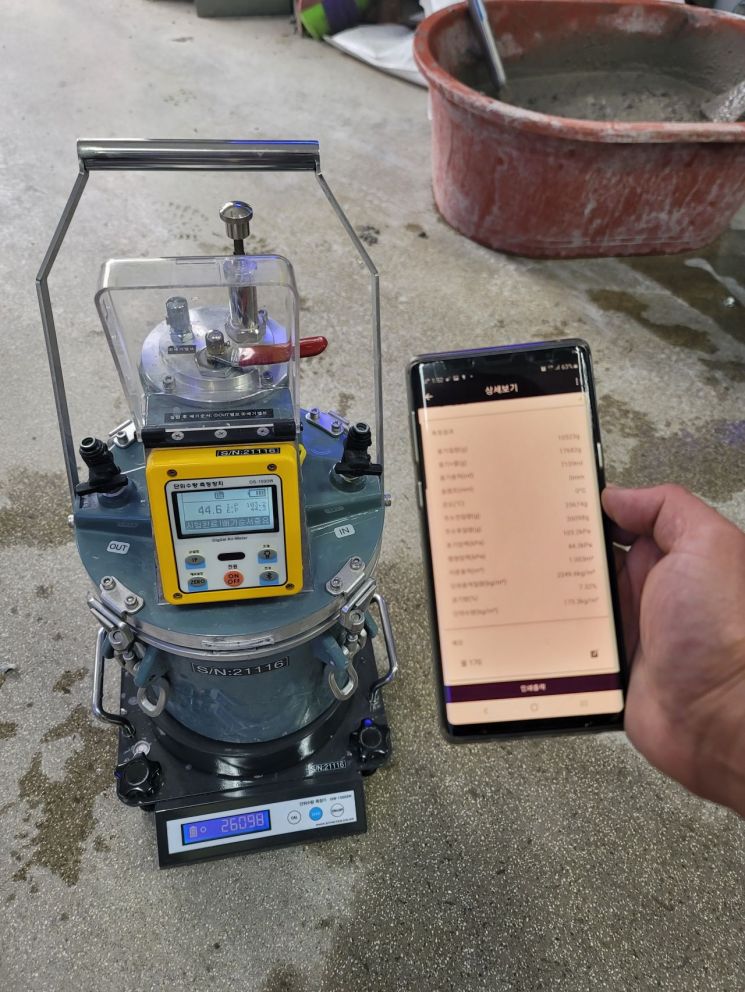 An employee is measuring unit quantities at a construction site using a measuring device from the domestic company D.
 [Photo by D]
There are four methods to measure unit water content: high-frequency heating method, air meter method (high precision), capacitance method, and microwave method. Among these, construction companies and Remicon manufacturers prefer the microwave method, which measures water content based on wave attenuation caused by water molecules. The air meter method, which uses differences in unit volume mass, and the capacitance method, which measures based on the relationship between capacitance and moisture content, are also used at construction sites.
In particular, the measuring device from German company I, which uses the microwave method, is small, lightweight, and relatively inexpensive compared to other products, resulting in over 120 backlogged orders, with products expected to be available only by May next year. The domestic company D's product, which uses the air meter method, also has about 20 backlogged orders, and products are expected to be delivered only after mid-December. An industry insider said, "Orders for measuring devices, which were almost nonexistent before, have surged since September," adding, "It will be impossible to receive the preferred measuring devices before the enforcement date."
"There May Be Supply Issues with Measuring Devices Initially... Construction and Remicon Companies Must Actively Participate"
In reality, Remicon companies' preparations are insufficient. Company A, operating large-scale sites in about 20 locations nationwide, has secured measuring devices only at its headquarters and 3-4 regional sites. Company B, operating 15 sites mainly in the metropolitan area, has no measuring devices except at its headquarters. Company C, the only large Remicon company operating 7 sites in the metropolitan area, has fully equipped each site with unit water content measuring devices and regularly checks unit water content.
Preparations by small and medium-sized Remicon companies are even more inadequate. A representative from a Remicon company in the Chungcheong region said, "The construction company should prepare. I don't think Remicon companies need to prepare," adding, "There is no problem even if we don't have measuring devices."
Regarding this, Professor Lee Han-seung of Hanyang University's Department of Smart Convergence Engineering, who played a key role in introducing the concrete unit water content quality inspection, said, "Trust in concrete manufactured by Remicon companies was low, and to solve this problem, the government and the Concrete Society have long been pushing for institutional improvements," emphasizing, "There may be supply issues with measuring devices initially, but construction and Remicon companies must actively participate. On-site unit water content quality inspections can resolve distrust in concrete."
© The Asia Business Daily(www.asiae.co.kr). All rights reserved.


















