Impact of Alpine and Greenland Glacier Melting on Sea Level Rise
Unusual High Temperatures Expected in October... Frequent Heatwaves and Floods Likely
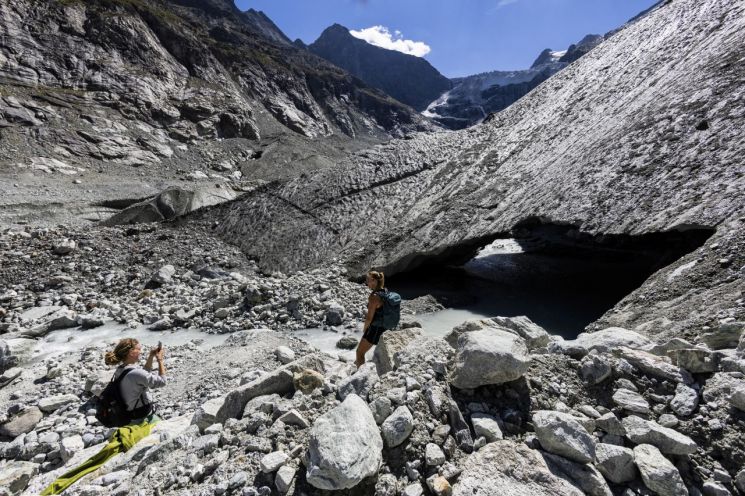 On the 29th (local time), a woman is posing in front of a hole where water flows from the melting Mont Min? Glacier near Perfeckle, a village in southern Evollin, Switzerland. Photo by Yonhap News
[Asia Economy Reporter Lee Gyehwa, Intern] Over the past 30 years, the temperature increase in Europe has been twice the global average. Due to the rapid rise in temperature, disasters such as heatwaves and floods are expected to occur more frequently in Europe in the future.
According to the World Meteorological Organization (WMO), a UN agency, on the 2nd (local time), the temperature in the European region rose by 0.5 degrees every 10 years from 1991 to 2021. This figure exceeds twice the global average.
Regardless of the future speed of global warming, the rate of temperature increase in Europe is expected to be faster than the global average. Alpine glaciers in Europe shrank by 30 meters between 1997 and 2021, and Greenland's glaciers are also melting rapidly, causing sea levels to rise. The WMO predicted, "The impacts of climate change will affect society, economy, and ecosystems overall, including record-breaking heatwaves, wildfires, and floods."
The WMO expressed the greatest concern about heatwaves in Western and Southern Europe. It pointed out that children are more vulnerable to climate change than adults. According to the UNICEF (United Nations International Children's Emergency Fund) Children's Climate Risk Index, about 125 million children in Europe live in countries classified as 'medium to high risk.'
M?t?o-France, the French National Meteorological Service, announced that October 2022 was the hottest October in Paris since October 1945. The average temperature in October was recorded at 17.2 degrees Celsius, about 3.5 degrees higher than the normal national average temperature. On October 23, severe lightning and storms caused damage across France. In September this year, the Gironde wildfire in the southwest burned 3,200 hectares to ashes, causing significant damage and changes due to climate change.
However, compared to other regions, Europe is a model region in responding to climate change. It is addressing climate change through cooperation between countries at the European regional level rather than individual nations. Due to these efforts, the European Union (EU) reduced its greenhouse gas emissions by 31% between 1990 and 2020. Petteri Taalas, Secretary-General of the WMO, said, "Europe shows a vivid scene of global warming progressing worldwide," adding, "Even societies well prepared for climate change are not safe from the impacts of extreme weather."
© The Asia Business Daily(www.asiae.co.kr). All rights reserved.

















