30 Trillion Won Vanished in a Month... Time Deposits Expected to Hit Record High Increase Since Statistics Began
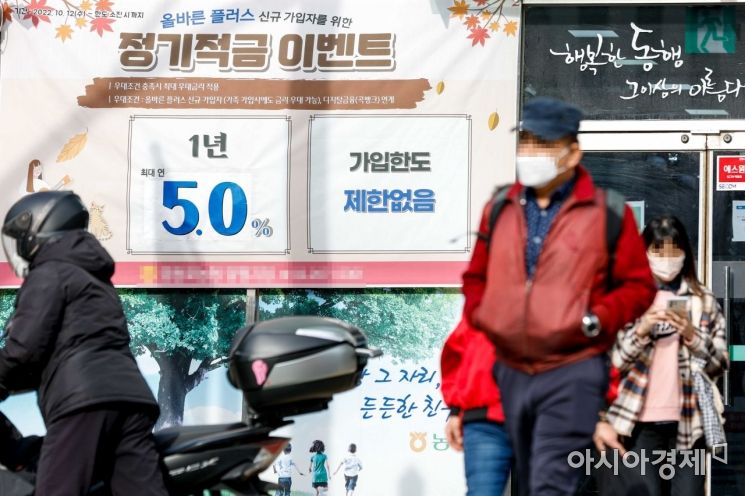 As the era of a 3% base interest rate begins for the first time in 10 years, commercial banks have been raising deposit interest rates one after another, bringing bank fixed deposit rates close to 5% per annum. On the 26th, a banner displaying the interest rate for fixed savings deposits was posted at a commercial bank in Seoul. Photo by Kang Jin-hyeong aymsdream@
[Asia Economy Reporter Yu Je-hoon] The pace of core deposit outflows in the financial sector is accelerating due to the rapid increase in the benchmark interest rate. As core deposit outflows cause a sharp rise in funding costs for banks, the increase in loan interest rates is also expected to become steeper.
According to the financial sector on the 2nd, the size of demand deposits at the five major commercial banks (KB Kookmin, Shinhan, Hana, Woori, NH Nonghyup) as of the end of October this year was 626.0159 trillion won, down 29.0999 trillion won from the end of the previous month. Considering that the decrease in demand deposits from the end of August to September was about 4.5 trillion won, the outflow trend has accelerated further.
Demand deposits refer to deposits that depositors can withdraw at any time. They essentially have the nature of investment standby funds and are called "low-cost deposits" because the interest rate level is around 0.1%. For banks, which secure profits through the interest rate spread between deposits and loans, they are treated as core deposits because they can raise funds by paying low interest.
The acceleration in the decrease of demand deposits is due to the Bank of Korea's benchmark interest rate hikes causing asset prices to fall, while deposit interest rates continue to rise. According to the Bank of Korea, the average interest rate on newly accepted time deposits (1-year maturity) at deposit banks in September was 3.83% per annum, up 200 basis points (1bp=0.01%) from 1.83% in January. During the same period, the KOSPI index fell by 19.1%, and the KB Housing Sales Price Index dropped by 0.79% (nationwide basis), showing a contrasting trend.
The size of time deposits at the five major banks is rapidly increasing. As of the end of October, the size of time deposits at the five major banks was 808.2276 trillion won, up 47.7231 trillion won (6.3%) from the end of the previous month and 153.2917 trillion won (23.4%) from the end of last year. In September, the total increase in time deposits at all deposit banks reached a record high of 32.5 trillion won since statistics began, and this situation has been reproduced by surpassing that amount in just one month.
The rise in deposit interest rates in the banking sector directly leads to an increase in loan interest rates. The Cost of Funds Index (COFIX), which serves as the benchmark for mortgage loan interest rates in the banking sector, represents the weighted average interest rate of funds raised by eight domestic banks. It is directly linked to the interest rates of deposit products such as actual deposits, savings, and bank bonds handled by banks. In other words, when deposit interest rates rise, loan interest rates inevitably follow.
This year, the banking sector's funding costs surged, with the COFIX based on new transactions rising from 1.64% in January to 3.40% in September, an increase of 136 basis points (1bp=0.01%). The COFIX rate based on new transactions exceeding the 3% level is the first time in 10 years. The COFIX based on outstanding balances also rose to 2.52%, the highest level in about seven years.
In addition to the decrease in core deposits, the bond market has begun to tighten due to the aftermath of the "Legoland incident," and competition for deposits in the financial sector is expected to intensify further. Recently, parking accounts offering interest rates in the 3% range have become common, mainly at mutual savings banks, and special promotional deposit products with 7-8% interest rates have expanded in various mutual finance institutions. This naturally acts as a factor that drives up loan interest rates. A financial sector official said, "Since additional interest rate hikes are expected throughout the year, the outflow of core deposits is inevitable, and the reverse money move to safe assets such as deposits and savings will continue," adding, "If this situation persists, mortgage and credit loan interest rates could both rise to the 8% range within the year."
© The Asia Business Daily(www.asiae.co.kr). All rights reserved.
![Clutching a Stolen Dior Bag, Saying "I Hate Being Poor but Real"... The Grotesque Con of a "Human Knockoff" [Slate]](https://cwcontent.asiae.co.kr/asiaresize/183/2026021902243444107_1771435474.jpg)











