Korea Institute of Geoscience and Mineral Resources Develops Material Recovery Technology from Waste Lithium-Ion Batteries
Enables Extraction with 99.5% High Purity
"Presents Technical Solution to Counter Resource Wars"
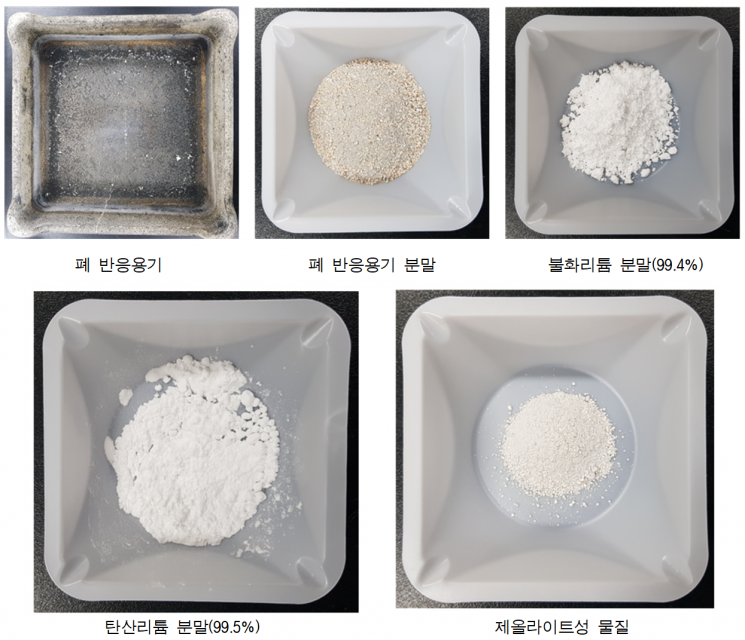
[Asia Economy Reporter Kim Bong-su] Domestic researchers have developed a technology to produce high-purity lithium secondary battery materials by recycling spent batteries. Amid China's weaponization of rare earth elements in response to the U.S.'s export restrictions on advanced technologies such as semiconductors, valuable secondary battery resources like high-purity lithium carbonate and lithium fluoride can now be recovered from spent batteries that were previously discarded.
The Korea Institute of Geoscience and Mineral Resources (KIGAM) announced on the 2nd that Dr. Ryu Tae-gong's research team at the Resource Utilization Research Division succeeded in developing an eco-friendly resource circulation technology to recover and recycle valuable resources from lithium waste solutions and spent reaction vessels generated during the lithium secondary battery manufacturing process. The research team focused on the difficulty of disposing of spent reaction vessels and studied the "technology for recovering and recycling valuable resources from waste discharged during the lithium secondary battery manufacturing process," confirming that the recovered materials can be manufactured and used as cathode materials for lithium secondary batteries with a purity of over 99.5%.
In particular, by applying a self-developed eco-friendly wet conversion technology, the team succeeded in recovering valuable metals such as NCM precursors (nickel, cobalt, manganese), lithium carbonate, lithium hydroxide, and zeolite-containing substances from spent reaction vessels. They secured NCM precursors and lithium carbonate from residual cathode powder remaining in the spent reaction vessels. After rinsing and separating the spent reaction vessel powder, impurities such as magnesium, aluminum, and calcium in the lithium waste solution were removed through ion concentration polarization (MCDI) and hydroxide precipitation, recovering lithium hydroxide.
Especially, the lithium-containing solution extracted by sulfation treatment of the powder is recovered as lithium carbonate through the wet conversion process. During this process, insoluble residues such as undissolved sludge undergo pH adjustment to regenerate zeolite-containing substances. Zeolite is a microporous aluminosilicate mineral mainly used as an adsorbent or catalyst.
The research team also succeeded in manufacturing lithium fluoride by mixing and separating lithium solutions recovered from spent reaction vessels or lithium waste solutions discharged during cathode manufacturing with fluoride waste solutions from the semiconductor industry. Lithium fluoride is used as an optical glass, flux, and raw material for lithium secondary battery electrolytes, making the recycling of lithium fluoride from lithium waste solutions economically and industrially significant. It is expected to contribute to reducing environmental pollution by recycling lithium waste solutions that were previously entirely treated as wastewater.
Recycling technologies for spent secondary batteries developed domestically have so far focused on recovering some high-value metals. However, the process operation costs are very high, and disposal issues of generated waste remain unresolved.
This technology development is gaining more attention as an eco-friendly, low-cost, and high-efficiency technology that recovers and recycles high-value metals amid the shortage of lithium and other secondary battery materials. It is evaluated as providing a technical solution for environmentally friendly recycling and resource recovery of mineral resources amid the uneven supply chain of critical minerals. The research team aims to achieve recovery of ultra-high-purity materials exceeding 99.5% through further advancement of the research technology.
Dr. Ryu Tae-gong stated, "We developed this research technology while considering the disposal problems and environmental pollution caused by various wastes discharged from the lithium secondary battery manufacturing industry," adding, "We will do our best to develop advanced eco-friendly resource circulation technologies, thinking of discarded waste around us as valuable resources."
© The Asia Business Daily(www.asiae.co.kr). All rights reserved.
![Clutching a Stolen Dior Bag, Saying "I Hate Being Poor but Real"... The Grotesque Con of a "Human Knockoff" [Slate]](https://cwcontent.asiae.co.kr/asiaresize/183/2026021902243444107_1771435474.jpg)
















