BA.5 Detection Rate 88.3% ... Slight Increase in BQ.1, BQ.1.1, XBB.1
Jeong Gi-seok: "Even if New Variants Become Dominant, Vaccines and Treatments Remain Effective"
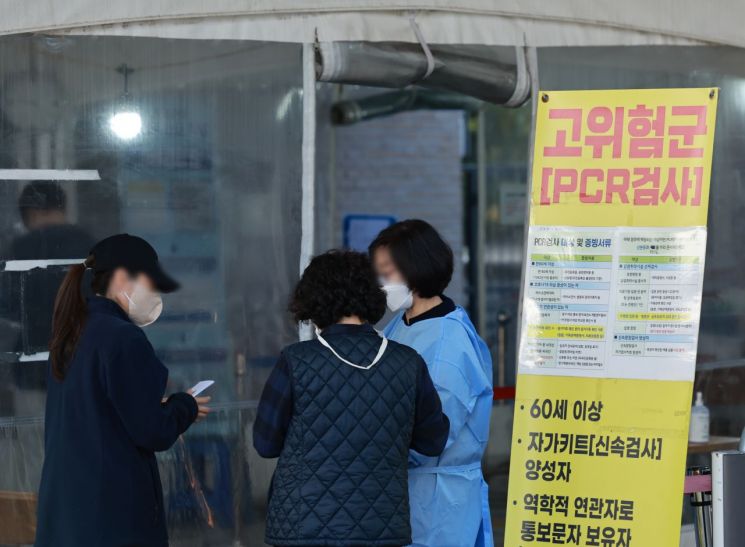 On the 2nd, a citizen visiting the COVID-19 screening clinic at Mapo-gu Public Health Center in Seoul is receiving guidance from a health center official. Photo by Yonhap News
[Asia Economy Reporter Yoon Seul-gi] As the number of new COVID-19 cases has recorded over 50,000 for two consecutive days (54,766 as of midnight on the 2nd), indicating a clear spread, it has been found that the majority of detected variants are Omicron subvariants.
According to the Central Disease Control Headquarters (hereafter, KDCH) on the 2nd, as of the 29th of last month (4th week of October), the detection rate of the BA.5 variant was 88.3%, an increase of 0.7 percentage points compared to the previous week. The domestic infection detection rate was 93.1%, and the detection rate from overseas inflow was 57.4%.
Although the BA.5 variant, which led the 6th wave of COVID-19, still shows an overwhelming detection rate, the detection rates of new Omicron subvariants in domestic infections have also slightly increased. The detection rate of the BQ.1 variant decreased by 0.2 percentage points from 1.2% to 1.0%, and the BQ.1.1 variant decreased by 1 percentage point from 2.5% to 1.5%. Excluding overseas inflow, the domestic infection detection rates increased from 0.2% to 0.4% and from 0.4% to 0.7%, respectively.
The detection rate of the XBB.1 variant increased from 0.3% last week to 0.8%. Looking only at domestic infections, it rose from 0.2% to 0.5%. The BA.2.75 variant recorded a detection rate of 3.6%, BA.2.75.2 at 0.2%, and BA.2.3.20 at 1.3%. The BF.7 variant detection rate was 2.2%.
The increase in detection rates of new variants appears to be influenced by the inflow of variants such as BQ.1, BQ.1.1, and XBB.1 from overseas into the country. Im Sook-young, the KDCH Situation General Manager, stated, "Whether these detailed variants become dominant and how they develop will determine whether a 7th wave resurgence occurs."
 Jung Ki-seok, Head of the Central Disaster and Safety Countermeasures Headquarters COVID-19 Special Response Team. Photo by Yonhap News
Although the detection rates of various variants are increasing, since they are sublineages of Omicron, analyses suggest that the scale of the 7th wave will not be larger than the previous wave. This is because 97.8% of the population already has antibodies due to the Omicron pandemic, and variants like BQ.1 and BQ.1.1 are types of the Omicron subvariant BA.5, meaning that the currently introduced or planned updated vaccines and treatments such as Paxlovid can provide some efficacy.
Jung Ki-seok, head of the COVID-19 Special Response Team and member of the National Infectious Disease Crisis Response Advisory Committee, said at the regular briefing of the COVID-19 Special Response Team on the 31st, "Whether BA.5 remains dominant or BQ.1, XBB, and BQ.1.1 become the dominant strains in the expected 7th wave this winter, the existing shield and spear we have?vaccines and treatments?will still be effective," adding, "Unless a completely new variant emerges, the belief that indoor masks can be removed by next spring remains unchanged."
However, Jung encouraged vaccination in November due to concerns about waning immunity. He stated, "The KDCH calculated the expected deaths if no one had been vaccinated against COVID-19, which was 145,000. However, the actual statistics in our country are about 25,000 (as of the 2nd week of October). Approximately 120,000 deaths were prevented."
© The Asia Business Daily(www.asiae.co.kr). All rights reserved.


















