Participation in Joint Air Exercise 'Vigilant Storm'
Strong Warning on North Korea's Possible Nuclear Test
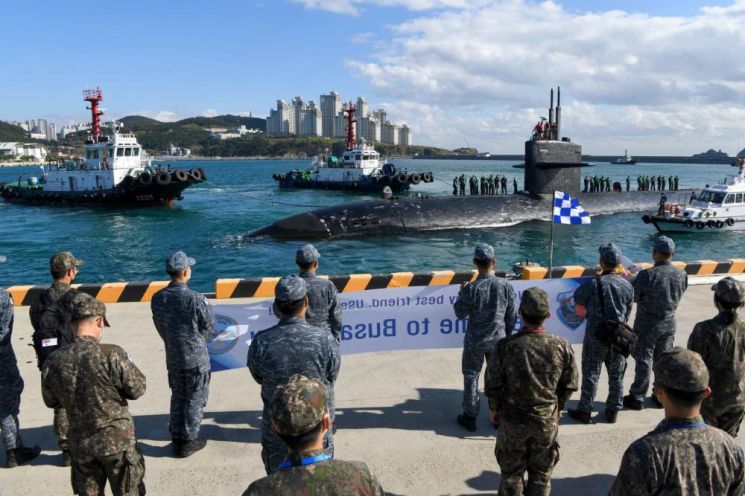
[Asia Economy Reporter Jang Hee-jun] Following the first landing of the U.S. Marine Corps' latest stealth fighter F-35B on Korean soil, the nuclear-powered submarine USS Key West (SSN-722, 6,000-ton class) surfaced off the coast of Busan. The consecutive deployment of U.S. air and naval strategic assets on the Korean Peninsula is seen as an implementation of the "timely and coordinated deployment of strategic assets" agreed upon by the South Korean and U.S. presidents, while simultaneously sending a strong warning message to North Korea, which is increasing its nuclear test threats.
On the 1st, the U.S. Department of Defense announced that the Los Angeles (LA)-class attack submarine USS Key West arrived at Busan Port on the 31st of last month, explaining that "as part of the Indo-Pacific regional deployment, it was a scheduled port visit." Photos released by the U.S. side show crew members lined up on the surfaced submarine, while onshore, South Korean naval personnel hold a banner welcoming the arrival of the USS Key West.
The U.S. Department of Defense revealed that the LA-class submarine is one of the world's most stealthy and technologically advanced submarines, capable of performing various missions such as anti-submarine warfare, anti-surface warfare, surveillance and reconnaissance, and strike operations.
The USS Key West is the 35th LA-class nuclear-powered submarine commissioned in 1987, with a submerged displacement of 6,900 tons. It can carry dozens of Tomahawk cruise missiles (UGM-109) with a range of 2,500 km. It can operate for 90 days without resupply and has unlimited cruising range. It measures 110 meters in length, 10 meters in beam, and has a crew of about 100.
The LA-class nuclear submarine is considered a representative U.S. strategic asset deployed to the Korean Peninsula in times of crisis.
Although it is customary not to disclose submarine forces, which rely on high stealth, the U.S. revealed the arrival of the USS Key West in Busan, which is interpreted as a warning to North Korea, which is escalating its military provocations. The U.S. Department of Defense did not mention the purpose or current mission of the USS Key West's visit, and there are no reported plans for joint exercises with the South Korean Navy.
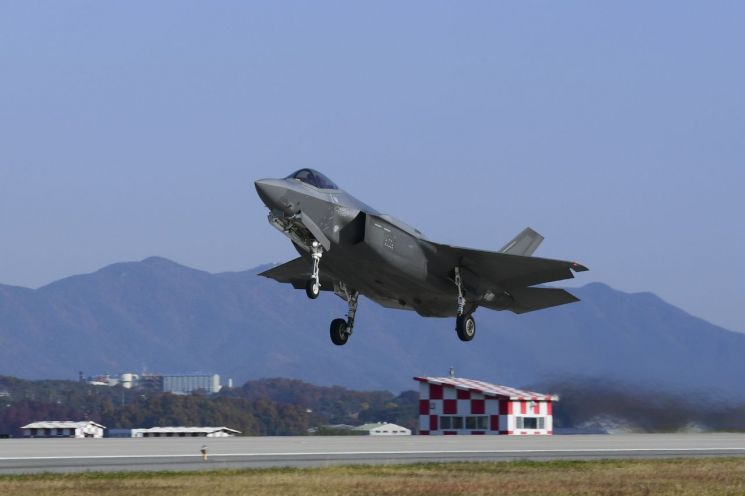 A South Korean Air Force F-35A fighter jet participating in the 'Vigilant Storm' exercise taking off from the Cheongju base runway [Photo by the Air Force]
Earlier, the U.S. 7th Air Force in Korea announced that four F-35B aircraft operated by the U.S. Marine Corps' 242nd Fighter Attack Squadron (VMFA-242) landed at Gunsan Air Base on the same day.
These forces, previously stationed at the U.S. Marine Corps base in Iwakuni, Japan, were deployed to South Korea to participate in the joint U.S.-South Korea air exercise "Vigilant Storm," which runs from the 31st of last month to the 4th of this month. Unlike the F-35A, which can only operate from land bases, the F-35B can take off and land vertically, allowing it to operate from land bases as well as aircraft carriers and amphibious assault ships, enabling sorties in various environments during emergencies.
The U.S. 7th Air Force explained, "As part of the annual joint and combined fighter training of the U.S. Pacific Air Forces Command, these fifth-generation fighters share Korean airspace with the U.S. 8th Fighter Wing and the Republic of Korea Air Force's 38th Fighter Squadron."
Both the U.S. 8th Fighter Wing and the South Korean 38th Fighter Squadron are stationed at Gunsan Air Base, operating F-16 and KF-16 fighter jets, respectively.
The deployment of nuclear submarines and F-35Bs to the Korean Peninsula is interpreted as a continuation of a series of U.S. strategic asset deployments, including the first joint U.S.-South Korea F-35A flight training in July and the deployment of the nuclear-powered aircraft carrier USS Ronald Reagan (CVN-76, 103,000-ton class) to the East Sea from September 23 to October 8.
Meanwhile, in this exercise, the South Korean Air Force is participating with over 140 aircraft, including F-35A, F-15K, KF-16 fighters, and KC-330 aerial refueling tankers. The U.S. Air Force has mobilized about 100 aircraft, including F-35B, EA-18 electronic warfare aircraft, U-2 high-altitude reconnaissance planes, and KC-135 aerial refueling tankers. The Australian Air Force is also participating by deploying one KC-30A aerial refueling tanker.
During the exercise, South Korea and the U.S. plan to conduct a record-high 1,600 sorties, sending a strong warning to North Korea, which has completed preparations for its seventh nuclear test and is escalating provocations through recent military demonstrations. Previously, in December 2017, after North Korea's consecutive major provocations such as the sixth nuclear test and intercontinental ballistic missile (ICBM) launches, the U.S. and South Korea mobilized about 260 military aircraft over the Korean Peninsula.
© The Asia Business Daily(www.asiae.co.kr). All rights reserved.


















