Two Intersections Created at Coastal Passenger Terminal Roadside and Nonggongdanji
Forest Creation to Reduce Fine Dust, Improve Streetscape, and Provide Resident Rest Areas
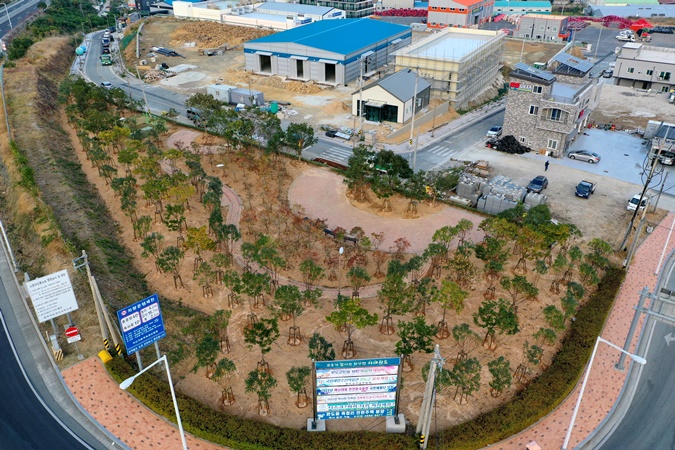
[Wando=Asia Economy Honam Reporting Headquarters Reporter Choi Kyung-pil] On the 1st, Jeonnam Wando-gun announced that the ‘Climate Response Urban Forest Creation’ project promoted by the county is receiving great response as it shows triple benefits including fine dust reduction, street landscape improvement, and providing resting places for residents.
The county proposed the project to related organizations last year to create an urban environment befitting the clean sea capital, and as a result, secured a total project cost of 1.7 billion KRW including climate response funds, creating forests at two locations: along the road near Wando Coastal Passenger Terminal and the intersection of the agricultural and industrial complex.
The Coastal Passenger Terminal is an area where fine dust frequently occurs due to various ships and cargo trucks using the 24-hour port, with nearly 3 million vehicles annually, especially a very high proportion of cargo trucks.
Emissions such as exhaust fumes and dust from cargo trucks and other vehicles pose a risk of entering nearby residential areas due to sea-land breezes and westerly winds blowing from the sea to inland, making fine dust blocking urgent.
Accordingly, a forest about 1 km long was created by planting local subtropical species such as Wando holly (Wando horanggashnamu), Hwangchil tree, and Dongcheongmok, which is resistant to the East Sea in winter.
Additionally, to allow the forest to be used as a walking course for residents, lower layers were planted with red holly (Honggashnamu) and golden sarcheol.
A resident, Mr. A, said, “When I used to go down the road toward the passenger terminal while climbing Wando Tower for exercise, it felt a bit empty, but with the forest created, a new walking course has appeared, making me want to come every day.”
The forest at the agricultural and industrial complex intersection was created in the form of a park, unlike the Coastal Passenger Terminal forest, and was mainly planted with large trees to maximize fine dust reduction effects.
Shin Woo-cheol, Wando County Governor, said, “Our county has relatively low fine dust concentration even within Jeonnam Province, but by creating forests in places where fine dust occurs locally, we have been able to provide a pleasant environment for residents. We will continue to strive to ensure that green environments are sustainably provided.”
Meanwhile, the National Institute of Forest Science revealed research results that 47 trees can absorb 1.68 kg of fine dust emitted by one diesel vehicle in one year, and that forest creation can reduce fine dust by about 25.6% and ultrafine dust by about 40.9%.
Wando=Asia Economy Honam Reporting Headquarters Reporter Choi Kyung-pil alwatros@asiae.co.kr
© The Asia Business Daily(www.asiae.co.kr). All rights reserved.

















