'Inscribed Recommendation' Decision by Evaluation Body under Intangible Heritage Committee
Generational Re-creation Highlighted: "Gives Identity and Continuity to Communities"
North Korea's 'Pyeongyang Naengmyeon' Also Receives 'Inscribed Recommendation' Decision: "Contributes to Cultural Diversity"
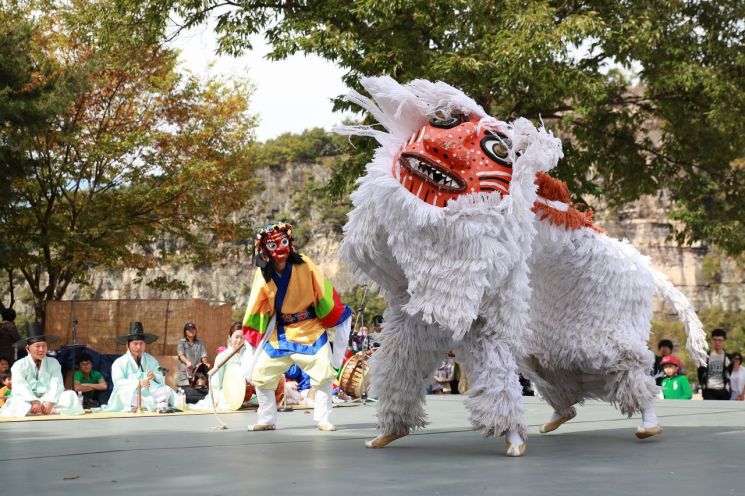
'Korean Talchum (Talchum, Mask Dance Drama in the Republic of Korea)' has taken a significant step toward being inscribed on the UNESCO Intangible Cultural Heritage list.
On the 1st, the evaluation body under the Intergovernmental Committee for the Safeguarding of the Intangible Cultural Heritage (Intangible Heritage Committee) of UNESCO made a decision recommending the inscription of Korean Talchum, which was applied for by our government. The final inscription decision will be made at the 17th Intangible Heritage Committee meeting held in Morocco from November 28 to December 3.
The evaluation body's 'recommendation for inscription' is an official conclusion based on experts' preliminary on-site inspections. Unless unexpected variables arise, it is customary for the subsequent Intangible Heritage Committee meeting to accept this recommendation as the final inscription decision. Currently, Korea holds twenty-one items of Intangible Cultural Heritage, including 'Ssireum, Traditional Korean Wrestling,' jointly inscribed by South and North Korea in 2018.
Korean Talchum is a traditional Korean dance performed wearing masks. It embodies both musical dance and theatrical characteristics. It publicizes absurd social issues through humor and satire. The exaggerated personalities of the characters create amusement and the performance concludes with a dance of reconciliation. Audience participation through cheers and jeers is used as a dramatic element, and it is also noted for continuously inspiring contemporary art.
The evaluation body highly valued the aspect of intergenerational recreation that provides identity and continuity to the community. The recommendation stated, "Korean Talchum uses everyday exaggeration and satire to convey demands for universal equality and criticism of social hierarchies," and explained, "Thanks to the interaction where the audience participates with cheers and jeers, it became widely popular among young people in the 1970s and 1980s." It added, "They still play an important role in transmission today," and evaluated that "It holds high value in that there is no gender distinction and it strengthens regional cultural identity through the use of dialects."
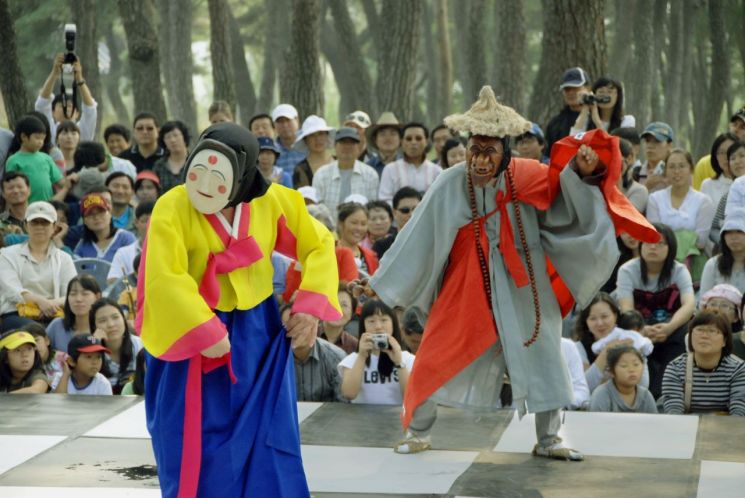
The evaluation body also cited the application submitted by our government as a well-prepared exemplary case. It stated, "It clearly explains the social function and cultural significance, and well describes ongoing efforts to address risks arising from excessive commercialization."
Korean Talchum includes thirteen items designated as National Intangible Cultural Properties, such as Yangju Byeolsandae Nori, Tongyeong Ogwangdae, Goseong Ogwangdae, Gangneung Danoje including Gwan-no Mask Play, Bukcheong Saja Noreum, Bongsan Talchum, Dongnae Yaryu, Gangnyeong Talchum, Suyeong Yaryu, Songpa Sandae Nori, Eunyul Talchum, Hahoe Byeolsingut Talnori, and Gasan Ogwangdae. There are also five items designated as Provincial Intangible Cultural Properties, including Sokcho Saja Nori (Gangwon Intangible Cultural Property), Toegyewon Sandae Nori (Gyeonggi Intangible Cultural Property), Yecheon Cheongdan Noreum (Gyeongbuk Intangible Cultural Property), Jinju Ogwangdae, and Gimhae Ogwangdae (both Gyeongnam Intangible Cultural Properties). The Cultural Heritage Administration stated, "We are continuously cooperating with each preservation organization that performs and educates on Talchum, as well as related government ministries, to achieve inscription of Talchum on the Intangible Cultural Heritage list."
Meanwhile, the evaluation body also made a 'recommendation for inscription' decision for North Korea's 'Pyongyang Raengmyon custom.' The recommendation noted, "A popular dish deeply rooted in the lives of Pyongyang people," and stated that it is related to longevity, happiness, hospitality, coexistence, and friendship. It further evaluated that "It shows how traditional cuisine contributes to cultural diversity and sustainable development." North Korea's Intangible Cultural Heritage includes 'Arirang (2013),' 'Kimchi Making (2014),' and Ssireum (2018, jointly inscribed by South and North Korea), among others.
© The Asia Business Daily(www.asiae.co.kr). All rights reserved.


















