A 4.1-Magnitude Earthquake, the Largest This Year, Strikes Goesan, Chungbuk... Followed by a 2.9-Magnitude Aftershock
Debate Over 'Earthquake Precursors' Arises Amid Mass Sardine Deaths in Busan
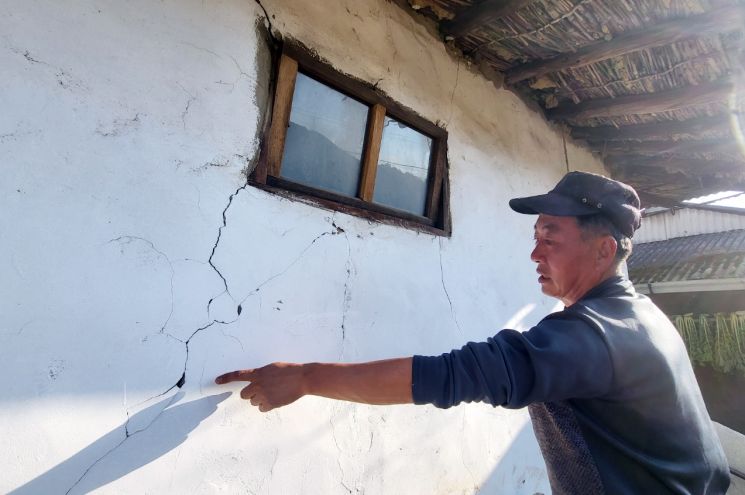 On the 29th, a magnitude 4.1 earthquake occurred in Jangam-ri, Jangyeon-myeon, Goesan-gun, Chungbuk, causing cracks in the walls of houses. Photo by Yonhap News
[Asia Economy Culture Young Intern Reporter] Around 8:27 a.m. on the 29th, earthquakes measuring 3.5 and 4.1 in magnitude occurred consecutively in the area 11 km northeast of Goesan-gun, Chungbuk (Jangyeon-myeon Jogok-ri). Subsequently, at 2:07 a.m. on the 1st, a magnitude 2.9 aftershock occurred in the northeast area of Goesan-gun, Chungbuk, with a total of 16 aftershocks recorded. This is the first time this year that an earthquake of magnitude 4.0 or higher has occurred domestically, and as the earthquake happened in the central region of Korea, concerns are rising that the Korean Peninsula is no longer a safe zone from earthquakes.
This earthquake was recorded as the 38th strongest since the Korea Meteorological Administration began earthquake observations in 1978. It is the first such event in about 10 months since a 4.9 magnitude earthquake occurred near Seogwipo, Jeju, on December 14 last year. At the time of the earthquake, the instrumental intensity in Goesan, Chungbuk, was measured at a maximum of 5. An instrumental intensity of 5 indicates that "almost everyone feels the tremor, dishes and windows may break, and unstable objects may fall."
Compared to Japan, which is located on a tectonic plate boundary, South Korea experiences relatively fewer earthquakes. However, since earthquakes can occur sporadically rather than in specific areas, there is a possibility of earthquakes anywhere in the country. Goesan, Chungbuk, had not experienced strong earthquakes until now. Experts say that strong earthquakes of magnitude 4.0 or higher can occur at any time and emphasize the need for preparedness.
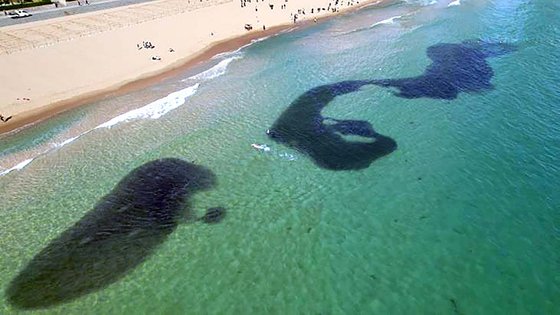 A school of sardines discovered on October 19 at Haeundae Beach in Haeundae-gu, Busan. Photo by Haeundae-gu Office
Following the occurrence of such a large earthquake, phenomena suspected to be "earthquake precursors" have also appeared. Recently, after the mass death of sardines, a school of sardines estimated to number in the hundreds of thousands has appeared off the coast of Busan and Gyeongnam, sparking discussions about whether this is an "earthquake precursor." According to the National Institute of Fisheries Science on October 21, sardine schools have been appearing consecutively along the southern coast of Gyeongnam, from Gangjin Bay in Namhae to Tongyeong, Masan, Jinhae, and parts of the sea off Busan.
On October 19, a sardine school forming a band hundreds of meters long was found 40 to 50 meters offshore from Haeundae Beach in Busan, and since September 30, sardines have been dying en masse throughout Jinhae Bay, including Jindong Bay and Masan Bay in Changwon. As the cause of the mass death was concluded to be suffocation due to oxygen deficiency, interest in the cause has spread. At the seaside, rumors have even emerged suggesting this is a "precursor to major natural disasters such as earthquakes or tsunamis."
In response, the National Institute of Fisheries Science has judged that a large increase in domestic sardine resources itself is not an unprecedented situation. However, they are investigating various possibilities, including an increase in sardine populations spawned in the eastern waters of Jeju and western waters of Japan, sardines entering to avoid predators, or sardines attracted by lights at night while searching for food and unable to leave, keeping an open mind about the causes.
© The Asia Business Daily(www.asiae.co.kr). All rights reserved.
![Clutching a Stolen Dior Bag, Saying "I Hate Being Poor but Real"... The Grotesque Con of a "Human Knockoff" [Slate]](https://cwcontent.asiae.co.kr/asiaresize/183/2026021902243444107_1771435474.jpg)

















