Gap Widens Further Based on Lowest Price, Not Average
Prolonged Ukraine War Impact... Transit Supply Disruptions Centered in Europe
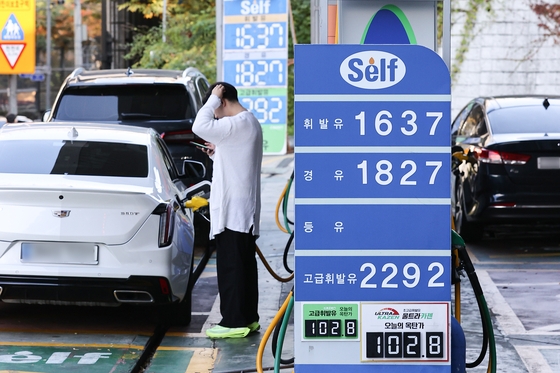 On the 23rd, diesel was being sold at a higher price than gasoline at a gas station in Seoul. Photo by Yonhap News
[Asia Economy Reporter Han Seung-gon] Diesel prices continue to surpass gasoline prices. Due to the prolonged impact of the Ukraine war, this price inversion phenomenon is expected to persist for the time being.
According to the Korea National Oil Corporation's oil price information service OPINET as of 9 a.m. on the 1st, the average fuel prices sold at gas stations are 1,660.17 KRW per liter for gasoline and 1,870.82 KRW for diesel.
Over the past three years, gasoline has generally been about 200 KRW more expensive than diesel. However, on June 5th, the average prices reversed for the first time, with diesel becoming more than 200 KRW more expensive. Since June 13th, diesel prices have been higher than gasoline prices for four consecutive months.
The price gap is even wider at the lowest prices. As of October 31st, the lowest gasoline price in the Gwangju area was 1,538 KRW, while the lowest diesel price was 1,796 KRW, a difference of 258 KRW.
Typically, in South Korea, gasoline is traded at a higher price than diesel because gasoline is subject to higher fuel taxes. In fact, in January, the average gasoline selling price was 1,635.22 KRW, about 180 KRW higher than diesel (1,453.53 KRW).
Experts attribute the sharp rise in diesel prices to supply disruptions centered in Europe caused by the prolonged Russia-Ukraine war. Additionally, following the COVID-19 pandemic, the reduction in diesel vehicle usage in Europe, where diesel cars have a large share, led refineries to cut diesel production, which is also considered a contributing factor.
Especially with winter approaching, heating demand centered in Europe is expected to increase, leading to higher demand for kerosene and diesel, which is anticipated to further widen the price gap. Industry insiders predict that diesel demand may increase further during winter, and the price difference could widen even more toward the end of the year.
© The Asia Business Daily(www.asiae.co.kr). All rights reserved.

















