Massive Purchases of Semiconductors and Secondary Batteries
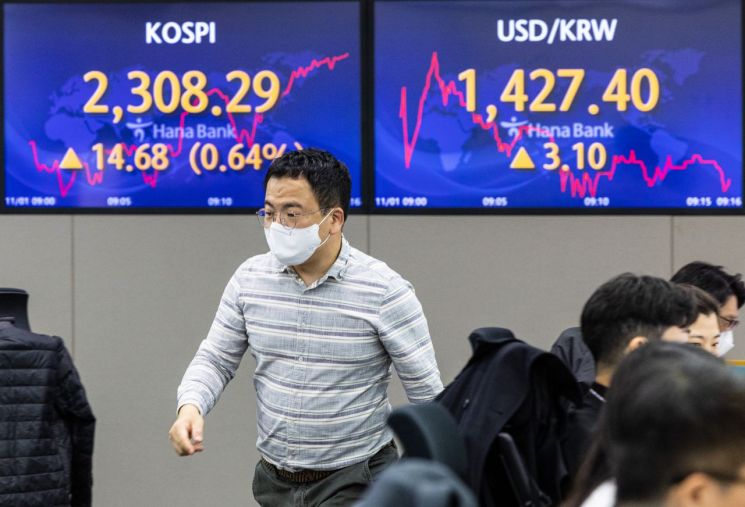
[Asia Economy Reporter Myungwhan Lee] Last month, foreign investors were found to have purchased a large volume of semiconductor and secondary battery stocks on the KOSPI. On the KOSDAQ, they mainly acquired secondary battery and bio stocks, but sold off a large number of other stocks.
According to the Korea Exchange on the 1st, foreign investors net purchased a total of 3.053 trillion KRW worth of stocks across KOSPI, KOSDAQ, and KONEX during the entire month of October (October 4?31). This is a notable net buying compared to individual investors and institutional investors, who sold 2.61 trillion KRW and 635 billion KRW worth of stocks respectively during the same period.
However, there was a stark difference by market. Foreign investors bought 3.31 trillion KRW worth of stocks on the KOSPI last month. They purchased stocks on 17 out of 19 trading days, excluding only two days. Foreign investors also maintained a consecutive net buying streak for 11 trading days. In contrast, on the KOSDAQ market, foreign investors sold stocks on 10 out of 19 trading days, showing an opposite trend to the KOSPI.
The financial investment industry interprets the large-scale buying by foreign investors as concentrated mainly on large-cap stocks. Since the KOSPI has a relatively higher proportion of large-cap stocks, foreign investors engaged in large-scale buying there, while they sold off stocks in the KOSDAQ, which has a higher proportion of small- and mid-cap stocks.
The preference for large-cap stocks was also evident in the list of top net purchased stocks. All of the top 10 net purchased stocks by foreign investors last month were large-cap KOSPI stocks. Large-cap KOSPI stocks such as Samsung Electronics, SK Hynix, and LG Energy Solution occupied the top ranks in net purchases.
Although foreign investors made large net purchases on the KOSDAQ, they mainly accumulated secondary battery and bio-related stocks. Secondary battery material specialist L&F ranked 12th among net purchases, along with EcoPro BM (28th), and Cheonbo (44th) also ranking high. KOSDAQ bio stocks such as HLB (30th), SillaJen (45th), Seegene (48th), and Celltrion Healthcare (55th) were also relatively high on the list.
The secondary battery material stocks on the KOSDAQ that they mainly acquired have seen strong buying interest, partly due to positive outlooks for the sector and their emergence as alternative investment destinations amid recent weakness in semiconductor stocks. Researcher Junghoon Jang of Samsung Securities stated, "Due to the contraction in IT demand, investors are selling semiconductor and IT large-cap stocks and choosing battery cells and materials with similar market capitalization, so the inflow of demand is likely to continue in November. Given the global macroeconomic situation, which makes recovery difficult to anticipate, investors are more likely to narrow their choices to sectors or stocks with relatively strong momentum rather than expanding their investment targets."
Some also diagnose that this preference for large-cap stocks is a phenomenon caused by automated algorithmic trading. Researcher Gyun Jeon of Samsung Securities said, "During the process of purchasing Korean stocks in basket units, buying was concentrated on the top market capitalization stocks. Foreign stock trading is presumed to be an algorithmic pattern that mechanically allocates funds flowing into emerging market (EM) ETFs or Korea-related funds overseas and purchases stocks over several days."
© The Asia Business Daily(www.asiae.co.kr). All rights reserved.

















