Increased Japan and US Alliance Exchanges Under Yoon Seok-yeol Government Only Heighten Korean Peninsula Tensions
B-52 Deployment Warns Australia-Targeted Exclusive Ballistic Missile Development Is Not Difficult
[Asia Economy Senior Reporter Jo Young-shin] Chinese state media warned that the South Korea-U.S. joint air exercise (Vigilant Storm) will further escalate tensions on the Korean Peninsula.
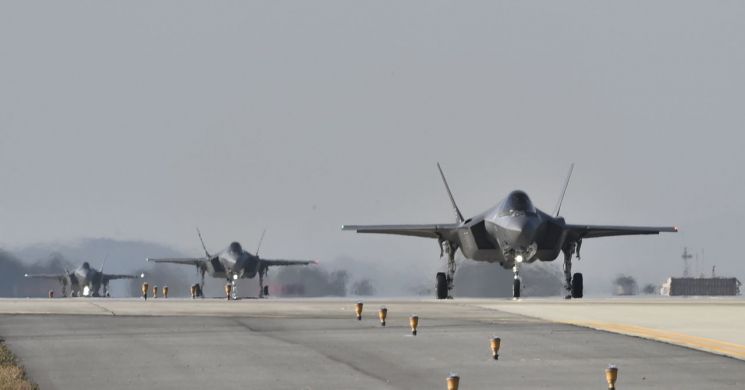
Global Times reported on the 1st that South Korea and the U.S. are conducting an exercise involving about 240 military aircraft, including advanced stealth fighters, until the 4th of this month. The media added that the South Korea-U.S. joint air exercise, which had been suspended since 2017, has resumed after five years.
Global Times reported that about 140 military aircraft, including South Korea's F-35A stealth fighters and F-15 and F-16 fighters, are participating in this exercise. The U.S. military also deployed about 100 strategic assets to the exercise, including F-35B stealth vertical takeoff and landing aircraft, EA-18G electronic warfare aircraft, U-2 high-altitude reconnaissance aircraft, and KC-135 Stratotanker (air refueling aircraft). It added that Australia participated in the South Korea-U.S. joint air exercise with one KC-30A air refueling aircraft.
Global Times cited experts saying that the South Korea-U.S. joint air exercise not only further escalates tensions on the Korean Peninsula but could also lead to unexpected consequences.
Jung Ji-yong, director of the Korean Studies Center at Fudan University, said, "Since the Yoon Seok-yeol administration, South Korea has been engaging extensively with regional alliances such as Japan, AUKUS, Quad, and NATO," adding, "These moves by the Yoon government could lead to unexpected actions (provocations) by North Korea."
Global Times claimed that the U.S. is heightening tensions on the Korean Peninsula to strengthen leadership among its allies and that U.S. military interference in Northeast Asia and the Western Pacific region will intensify.
China appears to suspect that the South Korea-U.S. joint air exercise and the South Korea-U.S.-Japan maritime exercises are U.S.-led military drills targeting China and Russia rather than North Korea.
China also showed a sensitive reaction to the deployment of the U.S. strategic bomber B-52 in Australia. Global Times, citing Australian media reports, criticized the U.S. for building an airbase capable of operating six B-52 bombers, calling it a clear move targeting China.
Regarding this, Zhao Lijian, spokesperson for the Chinese Ministry of Foreign Affairs, criticized, "The U.S. related (Australian B-52 deployment) measures escalate regional tensions, seriously undermine regional peace and stability, and trigger an arms race in the region."
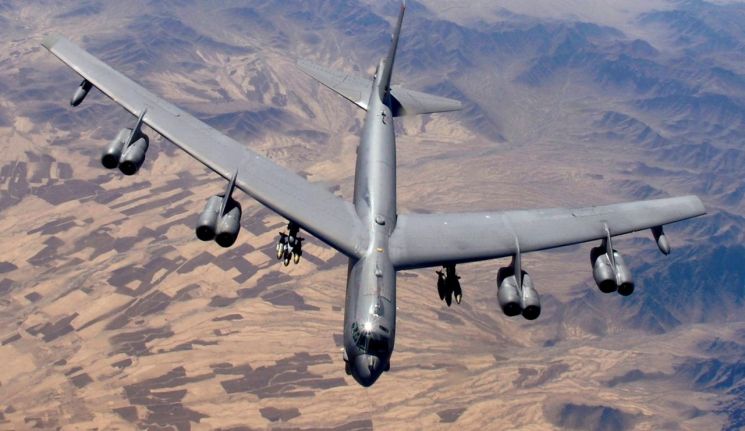
Global Times forecasted that Australia has become another option for the U.S. regarding the B-52 deployment and that the U.S. will use bases in Australia and Guam to carry out its strategic deterrence missions.
The media explained the background of the Australian airbase construction by stating that the U.S. base in Guam is no longer safe as it falls within the range of China's DF (Dongfeng)-26 medium-range ballistic missile (with a range of 4,000 km). Within China, the DF-26 ballistic missile is regarded as a missile dedicated to striking Guam.
Chinese military expert Zhang Xuefeng evaluated, "Once the Australian base is completed, bombers taking off simultaneously from Guam and Australia can enter East Asia (China) from different directions, enhancing bombing tactical capabilities." He added that the B-52 bomber is merely a trigger for war and cannot protect Australia, and that it would not be difficult for China to develop ballistic missiles dedicated to Australia.
China's sensitive reaction to the B-52 bomber deployment in Australia is due to its capability to carry hypersonic missiles. The U.S. Air Force plans to retire the B-2 (Spirit) and B-1B (Lancer) bombers sequentially once the next-generation stealth strategic bomber B-21 (Raider/Intruder) is deployed in combat. Instead, the plan is to use the first-generation B-52 bomber alongside the B-21.
China is closely monitoring the U.S. air tactics change, where the stealth-enhanced B-21 bomber is used inside China's defense line, and the improved model B-52 (B-52J or B-52K) is used outside the defense line. The prevailing assessment is that China's air defense capabilities are insufficient to block hypersonic missiles and stealth intruders flying in from outside the defense line.
© The Asia Business Daily(www.asiae.co.kr). All rights reserved.
!["The Woman Who Threw Herself into the Water Clutching a Stolen Dior Bag"...A Grotesque Success Story That Shakes the Korean Psyche [Slate]](https://cwcontent.asiae.co.kr/asiaresize/183/2026021902243444107_1771435474.jpg)

















