"World's First 'Unmanned Operation Reusable Robot' Developed, Exported but Cannot Undergo Demonstration Tests Domestically"
Park Jubong, SME Ombudsman, "Encouraging Possession of High-Level Technology and Equipment... Will Support Regulatory Improvement"
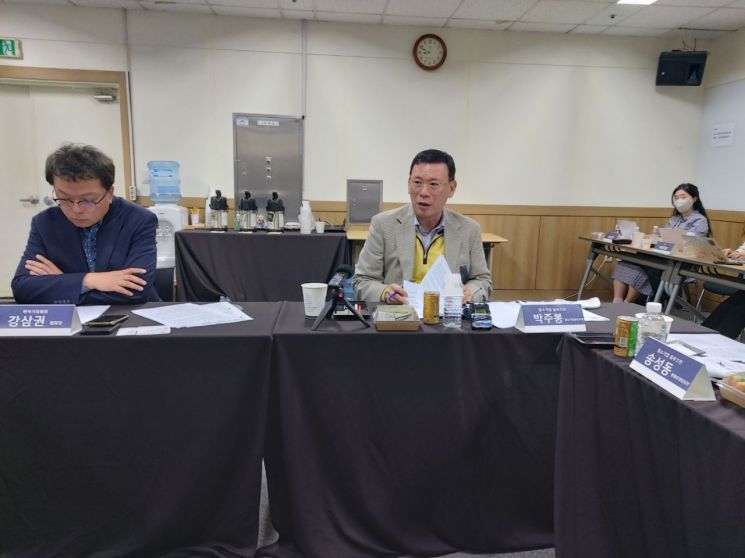 Jubong Park, Small and Medium Business Ombudsman (vice ministerial level, right), is speaking at the regulatory innovation meeting jointly held by the Venture Business Association in the main conference room of the Venture Business Association located in Guro-gu, Seoul, on the morning of the 1st.
 [Photo by Jonghwa Kim]
[Asia Economy Reporter Kim Jong-hwa] A venture company that developed a 'Level 4' fully autonomous vehicle but faced blocked sales channels due to the government's roadmap will be allowed to sell unmanned vehicles for research purposes starting in 2024.
The startup 'Autonomous A2Z,' which develops autonomous driving software and verification systems for autonomous driving capabilities, expressed difficulties as the Ministry of Land, Infrastructure and Transport set the commercialization timeline for 'Level 4 fully autonomous passenger cars' (unmanned vehicles) to 2027 under the 'Mobility Innovation Roadmap,' meaning that unmanned vehicles could not be sold even if developed before then. 'Level 4' is the final stage of autonomous vehicles that can operate solely with an autonomous driving system without a driver or without the need for intervention by the driver or passengers.
On the morning of the 1st at 8 a.m., Park Ju-bong, Deputy Ombudsman for Small and Medium Enterprises (vice minister level), held a regulatory innovation meeting jointly with the Venture Business Association at the Venture Business Association's main conference room in Guro-gu, Seoul, discussing current issues and difficulties faced by the venture industry. Attendees included Kim Bon-hwan, CEO of Law & Company; Song Young-min, Vice President of Autonomous A2Z; Lee Sung-won, CEO of Wells Care; and Park Kyung-taek, CEO of Koai. The early morning 'sandwich meeting' began with a moment of silence to mourn the victims of the Itaewon tragedy that occurred on the 29th of last month, and proceeded in a calm atmosphere with participants wearing mourning ribbons throughout.
Song Young-min, Vice President of Autonomous A2Z, said, "The company has the technology and has developed an autonomous vehicle applying Level 4, but sales are blocked, making it practically impossible to generate revenue," and requested, "Since there is considerable demand from general companies for Level 4 unmanned vehicles for research purposes, please allow vehicle sales even before the commercialization target date." He explained that despite having technology and developing innovative products, the lack of actual sales results is causing difficulties in attracting investment.
In response, Kim So-hye, a specialist at the SME Ombudsman, explained that after consultation with the Ministry of Land, Infrastructure and Transport, they received a reply stating, "Legislation will be pursued next year to establish a performance certification system for fully autonomous vehicles in 2024, and sales between companies and corporations will be permitted for certified unmanned vehicles."
Ombudsman Park said, "Global interest in autonomous vehicles is high, and it is very encouraging that high-level autonomous vehicles are being developed and can be launched in Korea," adding, "Along with the technological development of venture companies, appropriate systems must support this so that Korea can lead the fully autonomous (Level 4) vehicle market in the future."
Koai, a venture company that developed the 'Unmanned Operation Oil Recovery Robot (KOBOT)' deployed for marine pollution control tasks such as waste removal in Tetra Port, has excellent performance actively purchased overseas but cannot even conduct demonstration tests in the domestic market. This is due to regulations such as outdated registration standards for pollution control companies that are disconnected from reality. The 'KOBOT' developed by Koai is a robot gaining international attention, expected to be highly useful in pollution control operations due to its faster response compared to current systems when marine pollution occurs.
Park Kyung-taek, CEO of Koai, lamented, "It is the world's first developed unmanned operation oil recovery robot," adding, "There are continuous purchase requests from overseas markets, but domestically, we cannot sell or even properly conduct demonstration tests because we must register as a pollution control company." Koai exported about 200 million KRW worth of KOBOTs to Malaysia at the end of September and to Kuwait last month, and it has also received favorable reviews at the Abu Dhabi International Petroleum Exhibition and Conference (ADIPEC) currently held in Abu Dhabi, UAE. Park said, "Although this robot is more necessary in Korea, where pollution control work is still done with equipment from 30 or 50 years ago, it is regrettable that domestic regulations block its utilization."
Regarding this, Yoon In-joo, a specialist at the SME Ombudsman, said that after consultation with the Ministry of Oceans and Fisheries, they received a reply stating, "We will actively cooperate with the Ministry of Oceans and Fisheries, the Coast Guard, and the Port Authority to allow companies to conduct demonstration tests at ports."
Ombudsman Park said, "This is a case where the business itself did not progress due to insufficient related systems," adding, "Since the Ministry of Oceans and Fisheries has expressed willingness to actively cooperate with demonstration tests, I hope the business proceeds properly, and the Ombudsman will also actively assist in the process."
Other participating companies also requested improvements such as △ reform of related regulations under the Attorney-at-Law Act that block services like legal platform advertising and automatic legal document drafting, △ improvement of medical device supply procedures, and △ active government mediation plans between professional sectors and platform companies suitable for the platform era.
Kang Sam-kwon, Chairman of the Venture Business Association, said, "Regulatory innovation is a matter of corporate survival, so I hope this will be the starting point for establishing a practical cooperation system for regulatory reform," and added, "We will continue to work with the SME Ombudsman to revitalize the innovative venture ecosystem and promote regulatory innovation for venture companies in new industry fields."
Ombudsman Park emphasized, "Since we gathered during a national mourning period, we take the issues discussed at today's meeting more seriously," and said, "We will consult with relevant ministries to respond quickly to corporate demands."
© The Asia Business Daily(www.asiae.co.kr). All rights reserved.

















