Expansion of Ansim Income from 500 to 1,600 Households... Housing Upgrades for Semi-basements, Full Bus Fare Support for Disabled
Creation of 5 Trillion Won Fund for Innovative Industry Investment... Development of Waterfront Emotional Spaces
Start of Deep Tunnel Construction for Safe Seoul during Heavy Rain... Maintenance of Aging Facilities like Subways, Sewers, and Manholes
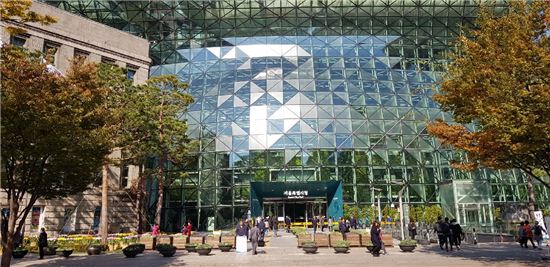 Seoul City Hall
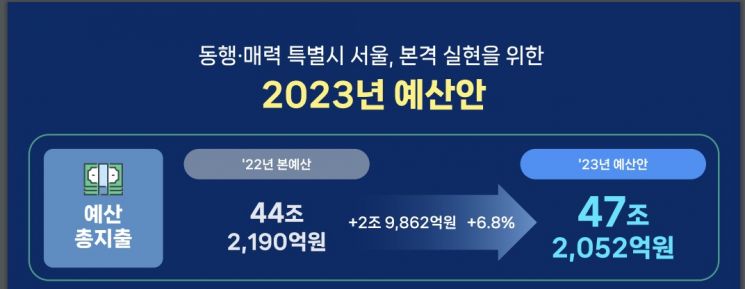
[Asia Economy Reporter Lim Cheol-young] Seoul City has organized next year’s budget proposal at 47.2052 trillion KRW, an increase of 2.9862 trillion KRW, to actively promote ‘Walking Together with the Vulnerable’ by restoring social mobility ladders, enhance ‘Global Competitiveness’ to establish itself as a leading attractive city in Asia, and focus investments on strengthening ‘Urban Safety’ in preparation for climate change and aging infrastructure.
In particular, the goal is to provide robust protection for socially vulnerable groups facing unprecedented difficulties due to the economic crisis characterized by high inflation, high exchange rates, and high interest rates?the ‘three highs (高)’?and to concentrate investments in creating a safe city against climate crises and disasters.
On the 1st, Seoul City announced that it has prepared the first main budget of the 8th term at 47.2052 trillion KRW and submitted it to the Seoul Metropolitan Council. Excluding the overlapping portion of inter-account transfers (5.7145 trillion KRW), the net budget size is 41.4907 trillion KRW. After deducting legally mandated expenses such as support for autonomous districts (6.7735 trillion KRW) and the education office (3.966 trillion KRW), the actual execution scale is 28.7874 trillion KRW.
Jung Soo-yong, Director of Planning and Coordination, explained, “Since 2023 is expected to be a difficult year financially due to the global economic downturn and increased fiscal demands such as support for the vulnerable, Seoul City will maximize fiscal efficiency through strategic financial management that cuts where necessary and spends properly where needed.” He added, “We secured a sound fiscal foundation by making efforts to increase revenue, issuing local bonds, and increasing local bond repayments.”
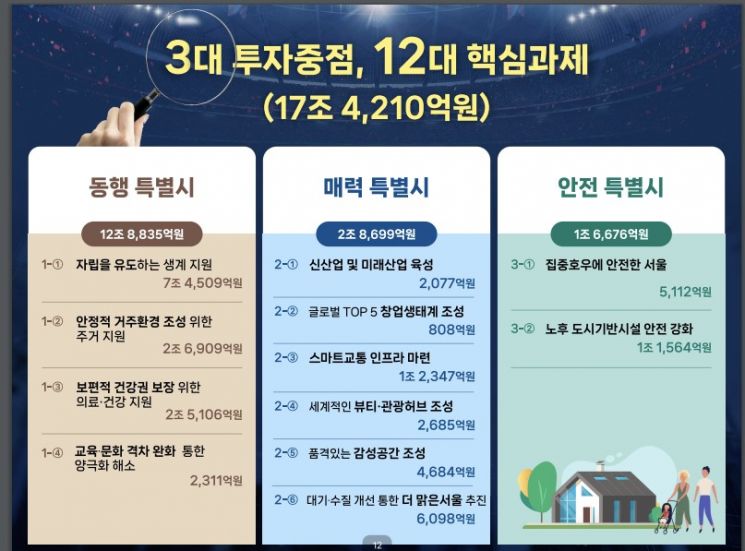
Seoul City will focus next year’s budget on three major investment priorities and 12 core tasks. The three major investment priorities are ▲ full-scale promotion of ‘Walking Together with the Vulnerable’ (4 core tasks, 12.8835 trillion KRW) ▲ creation of a ‘Special Attractive City’ (6 core tasks, 2.8699 trillion KRW) ▲ strengthening urban safety (2 core tasks, 1.6676 trillion KRW).
First, to fully implement the hallmark policy of the 8th term, ‘Walking Together with the Vulnerable,’ 12.8835 trillion KRW will be invested. Major measures in four vulnerable sectors?livelihood, housing, medical/health, education/leisure?will be actively pursued, and protection networks for various vulnerable groups such as transportation-disadvantaged persons, stalking victims, and youth preparing for independence will be strengthened. The pilot project for ‘Seoul-type Guaranteed Income’ will increase its target from the initially planned 800 households this year (up from 500) to 1,600 households. A housing upgrade project will also begin, providing a ‘specific voucher’ of 200,000 KRW per month for two years to residents of semi-basement units who wish to move to above-ground floors (private rental housing).
From July next year, bus fares for persons with disabilities will be fully supported, and low-floor buses and disability call taxis will be expanded to strengthen the mobility rights of transportation-disadvantaged groups. A new ‘one-stop support project’ will also start, providing comprehensive assistance to stalking victims, including accompaniment to and from work by professional security companies, legal litigation support, and psychological counseling.
In response to concerns about economic recession due to slowing economic growth and the ‘three highs’ of high inflation, high interest rates, and high exchange rates, protection measures for vulnerable groups have been prepared. Small business owners at risk of management crises will be identified early and proactively supported with management improvement consulting, 200 billion KRW worth of safe-interest refinancing loans (guarantees) for 1,000 businesses (128 billion KRW), and up to 3 million KRW for management improvement or business closure costs for those considering closure.
Additionally, to support employment-vulnerable groups struggling to cope with the economic downturn, major public job projects will be expanded by 35.1 billion KRW (from 172.7 billion KRW to 207.8 billion KRW) and 4,252 jobs (from 16,693 to 20,945 jobs). In particular, ‘Safe Jobs’ (from 7,830 to 11,000 people) and ‘New Deal Jobs’ (from 3,700 to 4,500 people) will be expanded and reorganized to lead the way in walking together with the vulnerable.
2.8699 trillion KRW allocated to build a ‘Global Top 5 Competitiveness’ city
Seoul plans to establish a ‘Seoul Vision 2030 Fund’ worth 5 trillion KRW by 2026 to focus investments on innovative industries and newly designate nine campus towns (four comprehensive, five unit types) to create a ‘Youth-Friendly Startup City Seoul.’ The ‘Great Sunset Hangang Project’ to develop the beautiful ‘sunset’ of the Han River as a tourism resource will also be actively promoted.
2.077 billion KRW has been allocated to foster new and future industries. To secure Seoul’s future food sources and growth engines, Seoul-type R&D support (43.8 billion KRW) and the Seoul Vision 2030 Fund establishment (40 billion KRW) will be pursued. Additionally, the second fintech (blockchain) lab (1.8 billion KRW) will be opened, and budgets will be invested in operating the Hongneung bio-medical anchor (12.6 billion KRW) and the Yangjae AI innovation district (13.7 billion KRW). To create a global top 5 startup ecosystem, 8.08 billion KRW will be invested.
1.2347 trillion KRW has been allocated for smart transportation infrastructure. Advanced transportation system operations (19.5 billion KRW), autonomous driving infrastructure establishment (8.7 billion KRW), and other smart transportation infrastructure projects (127.5 billion KRW) will be implemented. Installation of 283 traffic signal controllers, operation of five autonomous buses, and establishment of level 4 autonomous vehicle infrastructure will be carried out. From 2023, a traffic management system using drones to analyze traffic congestion will be fully operated. To build a safe and convenient Seoul transportation system, railway networks such as the Byeollae Line (completion in 2023), GTX-A (completion in 2024), and Dongbuk Line (733.5 billion KRW), as well as road networks including the Sillim-Bongcheon tunnel construction (34.1 billion KRW) and undergrounding of the Eastern Arterial Road (21 billion KRW), will be developed.
Furthermore, 268.5 billion KRW will be invested in establishing a world-class beauty and tourism hub, and 468.4 billion KRW will be allocated to create Seoul-style waterfront sensory city foundations in Hongjecheon, Dorimcheon, and Jeongneungcheon streams. 609.8 billion KRW has been budgeted to promote a cleaner Seoul through air and water quality improvements.
1.6676 trillion KRW invested in climate crisis and disaster response
Seoul City will make a safety investment of 1.6676 trillion KRW to respond to the imminent climate crisis and build a resilient city against disasters. Design work will begin for installing deep underground rainwater drainage tunnels at three locations: Gangnam Station, Gwanghwamun, and Dorimcheon, to withstand heavy rainfall. Aging sewer pipes in 29 flood-prone areas will be prioritized for maintenance to improve drainage performance, and deteriorated manholes throughout Seoul will also be repaired. Aging subway facilities and old trains will be replaced and upgraded to prepare for safety accidents, and safety railings will be installed on Han River bridges such as Jamsil Bridge to prevent suicide attempts.
Budgets for disaster prevention facilities expansion (133.2 billion KRW), aging sewer pipe maintenance (357 billion KRW), and slope facility safety management (21 billion KRW) will be significantly increased. Notably, the project costs for the three deep underground rainwater drainage tunnels (Gangnam Station, Gwanghwamun, Dorimcheon areas) are included. 1.1564 trillion KRW will be invested in transportation infrastructure vulnerable to major civic disasters. Safety management will be strengthened for 598 road facilities (375.7 billion KRW), and investments in road maintenance such as pavement will be expanded (203.7 billion KRW). Investments in urban railway facilities will also increase, including reinvestment in aging facilities on subway lines 1 to 8 (122.2 billion KRW) and replacement of old trains on lines 4, 5, and 8 (168.6 billion KRW).
In addition, Seoul City has meticulously newly established and expanded the ‘Citizen-Perceived Budget,’ which directly impacts citizens’ daily lives and well-being, although the budget amount is not large. The main projects of the ‘Mom and Dad Happiness Project’ will be actively promoted from next year. For infants (under 24 months), 100,000 KRW per child will be provided as ‘Seoul Mom and Dad Taxi’ usage points (1.6 billion KRW) to enable comfortable outings by taxi equipped with car seats. The ‘Birth Mom Happiness Accompanying Massage’ (1 billion KRW), offering breastfeeding massages by lactation experts and baby growth-promoting massages, will also begin. The ‘万能Key (Mannungi),’ a comprehensive Seoul Mom and Dad all-in-one childcare portal where all information can be checked and applications/reservations made at once, will be built and launched in August next year.
New projects include support for hearing aid purchase costs for low-income seniors aged 70 and over (100 million KRW) and a project using virtual reality (VR) technology to improve cognitive abilities and alleviate depression (200 million KRW). The ‘Gwanghwamun Book Square,’ where books and art coexist, will be operated at Gwanghwamun Plaza (2 billion KRW), and a metropolitan companion plant hospital, local companion plant clinics, and companion plant distribution expansion will be established and operated (500 million KRW and 600 million KRW, respectively).
Jung Soo-yong, Director of Planning and Coordination, said, “Although 2023 will be a difficult year financially due to the economic downturn, the fiscal demand for robust support for socially and economically vulnerable groups and enhancing Seoul’s urban competitiveness will be high. We will create a special city of walking together, attractiveness, and safety by strategically managing finances?cutting where necessary and properly spending where needed?to empower citizens’ lives.”
© The Asia Business Daily(www.asiae.co.kr). All rights reserved.
![From Bar Hostess to Organ Seller to High Society... The Grotesque Con of a "Human Counterfeit" [Slate]](https://cwcontent.asiae.co.kr/asiaresize/183/2026021902243444107_1771435474.jpg)

















