Forcibly creating space and boarding trains by sticking to doors
CNN: "Korea is used to crowded crowds... Awareness must be raised"
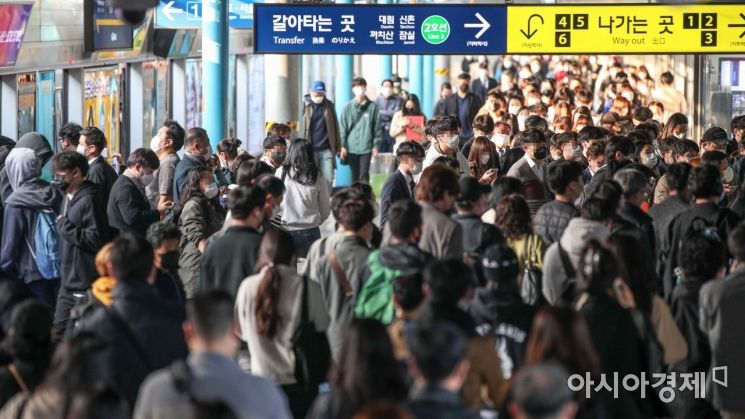 Citizens are heading to work at Sindorim Station in Guro-gu, Seoul. Photo by Jinhyung Kang aymsdream@
[Asia Economy Reporter Hwang Sumi] The deadly crush accident in Itaewon, Seoul, which resulted in a large number of casualties, has raised calls for heightened awareness even in places that are usually crowded.
The crush accident that occurred on the night of the 29th in Itaewon-dong, Yongsan-gu, Seoul, escalated in scale as the crowd suddenly swelled in a narrow space. At the time, tens of thousands of people were packed into a downhill path about 4 meters wide and 45 meters long, unable to move for 20 to 30 minutes. With no space to secure even the minimum area, the pressure increased, causing many casualties due to compressive asphyxia. In fact, research shows that when about 100 adults weighing 65 kg each apply force simultaneously, the pressure can rise up to 18 tons.
◆ Seoul Subway Line 9 Congestion Rate at 179%
Being trapped and pressured in a crowd does not only happen at special events like festivals or concerts. Similar experiences can occur during rush hours. This is because large crowds gather to use public transportation such as subways or buses.
According to the 2020 Railway Statistical Yearbook on urban railway transport performance, the time and section with the highest congestion rate on Seoul subway lines are 8 a.m. and Line 9 (Noryangjin to Dongjak section), respectively, with a congestion rate of 179%.
The congestion rate is an indicator that expresses the actual number of passengers as a percentage based on the standard capacity of one subway car (160 people) set as 100%. Congestion levels per car are divided into four stages: comfortable (80% or less), normal (80%?130%), caution (130%?150%), and congested (150% or more). When the subway congestion rate reaches the congested stage of 150% or more, movement inside the train becomes difficult. A congestion rate of 179% means about 286 passengers were on a car, 126 more than the standard 160.
Before the COVID-19 pandemic, the rush hour subway was even more crowded. According to 2017 urban railway corporation statistics released by the Land, Infrastructure and Transport Committee, during the busiest time (7:50 a.m. to 8:20 a.m.), about 380 passengers boarded one car on Line 9 (Yeomchang to Dangsan section), more than twice the assigned capacity of 160. Additionally, congestion rates on Line 2 (Sadang to Bangbae section) and Line 7 (Gunja to Children's Grand Park section) reached 202% and 172%, respectively.
In the metropolitan area, it is common to see passengers packed tightly like soybeans in a container during rush hours due to high density in public transportation. Even when trains are already full, many people push themselves onto the train. They force their way in by pushing others to create space or barely manage to get inside by holding onto the upper part of the door.
Because the body is tightly pressed, passengers often cannot even stretch an arm properly, and when the train suddenly stops, they lose balance and stagger or fall. Among university students and office workers who mainly use the subway during rush hours, the term "hell train" is used to describe this hellish subway experience.
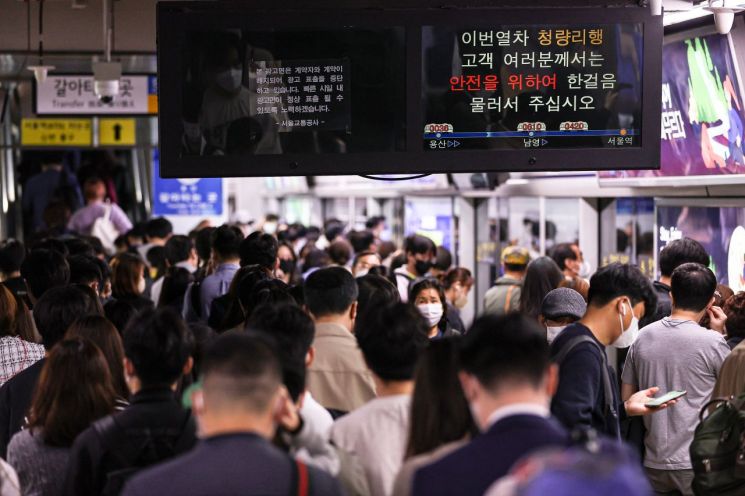 On the morning of the 6th of last month, passengers are waiting for the subway at Seoul Station on Line 1 in Seoul. Photo by Yonhap News
◆ Need to Investigate Why Safety Systems Collapsed
Experts suggest that situations like the "hell train" experienced daily may have influenced the Itaewon tragedy. Because people are accustomed to crowded spaces, they may have overlooked the dangers in places crowded with large numbers of people.
On the 30th of last month (local time), Juliet Kayyem, a U.S. disaster management expert, told CNN, "Seoul citizens are accustomed to crowded spaces," adding, "Because of this tendency, they may not have felt a strong sense of alertness even when the streets were packed with crowds."
Professor Park Cheong-woong of the Department of Fire and Disaster Prevention at Sejong Cyber University also told Yonhap News Agency, "Places like packed subways can actually cause difficulty breathing or feelings of fear," and pointed out, "Because it has become a daily occurrence, the perception of danger has dulled."
Professor Koo Jung-woo of the Department of Sociology at Sungkyunkwan University analyzed, "Korea’s population is concentrated in the metropolitan area, and within that, transportation is well developed, creating conditions conducive to gathering in one place," adding, "We have become very accustomed to such a lifestyle."
However, some voices argue that since large crowds have gathered at subways or past Halloween events at stations without major accidents, it is necessary to investigate why the safety system collapsed in this Itaewon accident.

© The Asia Business Daily(www.asiae.co.kr). All rights reserved.



















