Domestic Seasoning Sales Reach 95.6 Billion KRW in First Half of Year, Up 6.1% YoY
Growth Driven by High Inflation and Increased Home Meal Demand... Winter Demand Expected to Push Sales Over 200 Billion KRW
CJ and Daesang Strengthen Market Position with New Product Launches and Marketing Efforts
[Asia Economy Reporter Eunmo Koo] As the prices of ingredients and dining out continue to rise, demand for home-cooked meals is increasing, leading to sustained growth in the seasoning market. CJ CheilJedang and Daesang, the two dominant players in the domestic seasoning market, are gearing up for the winter season?when demand for seasonings used in soups, stews, and broths is high?by launching new products and strengthening their marketing efforts to secure their market positions.
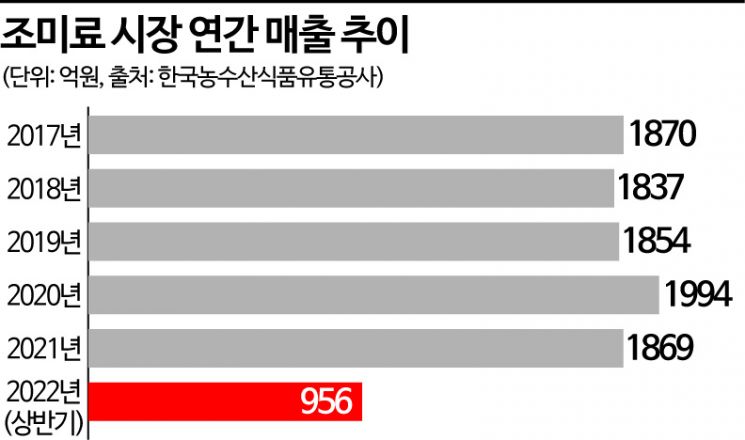
According to the Korea Agro-Fisheries & Food Trade Corporation (aT) on the 1st, domestic seasoning sales in the first half of this year reached 95.6 billion KRW, marking a 6.1% increase compared to the same period last year (90.1 billion KRW). Considering that seasoning sales typically rise sharply in the fourth quarter due to increased home dining demand in cold weather and a preference for soups and stews, the annual sales for this year are expected to exceed 200 billion KRW.
The domestic seasoning market has shown steady, albeit modest, growth as household types continue to evolve with an increase in single-person households and dual-income couples, and as demand grows not only for powdered seasonings but also for liquid seasonings and convenient sauces. The seasoning market, which was around 183.7 billion KRW in 2018, grew to 199.4 billion KRW in 2020 due to increased home meal demand amid the COVID-19 pandemic, then slightly dipped to 186.9 billion KRW last year as the home meal replacement (HMR) market, including meal kits, expanded. This year, however, the market is returning to growth driven by rising ingredient and dining-out prices.
The domestic seasoning market began to change consumer perceptions of MSG in 2016 when the Ministry of Food and Drug Safety started publicizing the safety of MSG and decided to remove the term “chemically synthesized additives” from the classification of food additives. Additionally, with home-cooked meals gaining popularity especially among younger consumers, purchases of seasonings for simple cooking have naturally increased.
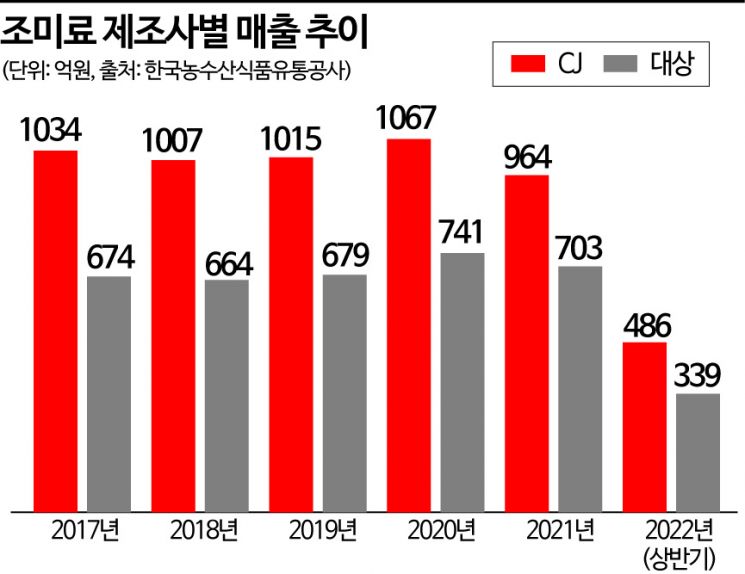
The domestic seasoning market is dominated by two traditional powerhouses, CJ CheilJedang with its ‘Dasida’ brand and Daesang with ‘Miwon.’ As the companies that split the market, their related sales have continued to grow modestly in line with market expansion. However, the recent launch of various products such as Big Mama Seafood’s ‘Haetongryeong’ and Sempio’s cooking essence ‘Yeondu’ has begun to slightly threaten the market shares of these two companies. The combined market share of CJ CheilJedang and Daesang, which was 91.4% in 2019, dropped to 88.4% last year and continued to decline to 86.4% in the first half of this year.
Both companies are once again striving to secure their market positions through new product launches and enhanced marketing. CJ CheilJedang introduced ‘Vegan Dasida,’ a seasoning made from plant-based ingredients in response to the growing vegan trend. Unlike existing plant-based seasonings made from broth and mushroom powder, this is the first time CJ CheilJedang has launched a seasoning that smells like beef but is made from soybeans.
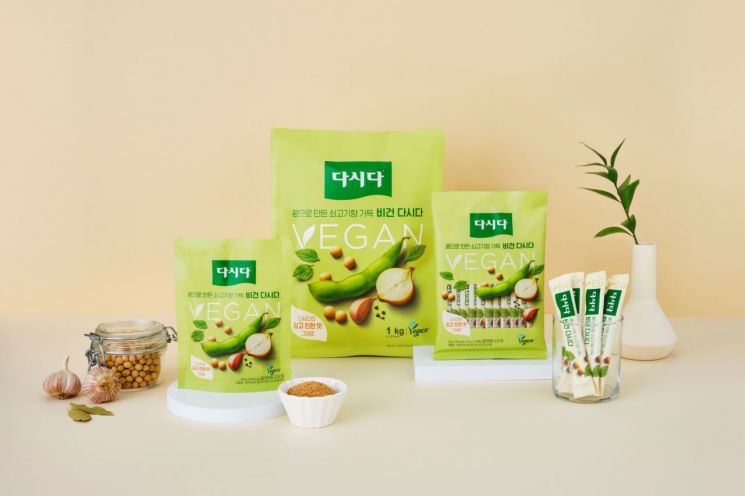
CJ CheilJedang has received vegan certification from the Korea Vegan Certification Institute and the European vegan V-label for Vegan Dasida, expressing its determination to open a new era for seasonings. A CJ CheilJedang representative said, “It can be used for a variety of dishes, including Korean soups, stir-fries, and salads, as well as Western dishes like pasta,” adding, “We will continuously strive to introduce products that satisfy consumer preferences and expectations.”
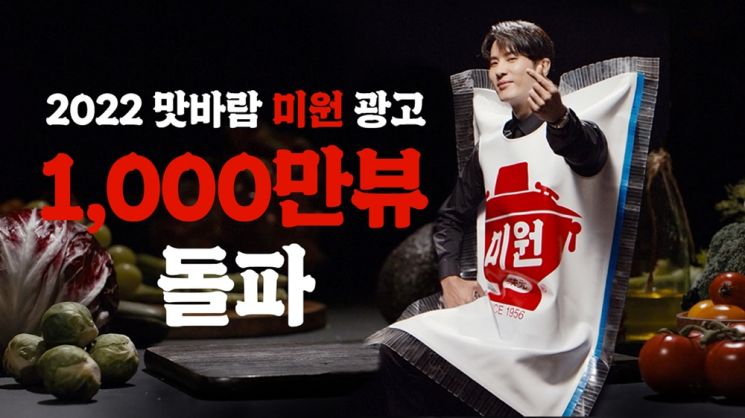
Daesang’s Miwon, with a 66-year tradition, is intensifying its efforts to target younger consumers through online advertising. Following last year’s popular Miwon ad featuring Woo Kim Ji-seok titled ‘The Supporting Role of Umami Taste,’ the new ad ‘Taste Wind Miwon,’ again starring the ‘Human Miwon,’ has surpassed 10 million views on YouTube, exceeding the previous ad’s performance. In addition to online ads, Daesang is expanding consumer engagement by releasing a dedicated font called ‘Miwonche.’
© The Asia Business Daily(www.asiae.co.kr). All rights reserved.
![Clutching a Stolen Dior Bag, Saying "I Hate Being Poor but Real"... The Grotesque Con of a "Human Knockoff" [Slate]](https://cwcontent.asiae.co.kr/asiaresize/183/2026021902243444107_1771435474.jpg)


















