Yongin Severance Hospital Professor Baek Min-ryeol's Team
Importance of Depression Screening in Acute Stroke Patients
 Professor Minryeol Baek (left), Department of Neurology, Yongin Severance Hospital, and Professor Youngdae Kim, Department of Neurology, Severance Hospital.
[Asia Economy Reporter Lee Gwan-joo] A study has revealed that depression, a common sequela of stroke patients, negatively affects early prognosis.
Professor Min-ryeol Baek of the Department of Neurology at Yonsei University Yongin Severance Hospital and Professor Young-dae Kim's team at Severance Hospital announced on the 31st the correlation between early depression and initial prognosis in patients hospitalized with acute cerebral infarction.
'Post-stroke depression' is a common complication accompanying stroke, affecting one in three stroke survivors. When accompanied by depression, recovery from neurological damage decreases and mortality rates may increase, making screening and management important.
The research team analyzed the 'PHQ-9 (Patient Health Questionnaire 9)' depression screening survey for 775 patients hospitalized with acute cerebral infarction (ischemic stroke) from July 2019 to June last year. A PHQ-9 score of 4 or higher was defined as early post-stroke depression, and the association with early prognosis was evaluated using the 'mRS (modified Ranking Score)', a scale measuring functional recovery in stroke patients.
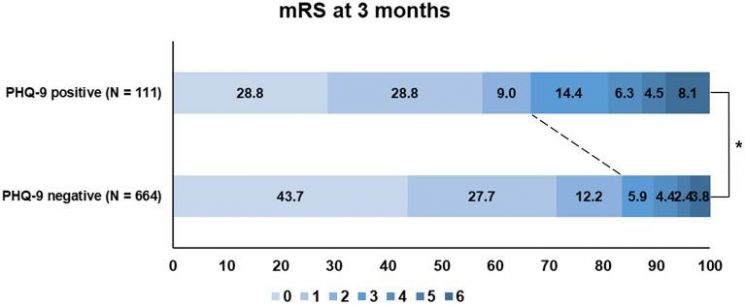 The proportion of patients with an mRS score of 4 or higher (higher scores indicate worse prognosis) was 33.3% in the group with early post-stroke depression (top), which was higher than the 16.5% observed in the group without early post-stroke depression.
As a result, among the 111 patients classified as having early post-stroke depression, 33.3% showed an mRS score of 4 or higher after 3 months, indicating a poor prognosis. In contrast, among the 664 patients without early post-stroke depression, only 16.5% had an mRS score of 4 or higher after 3 months. This trend was consistently observed across various patient groups with differences in age, gender, presence of malignant tumors, and initial neurological deterioration.
The research team explained that conducting early depression screening in acute cerebral infarction patients helps in prognosis assessment and enables rapid diagnosis and active treatment of early post-stroke depression, which can lead to positive outcomes in improving patient prognosis.
Professor Baek stated, “Through this study, we confirmed that early depression in acute cerebral infarction patients affects disease prognosis. We will strive to evaluate the occurrence of post-stroke depression early in acute cerebral infarction patients and actively intervene to improve disease prognosis and enhance patients' quality of life.”
© The Asia Business Daily(www.asiae.co.kr). All rights reserved.
![User Who Sold Erroneously Deposited Bitcoins to Repay Debt and Fund Entertainment... What Did the Supreme Court Decide in 2021? [Legal Issue Check]](https://cwcontent.asiae.co.kr/asiaresize/183/2026020910431234020_1770601391.png)

















