Advance Deployment of Taiwan-Related Personnel... Emphasis on Taiwan Unification Will
Appointment of Military Officials from Science and Engineering Backgrounds... People's Army Modernization by 2027
[Asia Economy Senior Reporter Cho Young-shin] 'The power of the Communist Party comes from the barrel of a gun'
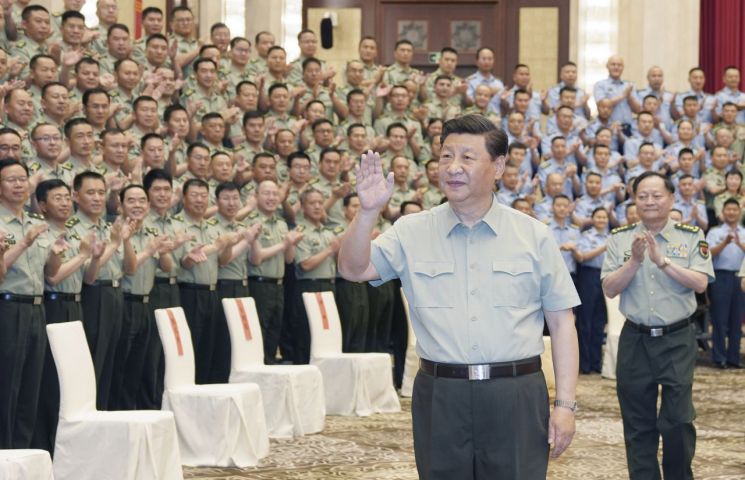
Amid escalating tensions between the U.S. and China, Xi Jinping, General Secretary of the Chinese Communist Party (also President of the State and Chairman of the Central Military Commission, hereafter referred to as Chairman), has established a one-man leadership system.
The strength of the one-man system comes from the military. The Chinese People's Liberation Army (hereafter PLA) is managed and controlled by the Central Military Commission (hereafter CMC). Without strong support from the military, Chairman Xi's one-man rule would be unattainable. Just as all seven members of the Politburo Standing Committee, the core power body of China (including Chairman Xi), are Xi’s loyalists, the CMC is also staffed with military personnel known as 'Xijiajun' (Xi’s army).
The CMC is also composed of seven members. The position of chairman, which holds supreme command over the military, naturally belongs to Chairman Xi. The CMC is then formed by two vice chairmen and four members.

The most notable feature of the third-term CMC under Chairman Xi is the rise of military personnel overseeing Taiwan and the East China Sea. A representative figure is He Weidong, commander of the Eastern Theater Command, who was appointed as the second vice chairman. The PLA is organized into five theater commands (Northern, Eastern, Southern, Western, and Central), with the Eastern Theater Command responsible for Taiwan and the East China Sea. This appointment is widely seen as a strong declaration of the Chinese leadership’s determination for Taiwan’s unification and a clear signal to the U.S. and Taiwan.
Miao Hua, director of the Political Work Department and a member of the CMC, also previously served in the 31st Group Army in Fujian Province. Fujian is the province closest to Taiwan and would be the frontline in the event of a war with Taiwan.
Another notable feature is that five out of the seven CMC members have science and engineering backgrounds. Vice Chairman He graduated from the National University of Defense Technology, and Li Shangfu, head of the Equipment Development Department (designated Minister of National Defense), holds a master's degree in automation from Chongqing University. Liu Zhenli (58), the designated Chief of the Joint Staff Department, earned a master's degree in military science from the National Defense University. Miao, director of the Political Work Department, majored in management engineering at the National University of Defense Technology.
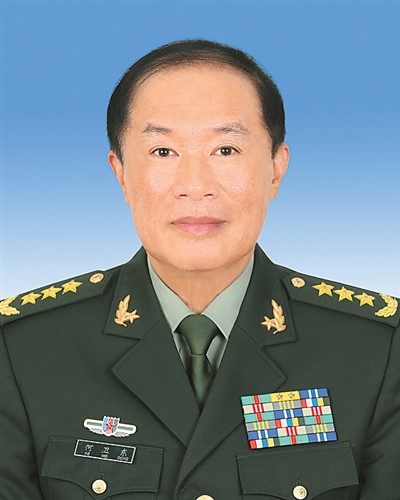
Among the seven CMC members, the only ones without science and engineering backgrounds are Zhang Youxia, first vice chairman of the CMC (National Defense University), and Zhang Shengmin, secretary (master’s degree in political science from the Central Party School). Chairman Xi himself majored in chemical engineering at Tsinghua University.
The Chinese Communist Party has set a goal to achieve modernization of the Chinese military by the 100th anniversary of the founding of the PLA in 2027. There are five years remaining until the PLA’s centennial.
The modernization of the PLA under the Chinese leadership is also evident in the military’s organizational structure. In 2016, the Chinese leadership reorganized the military. The previous four main service branches?Army, Navy, Air Force, and Artillery?were subdivided into six branches: Army, Navy, Air Force, Rocket Force, Strategic Support Force, and Joint Logistic Support Force. The four main branches were divided into four main branches and two main service types. The Strategic Support Force conducts science and technology-related operations such as space warfare, electronic warfare, and cyber warfare.
Zhang, the first vice chairman who broke the 'seven up, eight down' principle (meaning officials aged 67 remain in office while those aged 68 retire), has overseen PLA modernization and the space exploration program since Chairman Xi’s first term. Analysts suggest that his reappointment is less about personal ties with Xi and more about entrusting him with the responsibility to achieve the military modernization goals by 2027.
It is widely expected that achieving the PLA modernization goals by 2027 will also influence Chairman Xi’s potential additional (+) term in office.
Meanwhile, at the CMC Standing Committee meeting held on the 27th, first vice chairman Zhang, second vice chairman He, Minister Li, Chief of Staff Liu, Director Miao, and Secretary Zhang (in order of rank) attended, confirming the establishment of Chairman Xi’s third-term military lineup. At the meeting, Chairman Xi emphasized, "We must unite our efforts to realize the goal of the PLA’s 100th anniversary," and instructed to enhance the combat capabilities of the Chinese military through reform and innovation.
© The Asia Business Daily(www.asiae.co.kr). All rights reserved.
![Clutching a Stolen Dior Bag, Saying "I Hate Being Poor but Real"... The Grotesque Con of a "Human Knockoff" [Slate]](https://cwcontent.asiae.co.kr/asiaresize/183/2026021902243444107_1771435474.jpg)


















