Severance Hospital and Gangnam Severance Hospital Research Team
Prognosis Analysis by Treatment for Intractable Epilepsy
"Will Help Establish Treatment Strategies"
[Asia Economy Reporter Lee Gwan-ju] A study has found that severe seizures in patients with Lennox-Gastaut syndrome, a refractory pediatric epilepsy, can improve with treatment.
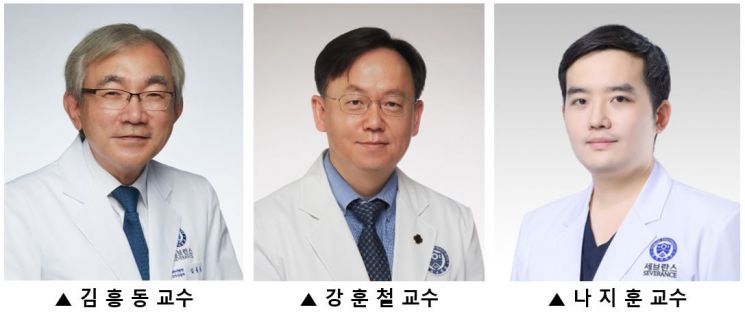
The research team led by Professors Kim Heung-dong and Kang Hoon-cheol from the Department of Pediatric Neurology at Yonsei University Severance Hospital, and Professor Na Ji-hoon from the Department of Pediatrics and Adolescents at Gangnam Severance Hospital, announced on the 31st that applying various treatments sequentially to patients with Lennox-Gastaut syndrome made it possible to control seizures over the long term and improve cognitive development.
Lennox-Gastaut syndrome is considered a representative refractory epilepsy with diverse causes such as structural abnormalities of the brain and genetic defects, and it does not show clear effects with any treatment. It causes life-threatening severe seizures as well as serious cognitive developmental delays.
Treatment includes medication such as anticonvulsants, ketogenic diet therapy that produces ketones to reduce seizures through metabolic changes, and epilepsy surgery. Epilepsy surgery is divided into resective surgery, which removes the localized area when the epileptogenic focus is clear, and palliative surgery, which reduces the frequency and intensity of seizures when the focus is not clear.
The research team actively applied various treatments sequentially from medication in Lennox-Gastaut syndrome, for which standard treatment methods have not been established, and evaluated effects such as seizure reduction and cognitive development improvement while tracking long-term prognosis.
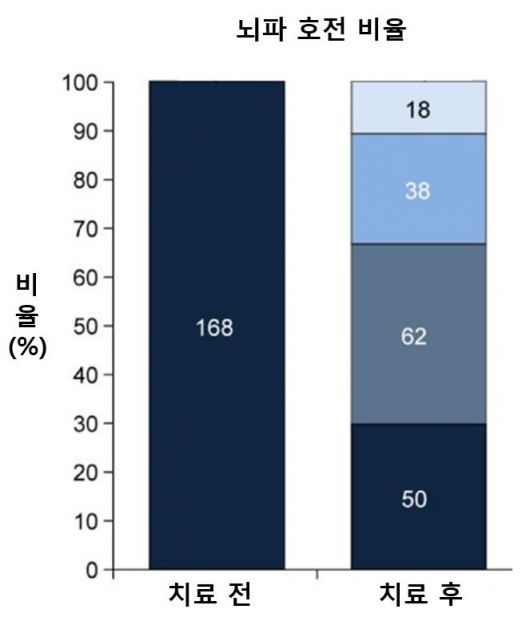 The rate of EEG improvement observed in the patient group that had no seizures for over one year; the lighter the color, the better the condition. [Source=Yonsei Medical Center]
First, an investigation into changes in seizure patterns over periods of more than 1 year and more than 5 years was conducted on 371 patients treated at Severance Hospital and Gangnam Severance Hospital from 2004 to 2019. Among the treated patients, 168 (45.3%) experienced no seizures for more than 1 year. Among these, patients who received medication, ketogenic diet therapy, resective surgery, and palliative surgery numbered 41 (11.1%), 53 (14.3%), 56 (15.1%), and 29 (7.8%), respectively.
Sixty-one patients (16.5%) experienced no seizures for more than 5 years. The number of patients who underwent medication, diet therapy, resective surgery, and palliative surgery were 15 (4.1%), 15 (4.1%), 19 (5.1%), and 12 (3.2%), respectively. Additionally, patients with Lennox-Gastaut syndrome showed improvements in EEG and cognitive development when treated. Among the group with no seizures for more than 1 year, 73% showed EEG improvement. In the same group, the rate of severe cognitive impairment decreased from 51% to 34%.
Professor Na said, “This research result will greatly help establish treatment strategies for Lennox-Gastaut syndrome, a representative refractory epilepsy. By analyzing the disease prognosis over 15 years, it revealed that sequential application of various treatments is a way to overcome Lennox-Gastaut syndrome.”
This research was published in the international academic journal Therapeutic Advances in Neurological Disorders.
© The Asia Business Daily(www.asiae.co.kr). All rights reserved.


















