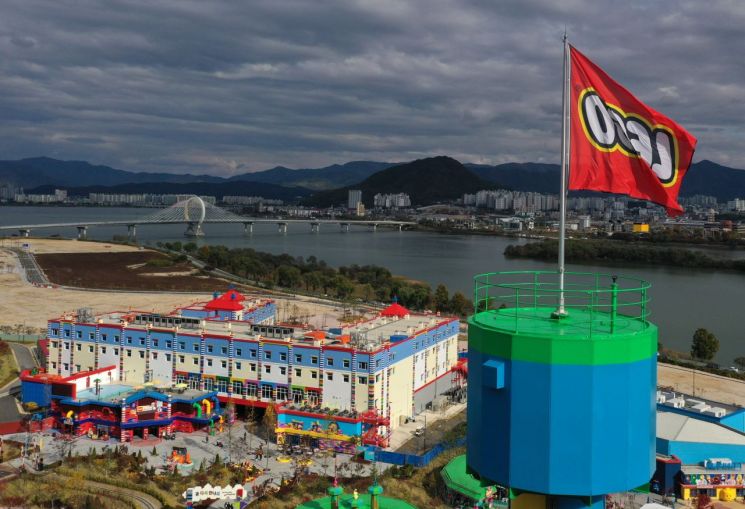
 The so-called liquidity crunch in the bond market triggered by the Legoland incident is tightening the financial lifelines of construction companies. The photo shows the Chuncheon Legoland Korea Resort. [Image source=Yonhap News]
[Asia Economy Reporter Cha Wanyong] Recently, as the real estate project financing (PF) loan freeze crisis has worsened the funding market situation, the finance teams in the construction industry have been put on high alert. They are busy managing financial risks by visiting financial companies to refinance maturing borrowings and raising funds from affiliates to refinance maturing borrowings.
According to the construction industry on the 31st, as interest rate hikes and concerns over real estate PF defaults intensify, construction companies are actively seeking countermeasures. In particular, at one construction company recently raising concerns about PF loan-related risks, department head meetings chaired by the Chief Financial Officer (CFO) have been ongoing for several weeks by project site. Detailed reports on borrowings by project site, PF loan status, project feasibility, and response strategies are being made, resulting in daily overtime for the finance-related departments.
In fact, most construction companies are known to be facing serious financial risks. This is because investment has stopped as warning signs of real estate PF defaults have been triggered in the financial market. Even large construction companies are raising funds through the Korea Credit Guarantee Fund’s Primary Collateralized Bond Obligation (P-CBO).
Daewoo E&C (100 billion KRW), Hyosung Heavy Industries (70 billion KRW), and Lotte E&C (30 billion KRW) have received P-CBOs. P-CBOs are securities issued with guarantees provided by institutions like the Korea Credit Guarantee Fund on corporate bonds and loan receivables of companies struggling to raise funds. This is a financing method mainly used by small and medium-sized construction companies. The fact that large construction companies, which previously had no difficulty raising funds, are now issuing P-CBOs indicates how tight the funding market has become.
Several construction companies are also repaying maturing corporate bonds in cash due to difficulties in issuing new bonds. POSCO E&C repaid 110 billion KRW of maturing corporate bonds on the 22nd without issuing refinancing bonds, using its own cash reserves. SK Ecoplant is also known to have repaid about 200 billion KRW of maturing corporate bonds in cash. Samsung C&T has a corporate bond maturity of about 50 billion KRW next month but plans to handle it in cash instead of issuing new bonds. Ssangyong E&C repaid 20 billion KRW of maturing commercial paper (CP) with its own funds and plans to repay another 12 billion KRW maturing next month in cash as well.
A finance team official from a large construction company who requested anonymity said, "With warning signs of real estate PF defaults flashing in the financial market, investment has effectively stopped. Even large construction companies could face a liquidity crisis in an instant if things go wrong, and for small and medium-sized construction companies with limited financial capacity, the risk of default is inevitably increasing."
© The Asia Business Daily(www.asiae.co.kr). All rights reserved.
![User Who Sold Erroneously Deposited Bitcoins to Repay Debt and Fund Entertainment... What Did the Supreme Court Decide in 2021? [Legal Issue Check]](https://cwcontent.asiae.co.kr/asiaresize/183/2026020910431234020_1770601391.png)