3 Major Tremors and 12 Aftershocks
Government Activates Central Disaster and Safety Countermeasures Headquarters Level 1
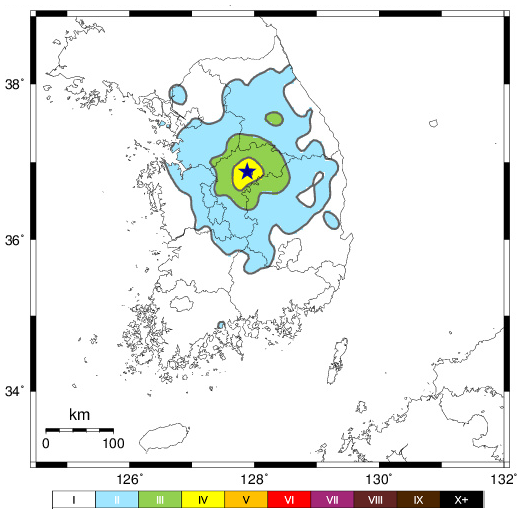
[Asia Economy Reporter Yoo Byung-don] At around 8:27 a.m. on the 29th, a magnitude 4.1 earthquake occurred in the area 11 km northeast of Goesan-gun, Chungbuk (Jogok-ri, Jangyeon-myeon).
This earthquake is the strongest to have occurred on the Korean Peninsula this year and ranks as the 38th largest ever recorded.
Geographically, a large-magnitude earthquake occurred in Goesan-gun, which is the exact center of South Korea, causing tremors to be felt not only in the Chungcheong region but also across the country including Seoul, Gangwon, and Gyeongnam.
Fortunately, there were no reports of significant damage or casualties, and no issues occurred at nuclear power plants. However, the Korea Meteorological Administration (KMA) urged continued caution as aftershocks may continue for some time.
◆ Largest earthquake of the year, 3 foreshocks and 12 aftershocks = The earthquake occurred at 8:27:49 a.m. It has been over 10 months since a magnitude 4.0 or higher earthquake occurred on the Korean Peninsula, the last being a magnitude 4.9 earthquake on December 14 last year, 41 km southwest off the coast of Seogwipo, Jeju.
The KMA initially reported the epicenter and magnitude as "12 km northeast of Goesan-gun" and 4.3 at 8:27:54 a.m., 23 seconds after the first observation, but after further analysis, officially announced the epicenter as "11 km northeast of Goesan-gun" and magnitude 4.1.
The depth of the epicenter was estimated at 12 km. According to the KMA, there were three foreshocks before this earthquake.
About 20 minutes before the magnitude 4.1 earthquake at 8:27:49 a.m., a magnitude 1.6 earthquake occurred at 8:08:14 a.m., followed by magnitude 1.3 and 3.5 earthquakes at 8:09:32 a.m. and 8:27:33 a.m., respectively.
These earthquakes are considered foreshocks, which are earthquakes occurring on the fault that causes the mainshock before the mainshock itself. After the mainshock, 12 aftershocks continued until 10 a.m.
The KMA explained that this Goesan-gun earthquake "appears to have been caused by a strike-slip fault moving in a north-northeast to south-southwest or east-southeast to west-northwest direction." A strike-slip fault refers to a fault that moves horizontally.
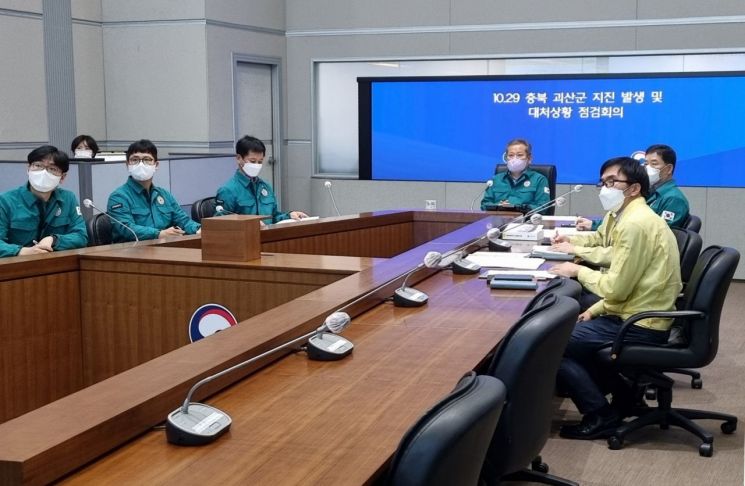
◆ Central Disaster and Safety Countermeasures Headquarters activated at Level 1: "No damage reports or dispatch cases"= Following the relatively large earthquake, the government activated Level 1 of the Central Disaster and Safety Countermeasures Headquarters (CDSCH) at 8:30 a.m. to assess damage and take emergency measures.
President Yoon Suk-yeol instructed, "All related ministries, led by the Minister of the Interior and Safety, must promptly assess whether there is any damage caused by the earthquake." Prime Minister Han Duck-soo also demanded, "Thoroughly inspect to ensure that there are no disruptions to national infrastructure services such as nuclear power, electricity, telecommunications, and transportation."
Chungbuk Province issued an "Emergency Level 1" alert and dispatched damage response support officers to Goesan-gun. The Nuclear Safety and Security Commission (NSSC) conducted emergency inspections of nuclear facilities and confirmed that there were no safety issues at nuclear power plants. The NSSC explained that seismic measurements at nuclear facilities, including the research reactor "Hanaro," located 69 km from the epicenter, and Hanul Nuclear Power Plant about 135 km away, were below the earthquake warning threshold, so no alarms were triggered.
According to the Fire Agency, as of around 11 a.m., 142 reports of earthquake detection had been received. However, no damage reports or dispatches have been made so far.
In fact, instrumental seismic intensity (calculated from seismometer readings) was estimated at level 2 in regions including Gyeongnam, Daegu, Seoul, Sejong, Incheon, Jeonnam, Jeonbuk, and Chungnam. Instrumental seismic intensity level 2 means "a quiet state where a few people on upper floors of buildings feel shaking."
◆ Average annual occurrence of magnitude 4.0 or higher earthquakes is 1.2 times = Including this event, there have been one earthquake of magnitude 4.0 to less than 5.0, five earthquakes of magnitude 3.0 to less than 4.0, and 55 earthquakes of magnitude 2.0 to less than 3.0 on the Korean Peninsula this year.
The largest earthquake ever recorded on the Korean Peninsula, including North and South Korea and adjacent waters, was a magnitude 5.8 earthquake that occurred 8.7 km south-southwest of Gyeongju, Gyeongbuk, on September 12, 2016. The second largest was a magnitude 5.4 earthquake on November 15, 2017, 8 km north of Buk-gu, Pohang, Gyeongbuk.
The largest earthquake within a 50 km radius of this epicenter since 1978 was a magnitude 5.2 earthquake on September 16, 1978. Excluding foreshocks and microearthquakes, the most recent earthquake in the same area before this was a magnitude 2.2 earthquake on April 9.
On average, about 70 earthquakes of magnitude 2.0 or higher occur annually on the Korean Peninsula. Since digital seismometer observations began in 1999 until last year, earthquakes of magnitude 2.0 to less than 3.0 occurred about 60 times per year on average, magnitude 3.0 to less than 4.0 about 9.4 times per year, and magnitude 4.0 or higher about 1.2 times per year. During the same period, a total of 1,623 earthquakes of magnitude 2.0 or higher were recorded.
© The Asia Business Daily(www.asiae.co.kr). All rights reserved.
![Clutching a Stolen Dior Bag, Saying "I Hate Being Poor but Real"... The Grotesque Con of a "Human Knockoff" [Slate]](https://cwcontent.asiae.co.kr/asiaresize/183/2026021902243444107_1771435474.jpg)












