Competitive Education Policies like Autonomous Private High Schools and National Assessment "Admitted Side Effects"
Regarding National Assessment, "It Was Right Then" Yet Criticizing 'Written Exams'
Education Sector Shaken After Yoon's Autonomous Evaluation 'Comprehensive Assessment' Remarks
Teachers: "After Autonomous Evaluation Announcement, Academies Created Prep Classes, Publishers Made Workbooks"
Lee Ju-ho Also Actively Supports Autonomous Evaluation... Likely to Remain a Hollow 'Autonomy'
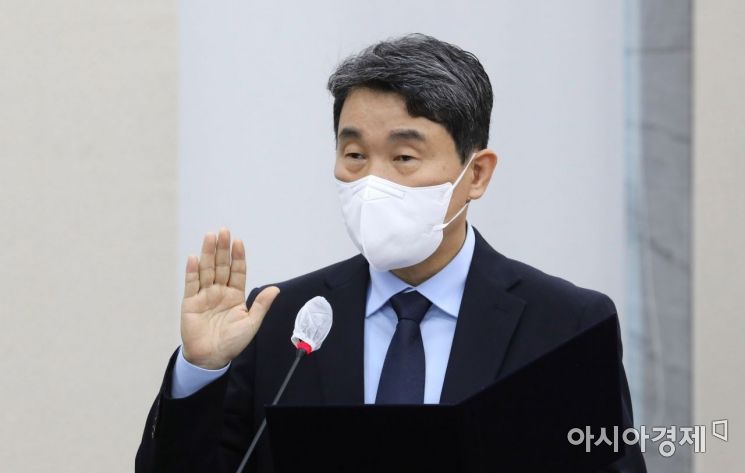 Lee Ju-ho, the nominee for Minister of Education, is attending the confirmation hearing held at the National Assembly on the 28th and taking the witness oath. Photo by Yoon Dong-joo doso7@
[Asia Economy Reporter Han Jinju] Lee Ju-ho, the Deputy Prime Minister for Social Affairs and Minister of Education nominee who designed the competitive education policy under the MB administration, admitted the side effects of competitive education policies during the confirmation hearing. Policies such as the expansion of autonomous private high schools (Jasago) and the nationwide standardized test (Ilje Gosa) implemented over a decade ago have backfired. Since he emphasized 'autonomy and responsibility' from his first day after being nominated as minister, it is highly likely that Lee will advocate for 'Competitive Education 2.0.'
At the confirmation hearing held at the National Assembly on the 28th, Lee acknowledged the side effects of policies emphasizing competition, such as the expansion of Jasago and the 'Nationwide Standardized Academic Achievement Assessment,' commonly known as Ilje Gosa. Lee said, "I did my best, but I am not satisfied with the current educational outcomes," referring to the implementation of Ilje Gosa and high school diversification policies.
During his tenure as Minister of Education under the MB government, Lee implemented the ‘High School Diversification 300 Project,’ which designated 150 boarding public high schools, 100 autonomous private high schools (Jasago), and 50 Meister high schools to reduce private education expenses. This policy has been continuously criticized for deepening educational polarization between Jasago and general high schools and creating a hierarchy among schools. The number of Jasago, which once reached 54 schools, has now decreased to 35 and will further reduce to 33 next year.
When Democratic Party lawmaker Park Kwang-on asked whether Lee believed the expansion of Jasago worsened educational disparities, Lee responded, "I believe the so-called high school diversification policy clearly had side effects that led to hierarchy." He explained, "When designing Jasago initially, we aimed to provide opportunities to socially disadvantaged students and tried to invest the resources saved from Jasago into local public high schools."
When Democratic Party lawmaker Ahn Min-seok asked if Lee intended to apologize for implementing competitive education policies at that time, Lee was asked the same question three times and replied, "I feel sorry." He added, "I did my best, and I ask you to understand that there were side effects."
Recently, after President Yoon Suk-yeol announced plans to conduct academic achievement assessments as 'universal evaluations,' concerns have arisen that this might be a step toward reintroducing Ilje Gosa. The Ministry of Education announced on the 11th the '1st Comprehensive Plan for Guaranteeing Basic Academic Skills,' stating that customized academic achievement assessments would be autonomously conducted by each school.
Seong Hyun-joo, a teacher at Namseong Elementary School in Cheongju who appeared as a reference witness, recalled, "When Ilje Gosa was implemented, the curriculum was disrupted. Science classes were theoretical without experiments, and arts and physical education classes were not conducted until after the exams." She added, "When education supervisors visited, they discussed school rankings and held meetings on support measures for underperforming students, openly pressuring schools."
There is also a possibility that the customized academic achievement autonomous evaluation will remain a mere facade of 'autonomy.' Teacher Nam explained, "Even if the test format changes, the 'academic achievement assessment' is still a burden. If schools have to conduct the test due to demands from education offices, schools, and parents, they inevitably have to prepare by solving test papers again." She added, "Right after the announcement to autonomously implement academic achievement assessments, academies started creating test preparation classes, and publishers began producing preparation workbooks."
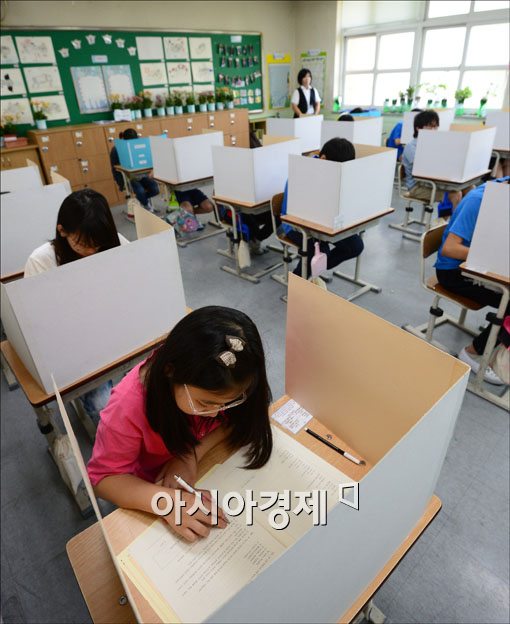
Yoo Ki-hong, Chairman of the Education Committee (Democratic Party), pointed out, "During the MB government when the nominee was minister, the government made education offices compete on scores, education superintendents made schools compete, and principals made classes compete." He added, "During this national audit, when we asked education superintendents nationwide about their stance on Ilje Gosa, both conservatives and progressives opposed the Ilje Gosa from the MB era. We need to reflect on that meaning."
Regarding the reason for promoting Ilje Gosa, Lee said, "It was right at that time," but explained, "The purpose was to actively support students who were falling behind as revealed by the evaluation." He acknowledged, "It was a written test conducted simultaneously, so there was competitive pressure."
When People Power Party lawmaker Jung Kyung-hee asked about measures to improve academic achievement, Lee said, "Autonomous evaluation is a good alternative." He added, "We will continue to support schools and education offices that introduce new evaluations and create such an environment," and "We will minimize past side effects and promote the activation of evaluations."
Although Lee admitted the side effects of competitive education multiple times during the confirmation hearing, it is difficult to conclude that his policy stance has completely reversed, given that he did not criticize the written test method and emphasized 'autonomy and responsibility.'
Educational civic groups such as the Korean Teachers and Education Workers Union stated, "He still talks about ‘autonomy’ like AI personal tutors and university autonomy, but now we painfully understand what that ‘autonomy’ means. His ‘autonomy’ is ‘autonomy’ for more competition." They added, "While claiming to support ‘AI personal tutors’ for student-tailored education, the conclusion is the expansion of academic achievement assessments and Ilje Gosa once again."
© The Asia Business Daily(www.asiae.co.kr). All rights reserved.

















