Judging Obstacles to Securing Top Talent in Research Institutions... "No Regulation Should Be Justified for Political Reasons"
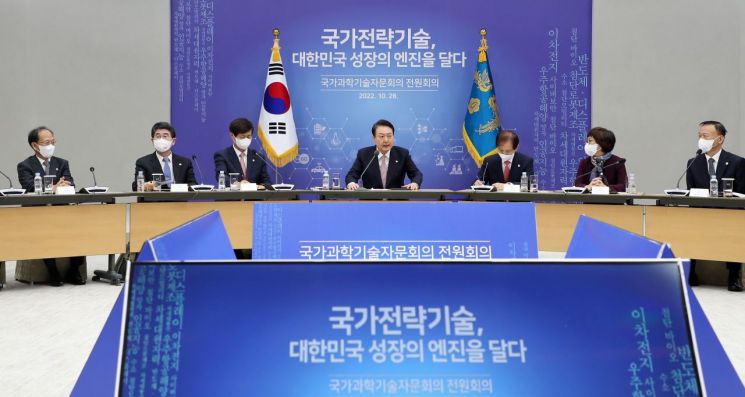
[Asia Economy Reporter Baek Kyunghwan] On the 28th, President Yoon Seok-yeol held a meeting of the National Science and Technology Advisory Council and announced the policy to abolish 'blind recruitment' in public research institutions. This system was introduced during the previous Moon Jae-in administration, but it was judged to act as an obstacle that rather hinders securing excellent researchers in research institutions.
At the meeting, President Yoon said, "The source of national wealth is the capability of science and technology, and no regulation that obstructs the development of science and technology can be justified for political reasons," according to Lee Jae-myung, deputy spokesperson of the Presidential Office.
Deputy Spokesperson Lee explained, "The previous government introduced blind recruitment in public institutions and applied it uniformly to research institutions. As a result, not only the alma mater but also recommendation letters, which overseas research institutions consider more important than the alma mater, were not accepted. Researchers were required to submit their research achievements with the school name and corresponding author’s name deleted, so the most important information to understand the researcher’s background was unknown during selection."
Deputy Spokesperson Lee also introduced the side effects of blind recruitment, citing the case where a Chinese national passed the final interview through blind recruitment at the Korea Atomic Energy Research Institute.
A Presidential Office official explained, "Most advanced countries select candidates for national research institutes based on alma mater recommendations. Since science and technology capabilities are crucial enough to determine a nation's wealth, it makes no sense to make a person’s background unknowable, which is why the policy was abolished." However, the official added, "Expansion to public institutions can be discussed later after abolishing it in research institutions, considering the characteristics and situations of each institution."
© The Asia Business Daily(www.asiae.co.kr). All rights reserved.

















