Active Research on Biomarkers Predicting Cancer Treatment Prognosis
Indicators Identified to Forecast Treatment Effects for Liver Cancer, Stomach Cancer, and More
Potential Applications in Diagnosing Rheumatoid Arthritis and Dementia
“A single drop of blood can diagnose various diseases and predict prognosis.”
[Asia Economy Reporter Lee Gwan-ju] Blood tests are considered the most basic examination to check the body's condition. Although there is a brief sting, it is convenient and provides vast information as it can be completed in a relatively short time while checking various indicators. With recent research and development, blood tests are evolving further. They are expanding their scope from analyzing genetic information in the blood or identifying specific biomarkers to diagnosing diseases and even predicting prognosis.
A representative field attracting attention in the medical community is the prediction of cancer prognosis. Blood tests are used to detect cancer early or predict prognosis after treatments such as chemotherapy. One of the cancers for which predicting treatment response is difficult is liver cancer. Recently, a research team led by Professors Park Jun-yong and Lee Hye-won from the Department of Gastroenterology at Yonsei University Severance Hospital, along with Professor Lee Seung-tae from the Department of Laboratory Medicine, presented noteworthy research results. They confirmed that the ‘TP53’ gene mutation detectable through blood liquid biopsy is directly related to the prognosis of liver cancer patients.
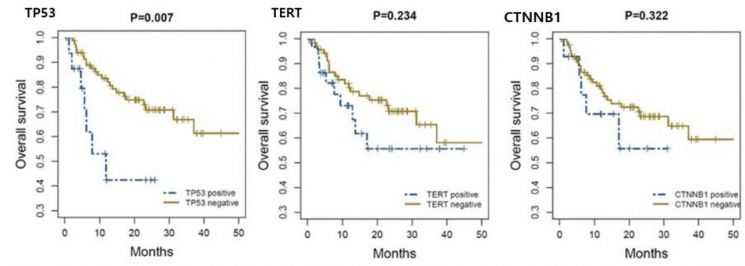 Patients with liver cancer harboring TP53 mutations showed worse survival rates compared to those without such mutations (P=0.007). In contrast, mutations in other genes such as TERT and CTNNB1 did not significantly affect patient survival. [Data provided by Yonsei Medical Center]
According to the research team’s findings, liver cancer patients with the TP53 mutation showed significantly (P-value=0.007) worse survival rates compared to those without the mutation. The P-value is an indicator used in clinical settings to determine whether differences between groups are statistically significant, with values below 0.05 generally considered statistically significant. This suggests that analyzing circulating tumor DNA (ctDNA) in the blood can be used as a biomarker to predict future treatment prognosis and monitor treatment response after chemotherapy. Professor Lee Hye-won stated, “By identifying mutation genes that affect prognosis in liver cancer patients, for whom predicting treatment response is difficult, prognosis can now be predicted using liquid biopsy,” adding, “It is also expected to enable personalized chemotherapy tailored to the patient’s cancer-related gene mutations.”
Related research is also active in gastric cancer. Professor Lee In-seop’s team from the Department of Gastrointestinal Surgery at Seoul Asan Medical Center, together with American medical staff, analyzed the blood genomic information of 12 patients with inoperable metastatic or locally advanced gastric cancer and discovered two microRNAs (miRNAs) that were overexpressed in patients with poor chemotherapy outcomes. Until now, there were almost no means to determine whether combination chemotherapy would be effective for gastric cancer patients who are difficult to operate on, but this study found clues to predict chemotherapy prognosis. Professor Lee explained, “Chemotherapy has toxicity and can worsen the patient’s health if the treatment effect is unsatisfactory, so the initial drug choice is very important,” adding, “The significance of this study lies in providing a basis for personalized treatment through biomarkers.”
Research expanding the scope of blood tests continues not only in cancer prognosis prediction but also in diagnosing various conditions such as arthritis and dementia. Professor Ahn Sung-soo from the Department of Rheumatology at Yongin Severance Hospital, Professor Kim Hye-min from the Department of Pathology, and Professor Park Yoon-hee’s team from the Department of Laboratory Medicine at Severance Hospital confirmed that the level of the enzyme ‘tumor M2-PK’ in the blood is higher in patients with rheumatoid arthritis compared to those with general degenerative arthritis and normal controls. This study is meaningful because there have been few clinically useful blood tests for diagnosing rheumatoid arthritis.
Additionally, NGENBIO developed a next-generation sequencing (NGS) panel and analysis software capable of early diagnosis of Parkinson’s disease dementia and Lewy body dementia using biomarkers discovered through a consortium of four institutions participating in the National Dementia Overcoming Technology Development Project. This test can predict genetic factors and risk related to dementia in a single examination, and it is expected to be utilized in various clinical settings related to dementia in the future.
© The Asia Business Daily(www.asiae.co.kr). All rights reserved.
![Clutching a Stolen Dior Bag, Saying "I Hate Being Poor but Real"... The Grotesque Con of a "Human Knockoff" [Slate]](https://cwcontent.asiae.co.kr/asiaresize/183/2026021902243444107_1771435474.jpg)

















