Expansion of Tariff Quotas on 10 Items to Reduce Heating Costs and Stabilize Grocery Prices
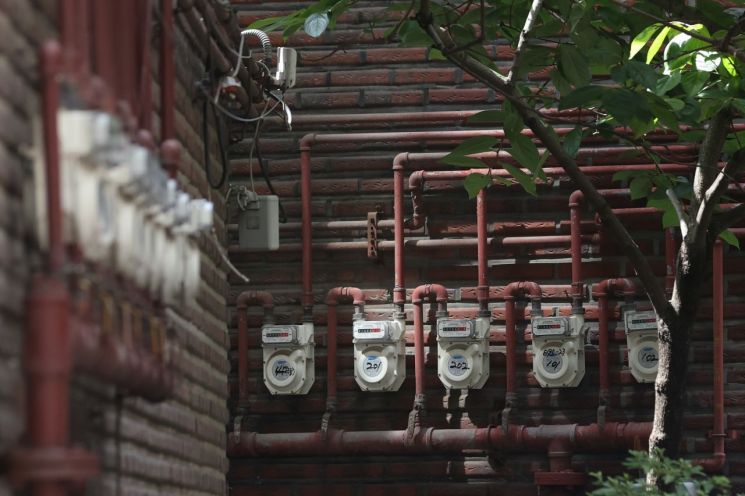
[Asia Economy Sejong=Reporter Kwon Haeyoung] The government will expand the application of tariff quotas on liquefied natural gas (LNG), liquefied petroleum gas (LPG), mackerel, pollock, and other items to stabilize the lives of low-income households by reducing winter heating costs and grocery price burdens.
The Ministry of Economy and Finance announced on the 28th that it plans to expand the application of tariff quotas to 10 items, aiming for implementation in early November.
First, to alleviate the heating and transportation cost burdens of low-income households, tariff quotas will be applied to LNG, LPG, and crude oil for LPG production. Due to gas supply disruptions caused by the prolonged Russia-Ukraine conflict and the sharp rise in exchange rates, the import price of LNG continues to increase. The zero-percent tariff quota, which is set to expire at the end of this year, will be extended until March next year. As a result, the city gas fee, which has risen about 40% in four rounds this year, is expected to decrease by approximately 1,400 KRW per household per month.
The tariff rates on LPG and crude oil for LPG production will also be reduced from 2% to 0% until March next year to ease heating and transportation cost burdens. In particular, propane gas is used for cooking and heating by about 3.78 million households, including low-income families and small business owners, so this measure is expected to help reduce fuel cost burdens for low-income and vulnerable groups.
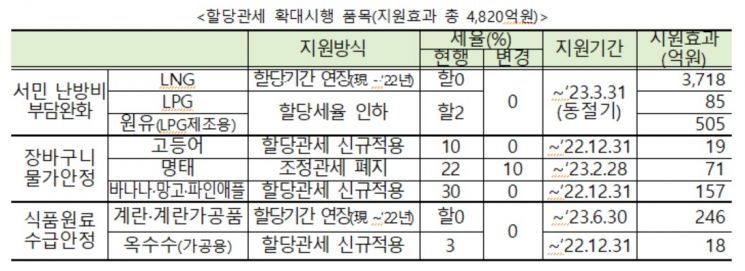
To stabilize grocery prices, tariffs on two popular fish species favored by low-income consumers and tropical fruits such as bananas, which have large import volumes, will also be reduced. Mackerel, a fish species with increased winter consumption, will have a new tariff quota applied (from 10% to 0%), and the adjusted tariff on pollock will be temporarily abolished (from 22% to 10%). Due to rising exchange rates causing price increases in tropical fruits mainly consumed by low-income households, tariff quotas will be newly applied to bananas, mangoes, and pineapples (from 30% to 0%) until the end of the year. According to the September Consumer Price Index by Statistics Korea, pollock prices rose 11.6% year-on-year, while bananas, mangoes, and pineapples increased by 11.2%, 18.5%, and 16.4%, respectively.
Additionally, the zero-percent tariff quota on eggs and egg products will be extended until June next year, and a new zero-percent tariff quota will be applied to corn for processing until the end of the year to resolve instability in food raw material supply.
The government estimates that this expansion of tariff quota applications will provide support worth approximately 480 billion KRW.
A Ministry of Economy and Finance official stated, "Due to the continued high oil prices and high exchange rates, the heating cost burden and grocery price instability for low-income households persist, making winter stabilization measures for low-income households urgent," and added, "We will proceed with revising tariff quota regulations aiming for implementation in early November."
© The Asia Business Daily(www.asiae.co.kr). All rights reserved.
![Clutching a Stolen Dior Bag, Saying "I Hate Being Poor but Real"... The Grotesque Con of a "Human Knockoff" [Slate]](https://cwcontent.asiae.co.kr/asiaresize/183/2026021902243444107_1771435474.jpg)

















