Pfizer and Moderna Vaccines to Exceed $100 for Single Dose Next Year
Last Year, South Korea's Human Vaccine Trade Deficit Reached $1.8 Billion
Importance of Securing Vaccine Sovereignty Grows Amid Prolonged COVID-19
SK Bioscience Successfully Develops 'Skycovione'
Excellent Immunogenicity and Booster Dose Effect Confirmed
Accelerating 'Post-Corona' Preparations Through International Collaboration
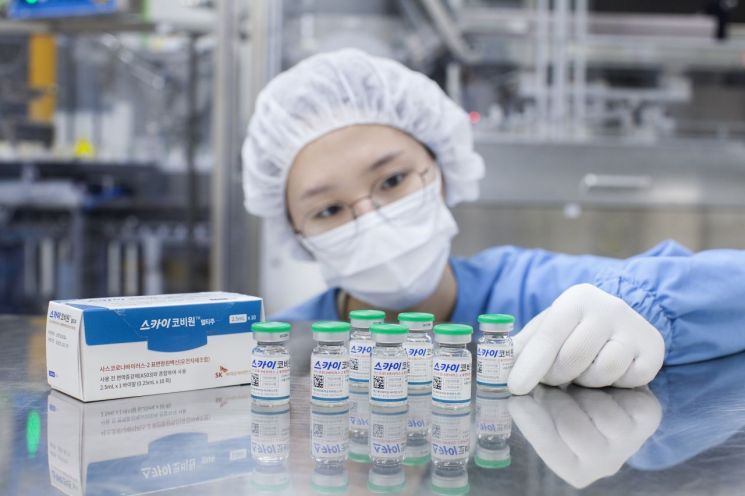
[Asia Economy Reporter Lee Gwan-joo] As the possibility of a COVID-19 resurgence increases this winter, news of price hikes for COVID-19 vaccines by global pharmaceutical companies such as Pfizer and Moderna is drawing renewed attention to the importance of ‘vaccine sovereignty.’ South Korea has joined the ranks of vaccine sovereign nations with SK Bioscience’s successful development of the synthetic antigen-based vaccine ‘Skycovione Multi.’
Pfizer and Moderna "To Raise Vaccine Supply Prices Next Year"
According to the pharmaceutical and bio industry and major foreign media on the 28th, Pfizer is reportedly considering raising the price of its COVID-19 vaccine ‘Comirnaty’ to about four times the current U.S. government supply price. Angela Lukin, Pfizer’s CEO, recently announced at an analyst and investor meeting that when the contract with the U.S. government expires next year and vaccine supply proceeds through the private market, the price per adult dose will be adjusted from the current $25?30 to around $110?130. Moderna is also expected to raise the price from $64 to about $100 per dose when COVID-19 vaccine supply shifts to the private market.
The price increases by these two major COVID-19 vaccine suppliers are expected to affect vaccine supply worldwide beyond the U.S. Earlier, health authorities mentioned the vaccine price hikes during a regular briefing, noting that it could impact the parts South Korea is negotiating to contract next year. Since only a few suppliers exist and countries worldwide are trying to purchase from them, buyers are at a ‘comparative disadvantage’ compared to suppliers in all negotiations.
The Importance of Vaccine Sovereignty and SK Bioscience’s Success with ‘Skycovione’
Given this situation, securing vaccine sovereignty has become even more important. There is a consensus on the necessity of vaccine sovereignty during the COVID-19 pandemic. At the early stage of the crisis, only a few countries such as the U.S., the U.K., and Germany had their own vaccines, and these countries prioritized vaccinating their own citizens and used COVID-19 vaccines as a means to expand national power, intensifying vaccine supply imbalances. In fact, South Korea’s human vaccine trade balance recorded a deficit of $1.83 billion last year. While exports amounted to $520 million, imports reached $2.35 billion, interpreted as a deficit caused by COVID-19 vaccine imports.
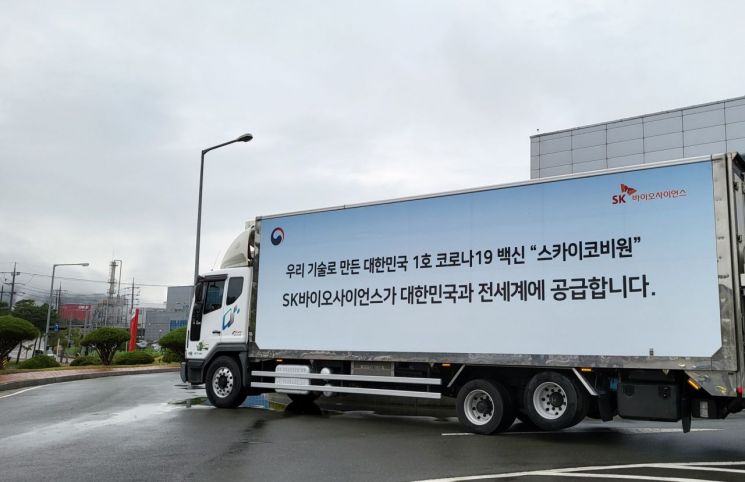 SK Bioscience's COVID-19 vaccine Skycovione being shipped from L House in Andong.
 [Photo by SK Bioscience]
The fortunate part is that South Korea has recently joined the ranks of vaccine sovereign nations. In August, SK Bioscience succeeded in developing the synthetic antigen-based COVID-19 vaccine Skycovione, securing a domestically developed vaccine. Skycovione was jointly developed by SK Bioscience and the Antigen Design Research Institute (IPD) at the University of Washington School of Pharmacy in the U.S., and global clinical trials confirmed excellent immunogenicity for the primary vaccination series (1st and 2nd doses). The booster shot effect for those previously vaccinated with existing vaccines was also demonstrated.
In fact, the phase 3 clinical trial of Skycovione primary vaccination involving 4,037 adults aged 18 and over showed that neutralizing antibody titers increased approximately 33-fold compared to before vaccination, and neutralizing antibody titers were three times higher compared to the control vaccine. Additionally, individuals who completed primary vaccination with Pfizer, Moderna, AstraZeneca, or Janssen vaccines authorized in South Korea and then received a Skycovione booster showed an average 52.9-fold increase in neutralizing antibody titers against the Omicron variant BA.1 and an average 28.2-fold increase against BA.5 compared to before the booster.
The pharmaceutical and bio industry highlights that all phases 1, 2, and 3 clinical trials of Skycovione were conducted domestically. This serves as evidence that the vaccine is more suitable and stable for the Korean population. The global clinical trials and analyses of Skycovione were conducted in cooperation with the International Vaccine Institute (IVI), a nonprofit international organization, and supported by the National Institute of Health’s Public Vaccine Development Support Center, with multiple institutions including Korea University Guro Hospital conducting domestic trials.
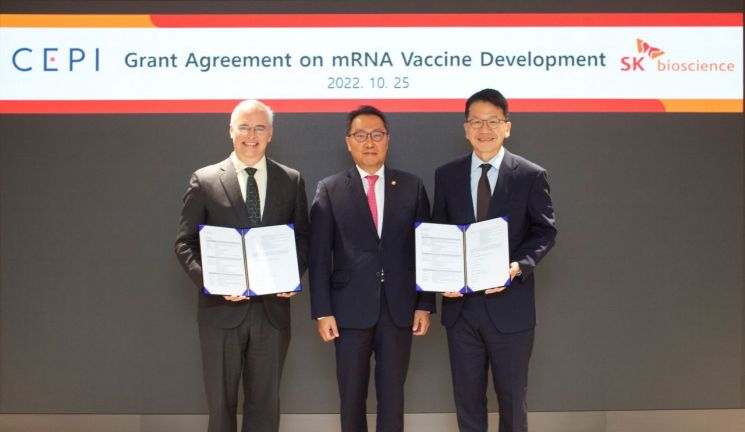 SK Bioscience and the Coalition for Epidemic Preparedness Innovations (CEPI) held a signing ceremony on the 25th at the Walkerhill Hotel in Gwangjin-gu, Seoul, agreeing to collaborate on mRNA vaccine development. From the left, Richard Hatchett, CEPI CEO; Minsoo Park, 2nd Vice Minister of Health and Welfare; Changwon Choi, Vice Chairman of SK Discovery.
 [Photo by SK Bioscience]
"Accelerating Development of New Vaccines and Platforms"
SK Bioscience is accelerating efforts to secure new platforms through its global network beyond Skycovione. It is currently developing multivalent vaccines targeting multiple COVID-19 viruses, combo vaccines that respond to both influenza and COVID-19 at once, universal vaccines targeting ‘Sarbecoviruses’ which include COVID-19 and SARS, and nasal sprays for virus prevention and treatment. SK Bioscience recently signed agreements with international organizations such as the Coalition for Epidemic Preparedness Innovations (CEPI) and the Hillerman Institute to embark on new vaccine and platform development.
Choi Chang-won, Vice Chairman of SK Discovery, said, “The whole world agrees that ‘speed’ is the most important factor in protecting humanity from future pandemics. Based on networks with global institutions and companies, we will strive to achieve innovation in vaccine development and ultimately contribute to improving global health.”
© The Asia Business Daily(www.asiae.co.kr). All rights reserved.
![A Woman with 50 Million Won Debt Clutches a Stolen Dior Bag and Jumps... A Monster Is Born [Slate]](https://cwcontent.asiae.co.kr/asiaresize/183/2026021902243444107_1771435474.jpg)


















