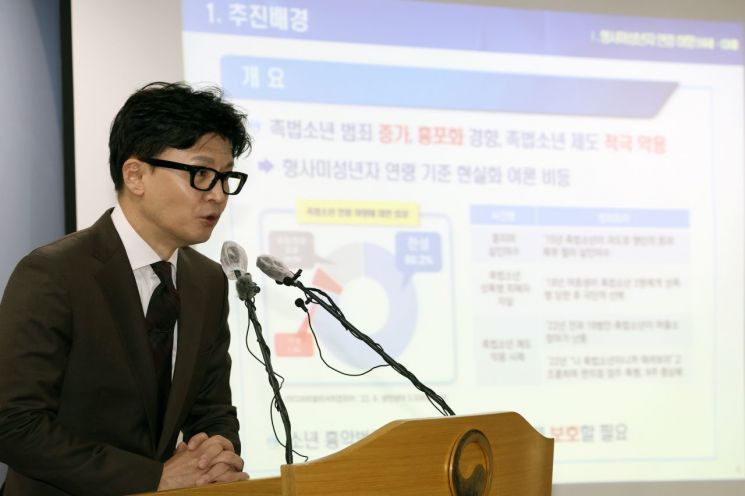
 Minister of Justice Han Dong-hoon is announcing a comprehensive plan for juvenile crime on the afternoon of the 26th at the Ministry of Justice in the Government Complex Gwacheon, Gyeonggi Province. [Image source=Yonhap News]
[Asia Economy Reporters Kim Hyung-min and Yoo Byung-don] As the government lowers the age of 'Chokbeopsonyeon' (criminally responsible juvenile) by one year, from now on, students in the 1st and 2nd grades of middle school will also face criminal punishment if they commit crimes.
Additionally, juvenile divisions will be established in prosecution offices with many juvenile cases, and programs for the prevention and rehabilitation of juvenile crime will be strengthened.
The Ministry of Justice announced on the 26th a 'Comprehensive Plan for Juvenile Crime' containing these measures. By amending the Criminal Act and Juvenile Act, the upper age limit for Chokbeopsonyeon will be lowered from the current 'under 14 years old' to 'under 13 years old.' Chokbeopsonyeon refers to youths aged 10 to under 14 who commit crimes and have been subject to protective measures such as community service or transfer to juvenile training centers instead of criminal punishment. After the legal amendment, 13-year-olds will no longer be considered Chokbeopsonyeon.
However, to minimize disadvantages related to schooling and employment, restrictions on criminal record inquiries for crimes committed at age 13 will be reviewed. Juvenile-related criminal justice procedures will also be improved.
In prosecution offices with many juvenile cases, such as Incheon and Suwon District Prosecutors' Offices, dedicated departments called 'Juvenile Divisions' (tentative name) will be established. The expertise of prosecutors specializing in juvenile cases will also be enhanced.
The Ministry of Justice prepared these measures because juvenile crimes, including those committed by Chokbeopsonyeon, are increasing.
According to the '2021 Crime Statistics' by the National Police Agency, the number of juvenile offenders aged 18 or younger arrested nationwide was 72,337 in 2017, 65,784 in 2018, 65,907 in 2019, 64,152 in 2020, and 53,760 in 2021. Excluding those under 14 years old in 2017, the total number over five years reached 321,940. This means that on average, more than 176 children were arrested daily for crimes. Until 2017, the police included 'under 14 years old' in their statistics, but since Chokbeopsonyeon offenders are transferred to the juvenile court rather than the prosecution according to juvenile offender handling regulations, the police have not prepared suspect records since 2018.
The number of Chokbeopsonyeon separately counted by the National Police Agency was 7,364 in 2018, 8,615 in 2019, 9,606 in 2020, and 10,915 in 2021. Including these, the number of juvenile offenders aged 18 or younger was 73,148 in 2018, 74,522 in 2019, 73,758 in 2020, and 65,675 in 2021, significantly increasing the scale.
When considering only figures excluding Chokbeopsonyeon, violent crimes were the most common with 92,576 cases, and theft crimes were also significant with 83,666 cases. In particular, among all offenders totaling 488,086, 17.1% of theft offenders were juveniles. For violent crimes, 7.7% of all offenders were juveniles. In 2021 alone, juvenile offenders committed 5 murders, 6 attempted murders, 175 robberies, 1,386 sex crimes, and 76 arsons, totaling 1,648 juvenile offenders. Compared to the previous year, murders increased by 3 cases, and attempted murders decreased by 1. Juvenile robbers were caught approximately every two days, and nearly four juvenile sex offenders occurred daily. Among juveniles arrested for violent crimes, 107 were detained last year. All five juveniles who committed murder were detained, and half (3) of the attempted murderers were detained. Sixty juveniles were detained for sex crimes, and 38 juveniles were detained for robbery.
There were even more detentions for non-violent crimes. A total of 195 juveniles were detained for theft and violent crimes, with 146 for theft, 26 for violent acts, and 9 for injury. Recently, two teenagers who stole about 1 million won from three unmanned stores in Dongjak-gu, Seoul, were caught by the police, and one of them was detained.
The problem is the high recidivism rate among juvenile offenders. Among 53,760 juvenile offenders last year, 21,474 were repeat offenders with prior criminal records, accounting for 39.9% of all juvenile offenders. The number of prior offenses among juvenile offenders is also serious. The largest group was those with one prior offense at 4,869, followed by those with nine or more prior offenses at 2,982, which is more than those with two (2,612), three (1,843), or four (1,182) prior offenses. Among them, 79.3% were caught committing crimes again within one year. The probability of committing the same type of crime again was also high at 47.6%. In particular, 54.7% of theft offenders were caught again for the same crime. Robbery had a recidivism rate of 54.4%, and fraud was 53.8%, ranking just after theft. According to the Ministry of Justice's 'Probation Statistics,' the recidivism rate among juvenile probationers (those committing crimes during probation) increased from 12.3% in 2018 to 13.5% in 2020, then slightly decreased to 12.0% in 2021. This rate is nearly three times higher than that of adults (4.5%).
Professor Gong Jeong-sik of the Department of Criminal Psychology at Kyonggi University emphasized, "The age of offenders is getting lower, and the mechanisms for rehabilitation are not functioning properly, leading to high recidivism. It is urgent to reorganize measures to prevent juvenile crime."
© The Asia Business Daily(www.asiae.co.kr). All rights reserved.

















