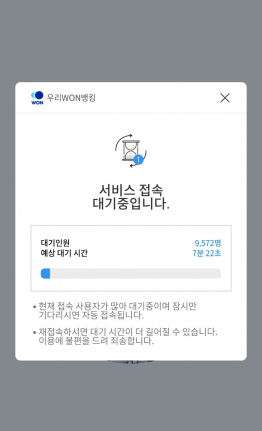
[Asia Economy Reporter Buaeri] "What happened to Woori Bank app?" On the morning of the 25th at 8:20 AM, users experienced inconvenience due to an access failure in Woori Bank's mobile banking app, 'WooriWON Banking.' Especially on this day, which is payday for many companies, the app became unresponsive, leading to frustration among users. When opening the app, a waiting screen appeared, and the waiting time was announced, making access difficult. Recovery was completed in about an hour. Woori Bank had also experienced an access failure on August 25th, and Shinhan Bank's banking app 'SOL' had a similar outage lasting about an hour on March 1st.
Bank app errors are recurring whenever they seem to be forgotten. According to data from the Financial Supervisory Service on the 26th, there were a total of 159 IT system failures in the financial sector from January to August this year. Financial sector IT failures have increased annually, with 196 cases in 2019, 198 in 2020, and 228 last year. Over the past four years, banks accounted for the most IT failures with 275 cases, followed by securities firms (246), insurance companies (137), savings banks (66), and card companies (57). Woori Bank explained regarding the previous day's error, "There was a problem during the update process, and as many users accessed the app simultaneously, the recovery process was slightly delayed."
Banks emphasize digital enhancement, but frequent errors undermine the digital transformation strategies they promote. However, as offline branches shrink, the role of financial apps becomes increasingly important, and users feel anxious whenever the app becomes unresponsive. Industry insiders point out that banks' development capabilities remain insufficient both qualitatively and quantitatively.
Criticism also arises regarding banks' lack of capacity to handle large volumes of traffic when users suddenly surge. Many banks use external companies to develop and manage their apps, and there are frequent errors during integration with internal networks. An IT industry insider said, "Skilled developers mostly work at IT companies like Naver and Kakao, and many personnel in the financial sector are people who used to handle legacy IT tasks, so there is inevitably a qualitative gap." Professor Wi Jeong-hyun of Chung-Ang University's Business Administration Department said, "There is a significant salary gap between developers in IT companies and banks, so young developers do not prefer banks. However, banks cannot give special high salaries only to some developers unlike existing personnel, so they face deep concerns."
The financial sector still suffers from a shortage of IT personnel. According to data on the 'Status of IT Personnel in Commercial Banks' from the office of Kang Min-guk, a member of the People Power Party (as of the end of August), the proportion of IT personnel among total employees at KB Kookmin, Shinhan, Woori, and Hana Banks averaged only 8.2%. Out of 54,863 total employees, 4,493 were IT-related staff. Because of this, there are ongoing calls for the banking sector to establish systems to respond to IT personnel and security risks. Representative Kang argued, "The Financial Services Commission should specify the level of IT personnel secured by financial companies, which is currently only a recommended measure under the Financial Security Governance Guide of the Financial Security Institute, in the subordinate regulations of the Electronic Financial Transactions Act currently being revised, after collecting domestic and international cases and industry opinions."
© The Asia Business Daily(www.asiae.co.kr). All rights reserved.
![Clutching a Stolen Dior Bag, Saying "I Hate Being Poor but Real"... The Grotesque Con of a "Human Knockoff" [Slate]](https://cwcontent.asiae.co.kr/asiaresize/183/2026021902243444107_1771435474.jpg)










