Southeast Asia and Japan Open Air Routes, but China Remains Closed
280,000 Passengers on China Routes at Incheon Airport This Year... 2.08% of 2019
China's Easing of Quarantine Policies Still Far Off... Diplomatic Relations Also a Challenge to Resolve
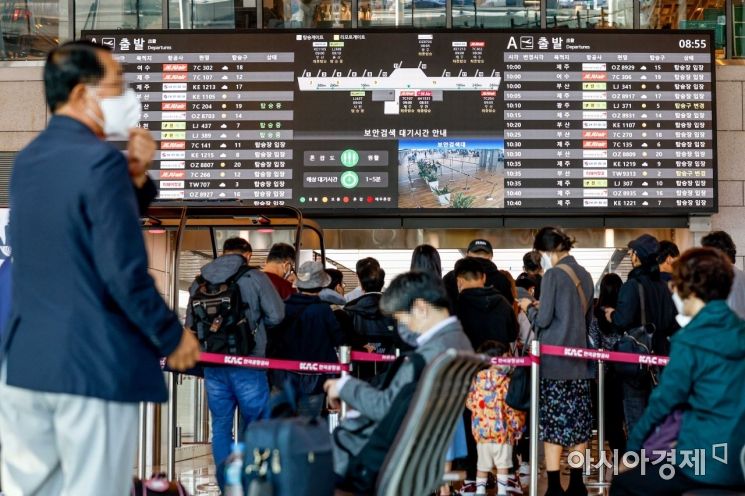
[Asia Economy Reporter Yoo Hyun-seok] As Southeast Asian countries and Japan reopen, giving airlines some breathing room, China remains the last gateway. Like Japan, China accounts for a significant portion of airlines' revenue, so if routes to China also reopen, it is expected that airlines' performance improvement will accelerate.
According to Incheon International Airport Corporation on the 25th, from January this year until the 23rd, 282,257 passengers used the Incheon-China route. This is only 2.08% of the 13,582,674 passengers in 2019. The same applies to airports other than Incheon Airport. Nationwide airports excluding Incheon saw only 17,480 passengers on China routes this year, which is just 0.35% of the 4,926,502 passengers in 2019.
China routes were one of the major revenue sources for airlines. The number of tourists entering Korea from China reached 8,067,000 in 2016 but declined due to the impact of the Terminal High Altitude Area Defense (THAAD) system in 2016, then increased again to 6,023,000 in 2019 before COVID-19. Additionally, travelers from Korea to China reached as many as 4,194,000 in 2018.
The annual passenger count, which once reached 10 million, sharply decreased after COVID-19. Unlike other countries that have eased quarantine measures and opened borders, China has continued its 'Zero COVID' policy, so air routes to China remain distant.
However, this trend has recently begun to change. Chinese state-owned airlines have decided to increase flights. According to foreign media, China Eastern Airlines and China Southern Airlines have decided to increase their weekly flights from 42 and 71 to 108 and 86, respectively. Also, Chinese authorities are gradually easing quarantine policies.
Last month, five ministries including the Ministry of Culture and Tourism and the Ministry of Foreign Affairs jointly issued a revised 'Border Management Policy' and began collecting opinions. The quarantine period for incoming travelers, which was applied up to 28 days, has been shortened to 10 days. Recently, discussions are underway to reduce it further to 7 days.
There is a positive outlook that quarantine policies will be substantially eased starting next year. Since Chinese President Xi Jinping has touted the economic and quarantine policies as successful, the easing of Zero COVID is still considered distant. Jeon Jong-gyu, a researcher at Samsung Securities, said, "There will be no significant changes in economic stimulus and quarantine policies after the Party Congress. Although some quarantine period reductions and easing of interregional travel restrictions for certain entrants are expected after the Party Congress, the turning point for Zero COVID policy is likely after the National People's Congress in March next year."
There are also many diplomatic issues to resolve. Since there are opinions that the intensity of 'Wolf Warrior diplomacy,' referring to China's aggressive diplomacy after the Party Congress, will increase, improving relations between Korea and China is necessary. Professor Hwang Yong-sik of Sejong University said, "China is currently entangled with Korea in various areas, starting from diplomatic issues to economic matters. Only by untangling these knots will route recovery be possible."
© The Asia Business Daily(www.asiae.co.kr). All rights reserved.
![User Who Sold Erroneously Deposited Bitcoins to Repay Debt and Fund Entertainment... What Did the Supreme Court Decide in 2021? [Legal Issue Check]](https://cwcontent.asiae.co.kr/asiaresize/183/2026020910431234020_1770601391.png)
















