Short-Term Bond Market Tightening Due to Legoland Incident
Overall Loan Interest Rates Affected as Financial Bond Yields Rise
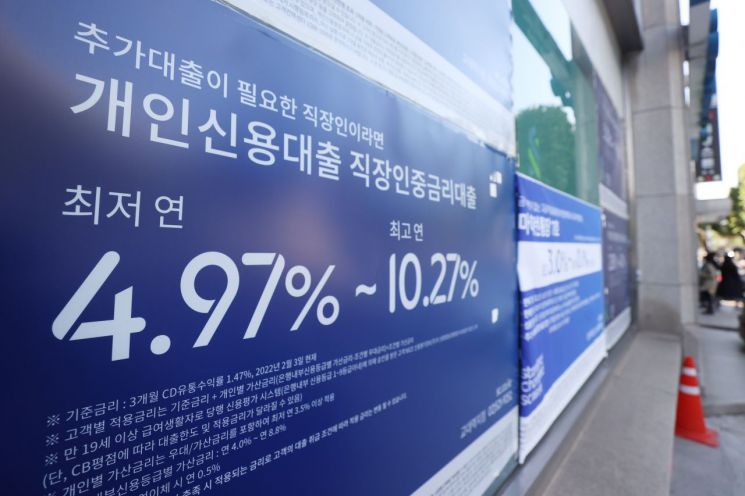
[Asia Economy Reporter Sim Nayoung] As the short-term bond market became unstable due to the default on the Gangwon-do Legoland ABCP (Asset-Backed Commercial Paper), bond yields surged sharply, leaving only the 'Yeongkkeuljok' (those who borrowed to the maximum) to bear the brunt of the damage. This is because mortgage loans, credit loans, and jeonse deposit loans, which move in tandem with the rise in financial bond yields, all saw their interest rates rise simultaneously.
According to the banking sector on the 25th, among the five major banks (KB Kookmin, Shinhan, Hana, Woori, NH Nonghyup), interest rates rose by 0.2 to 0.5 percentage points (p) within a week. As of the 24th, fixed-rate mortgage loan interest rates ranged from 5.35% to 7.32%, credit loans for six months were between 5.72% and 6.96%, and jeonse loan interest rates were from 4.92% to 6.75%.
An official from a commercial bank said, "As the short-term bond market tightened and financial bond yields rose, it affected overall loan interest rates," adding, "The interest rate levels changed within a week."
The financial bond AAA 6-month yield, which affects six-month credit loans, was 4.752% as of the 24th. This marked the highest point in 13 years and 9 months since January 5, 2009 (4.27%). Although the government announced injecting liquidity of 50 trillion won plus alpha into the short-term bond market, the effect was negligible, and the rate rose further compared to the previous business day on the 21st (4.231%). The financial bond AAA 5-year yield, directly linked to fixed-rate mortgage loans, was 5.356%, slightly easing from the previous business day (5.467%), but still soaring compared to the 2% range in October last year. The rate reaching the 5% range is the first time in 12 years and 2 months since July 2010.
As interest rates rise, the worries of Yeongkkeuljok, who took out mortgage loans and credit loans to the maximum limit when buying a house, deepen. Lee Myungseop, an employee of a large corporation who bought an apartment in Ahyeon-dong, Mapo-gu, Seoul, earlier this year, said, "I took out a credit loan to pay taxes when buying the house, and the 6% interest rate I had only heard about became my reality," adding, "I initially got a mortgage loan with a 5% variable interest rate, and now my monthly principal and interest repayment exceeds 4 million won, which is about the salary of an average person."
If the U.S. Federal Reserve (Fed) and the Bank of Korea raise the base interest rate in November, loan interest rates are expected to rise again. A financial sector official predicted, "If the base rate rises, bond yields will increase, and loan interest rates will also rise accordingly, potentially pushing mortgage and credit loan rates to around 8%."
© The Asia Business Daily(www.asiae.co.kr). All rights reserved.

















