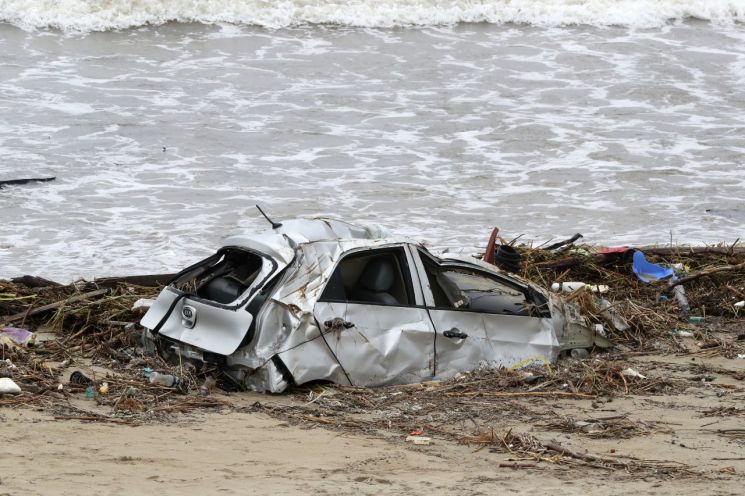
 On the 14th of last month, a car carried inland by the influence of Typhoon Hinnamnor, the 11th typhoon, was buried in the sand near Dogu Beach in Donghae-myeon, Nam-gu, Pohang-si, Gyeongbuk. [Image source=Yonhap News]
[Asia Economy Reporter Changhwan Lee] Due to the typhoon that swept through the southern regions last month, the loss ratio of automobile insurance for non-life insurance companies has sharply increased. The automobile insurance surplus trend, which had been maintained until the second quarter, is likely to be broken in the third quarter, and it is expected to negatively impact the companies' performance.
According to the non-life insurance industry on the 25th, the average automobile insurance loss ratio of 11 domestic non-life insurance companies last month was 94.0% (provisional), up 9.5 percentage points (p) from 84.5% recorded in the same period last year. It is the highest figure this year, surpassing the 88.1% recorded in the previous month.
By company, MG Non-Life Insurance had the highest loss ratio at 141.7%. AXA Non-Life Insurance recorded 108.5%, Heungkuk Fire & Marine Insurance 102.4%, and Hana Non-Life Insurance 98.6%, showing a surge in loss ratios among small and medium-sized companies. Large companies also worsened compared to the same period last year or the previous quarter, with Samsung Fire & Marine Insurance at 86.0%, KB Non-Life Insurance at 85.7%, DB Non-Life Insurance at 85.5%, and Hyundai Marine & Fire Insurance at 81.8%.
Insurance companies consider that if the automobile insurance loss ratio is maintained only in the low 80% range, a surplus can be expected when considering operating expenses. If it exceeds the high 80% range or 90%, the possibility of a deficit is high.
The automobile insurance situation worsened due to consecutive heavy rains and typhoons. The non-life insurance industry estimated that 9,691 vehicles nationwide were flooded due to Typhoon Hinnamnor last month, resulting in a total damage of 77.2 billion KRW.
Earlier in August, concentrated heavy rain centered around Gangnam, Seoul, caused 11,685 flooded vehicles, with estimated damages reaching 163.7 billion KRW. An insurance company official said, "With heavy rain damage occurring significantly for two consecutive months, the profitability of automobile insurance business has rapidly deteriorated."
Last month, the increased traffic volume due to the Chuseok holiday was also identified as a factor raising the automobile insurance loss ratio. This year’s Chuseok was the first holiday after the lifting of social distancing measures, resulting in a significant increase in traffic volume compared to the previous year. As traffic volume increases, accidents become more frequent, raising the automobile insurance loss ratio.
As the automobile insurance loss ratio worsens, the third-quarter performance of non-life insurers is also expected to be affected. Lee Byung-geon, a researcher at DB Financial Investment, explained, "The performance of non-life insurers in the third quarter will deteriorate compared to the same period last year. Due to the concentrated heavy rains in July and the damage related to Typhoon Hinnamnor in August, the automobile insurance loss ratio will be higher than the same period last year, and the general insurance loss ratio will inevitably increase as well."
© The Asia Business Daily(www.asiae.co.kr). All rights reserved.

















