Some Places Start Selling One Egg Bread for 2000 Won
Store Owners Say "Fuel and Ingredient Cost Increases Make Price Hikes Inevitable"
[Asia Economy Reporter Jeon Jinyoung] “Two fish-shaped buns for 1,000 won? That’s expensive. If I buy 2,000 won worth, will you give me one more?” When a customer asked this at a nearby fish-shaped bun stall in Mapo-gu, Seoul, the owner just scratched his head silently. He replied, “I’m always at a loss in situations like this. I want to give more, but the rent is high, and now there’s really no profit left, so I can’t help it.”
As the season for winter’s representative snacks, fish-shaped buns and egg bread, approaches, consumers’ “fish-shaped bun index” is rising sharply. Due to rising prices, most street vendors have raised the price of fish-shaped buns from 3 for 1,000 won last year to 2 for 1,000 won this year. Egg bread, which has even higher ingredient costs than fish-shaped buns and leaves even less profit, has been removed from the menu at some places this year.
In fact, a fish-shaped bun stall near Gongdeok Station on Seoul Subway Line 6 was selling fish-shaped buns at 2 for 1,000 won, down from 3 for 1,000 won. At an egg bread stall near Hongdae Entrance Station on Line 2, egg bread that used to be 3 for 2,000 won was sold at 2,000 won each. Fish-shaped buns with ingredients other than red bean paste, such as sweet potato, were priced at around 1,000 won each. The situation was similar in the metropolitan area; in Incheon, fish-shaped buns were sold at 3 for 2,000 won.
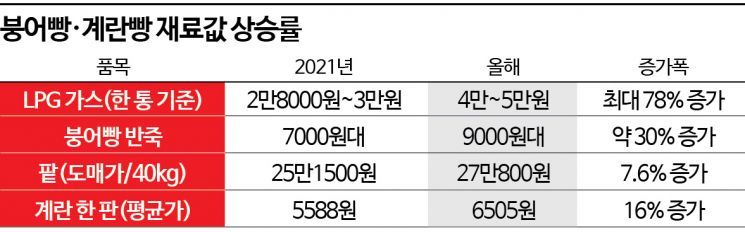
This rise in the fish-shaped bun index is due to increased raw material costs. According to a fish-shaped bun startup company, a cylinder of LPG gas used for baking the batter was supplied at 28,000 to just over 30,000 won last year, but this year it approaches 40,000 to 50,000 won. Not only fuel costs but also flour and red bean prices have risen. The price of a sack of dough rose from the 7,000 won range to the 9,000 won range due to flour price increases. According to the Korea Agro-Fisheries & Food Trade Corporation (aT) agricultural product distribution information, the wholesale price of imported red beans (40kg), used as filling for fish-shaped buns, is 270,800 won, up 19,300 won from a year ago. Cooking oil prices have also risen by more than 20% since February. The same applies to egg bread. According to the Agricultural Products Quality Management Service, the average consumer price for a carton of eggs in October was 6,505 won, about 1,000 won higher than the usual price (5,588 won). Considering other costs such as rent, the burden on store owners inevitably increases compared to last year.
Park, the owner of a fish-shaped bun stall in Jung-gu, Incheon, said, “It hurts us to hear customers say why it’s become so expensive. We want to keep prices frozen, but then there’s no profit at all.” He added, “At least fish-shaped buns are in a better situation. Many store owners who sell egg bread, which has higher ingredient costs than fish-shaped buns, have removed egg bread from their menus this year.”
Inquiries about starting fish-shaped bun stalls, which usually line up around this time to capitalize on seasonal demand, have noticeably decreased recently. Kim, who runs a street food startup business, said, “Store owners are struggling a lot because the economy is bad,” and added, “Maybe because of this, calls inquiring about starting fish-shaped bun businesses, which usually come frequently before winter, have definitely decreased this year.”
© The Asia Business Daily(www.asiae.co.kr). All rights reserved.
![User Who Sold Erroneously Deposited Bitcoins to Repay Debt and Fund Entertainment... What Did the Supreme Court Decide in 2021? [Legal Issue Check]](https://cwcontent.asiae.co.kr/asiaresize/183/2026020910431234020_1770601391.png)
















