[When to Remove Masks] Need to Evaluate the Effectiveness of Uniform Indoor Mask Wearing
Asked 13 Quarantine and Health Experts...
"Restaurants, Cafes, and Daycare Centers Should Be Prioritized"... Concerns Over 'Full Lift'
Many Say Removal Timing Is "Possible Only After This Winter's Resurgence and Twin Demic"
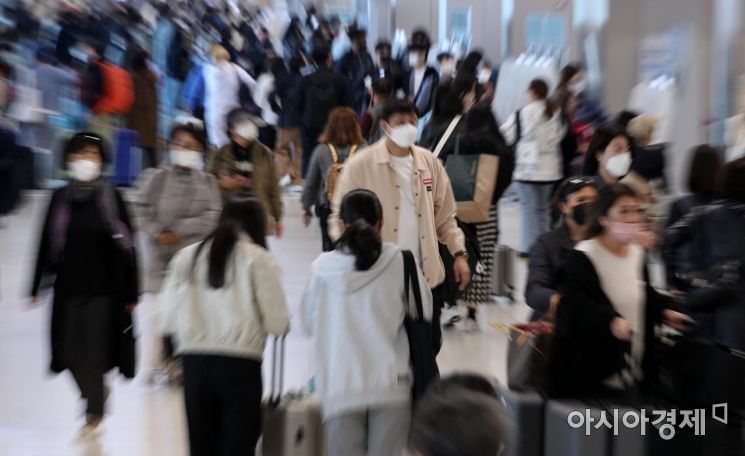 On the 11th, travelers wearing masks are moving inside the domestic terminal of Gimpo Airport in Gangseo-gu, Seoul. Photo by Hyunmin Kim kimhyun81@
Public opinion is now heatedly debating whether it is time to remove masks indoors. There are many criticisms that mandatory mask-wearing measures in places like restaurants and cafes are not very effective, and there are growing concerns that infants and toddlers in daycare centers are not properly acquiring language skills. The government is also considering selectively lifting the mask-wearing mandate in all indoor spaces.
A considerable number of experts agree that whether to wear masks should be left to individual discretion. Just as people have voluntarily continued to wear masks in crowded outdoor spaces even after the outdoor mask mandate was lifted, it is considered desirable to trust the mature civic consciousness of our citizens regarding indoor mask-wearing. However, since the possibility of a seventh wave of COVID-19 is increasing this winter, many believe that the safest time to remove indoor masks would be after the COVID resurgence and flu season subside, likely early next year.
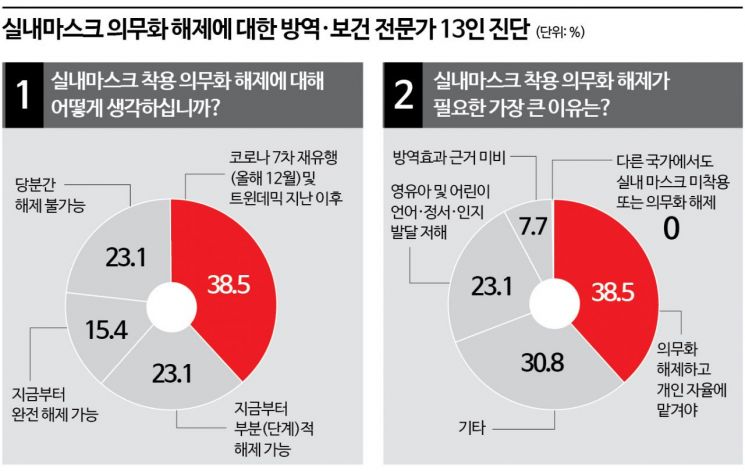
According to a survey conducted on the 24th by Asia Economy targeting 13 domestic COVID-19 prevention and health experts, 38.5% of respondents said the reason to lift the indoor mask mandate is that it should be left to personal discretion. This implies that, as with outdoor mask-wearing, the indoor mask mandate should ultimately be lifted, and even if masks are worn indoors for prevention, there is no need for compulsory regulation. Professor Jeong Jae-hoon of Gachon University College of Medicine’s Department of Preventive Medicine said, "It is desirable for the indoor mask mandate to be lifted and then recommended. Even after the outdoor mask mandate was lifted, many people still wore masks, so individual choice and risk assessment should be respected."
Opinions that masks should now be removed because mask-wearing hinders language, emotional, and cognitive development in infants and children accounted for 23.1%. Professor Eun Byung-wook of Nowon Eulji University Hospital’s Department of Pediatrics pointed out, "There is a growing body of empirical research showing that mask-wearing impedes language acquisition in infants and toddlers, so it is an urgent task to remove masks from infants or childcare workers who care for them."
However, opinions were divided on the timing and target facilities or locations for lifting the indoor mask mandate. 38.5% of experts said masks can only be removed indoors after the seventh wave of COVID and the twin-demic subside, while 23.1% held a more conservative view that lifting the indoor mask mandate is impossible for the time being. On the other hand, 15.4% believed that a full indoor mask mandate lift is possible immediately, and 23.1% supported a partial (phased) lift.
Professor Kim Woo-joo of Korea University Guro Hospital’s Department of Infectious Diseases warned, "Premature lifting of the indoor mask mandate risks lowering vigilance about prevention. It is a matter to be observed at least after the seventh wave." Professor Eun Byung-wook also predicted, "(While lifting indoor masks for infants and toddlers is necessary) the current pediatric emergency critical care system is severely weakened, and other respiratory infectious diseases are also spreading, so it can only be considered after the seventh wave this winter."
Masks Should Be Removed First in Restaurants and Daycare Centers
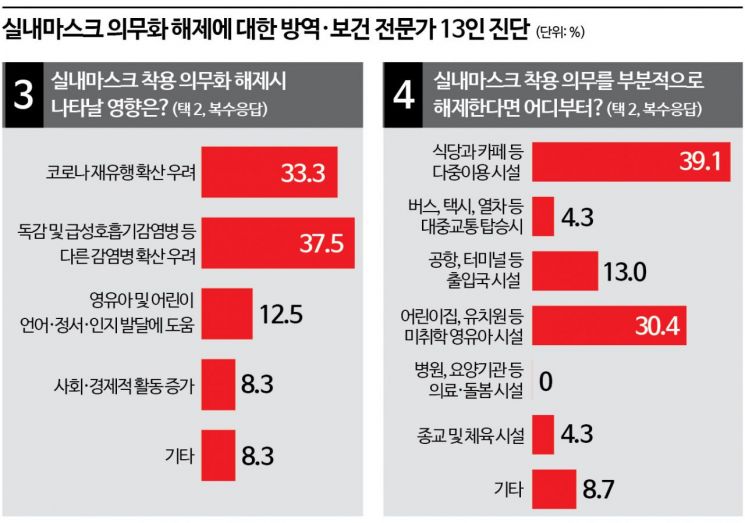
Experts are paying attention to the fact that the COVID resurgence, which had been declining since early September, has plateaued since mid-month and new confirmed cases are rising again. If the indoor mask mandate is fully lifted, 70.8% (multiple responses allowed) of respondents expressed concerns that "COVID resurgence could spread or other infectious diseases like flu and acute respiratory infections could spread."
Opinions that "lifting the indoor mask mandate would help infants' and children's language and emotional development" accounted for 12.5%, and those who believed "social and economic activities would increase" accounted for 8.3%. Professor Lee Hyuk-min of Severance Hospital’s Department of Diagnostic Medicine said, "If both outdoor and indoor mask mandates are lifted, it may give the public the impression that the COVID-19 pandemic is over, making it difficult to supplement policies. Subsequently, vaccination rates may decline."
If the indoor mask mandate is partially lifted, it was suggested that it should be applied first to multi-use facilities such as restaurants and cafes (39.1%), followed by facilities for preschool infants and toddlers such as daycare centers and kindergartens (30.4%), and then immigration facilities such as airports and terminals (13.0%). Hospitals, nursing facilities, and other medical and care facilities, as well as public transportation such as buses, taxis, and trains, were identified as indoor facilities where mask-wearing should be maintained until the very end.
Professor Kim Tak of Soonchunhyang University Bucheon Hospital’s Department of Infectious Diseases emphasized, "Even if the indoor mask mandate is lifted, we need to consider which facilities should lift it later and how to ensure compliance in places where mask-wearing is maintained. Masks should be strictly worn in vulnerable facilities such as medical institutions." Professor Jeong Jae-hoon proposed, "We should designate mandatory mask-wearing facilities such as public transportation and medical institutions and fully lift the mandate in other places and situations, moving toward a 'negative regulation' system."
Confirmed Cases to Be Treated in General Medical System
Once the indoor mask mandate is lifted, all COVID-19 prevention measures except the '7-day isolation for confirmed cases' will effectively disappear. Most experts agree that even if masks are completely removed, vaccination for high-risk groups should continue to be encouraged, and preparations should be made to treat COVID-19 patients effectively within the routine healthcare system.
Professor Baek Soon-young, Emeritus Professor at Catholic University College of Medicine, said, "We must prepare in advance to prevent bed shortages if respiratory diseases surge this winter, not just COVID. Prevention efforts should focus on early diagnosis and treatment at frontline medical institutions." Professor Chun Eun-mi of Ewha Mokdong Hospital’s Department of Respiratory Medicine also argued, "We must prevent confusion in medical settings caused by the twin-demic. COVID-19 treatment in hospitals should be normalized so that symptomatic patients can be treated without isolation, returning to the pre-COVID medical system."
There was also advice to strengthen infectious disease surveillance systems more tightly even if the COVID resurgence subsides, and to respond flexibly by changing prevention guidelines if necessary. Professor Choi Jae-wook of Korea University College of Medicine’s Department of Preventive Medicine said, "We need to establish a nationwide active infectious disease sentinel surveillance system and conduct COVID-19 genetic surveillance to detect variants. If a risk or crisis alert is issued based on the surveillance system, the public should be informed in advance that additional prevention measures such as indoor mask-wearing may be reinstated."
Director Song Jeong-heup of Jeong Myeong-hee Pediatrics Clinic (former Professor of Preventive Medicine at Chilgok Kyungpook National University) said, "COVID is not over until it is truly over. Even if the indoor mask mandate is lifted, personal hygiene rules such as social distancing, mask-wearing, and handwashing should be consistently emphasized and followed until COVID completely disappears."
Survey Participants (in alphabetical order)
© The Asia Business Daily(www.asiae.co.kr). All rights reserved.



















