[Asia Economy reporters Byunghee Park and Yujin Jo] British Prime Minister Liz Truss announced her resignation on the 20th (local time), just 44 days after taking office, making the UK set to welcome its fifth prime minister since the Brexit referendum in June 2016. Following the Brexit referendum, then-Prime Minister David Cameron resigned, and his successors Theresa May and Boris Johnson each served for three years. Truss became the shortest-serving prime minister in British history. Candidates for Truss's successor include former Chancellor of the Exchequer Rishi Sunak, who competed with Truss until the end, and former Prime Minister Boris Johnson. The next prime minister is expected to be decided as early as the 24th.
The Economist mocks UK as "Britaly"
The British economic weekly The Economist used the neologism "Britaly," a blend of "Britain" and "Italy," to mock the UK for becoming similar to Italy, a country plagued by severe political instability and frequent government changes. Coincidentally, Italy is also about to appoint its fifth prime minister since 2016.
The Economist pointed out that the UK resembles Italy in three aspects: political instability, a sharp drop in government bond prices, and low growth. Regarding the recent surge in UK government bond yields (and the corresponding drop in bond prices), it noted that UK bonds have become a target in the bond market, similar to Italian bonds during the Eurozone crisis. Comparing productivity growth rates among the Group of Seven (G7) countries from 2009 to 2019, Italy was the worst by far, with the UK coming next. Amid severe political and economic turmoil, the UK has had four different chancellors since July. The Economist criticized that these complex problems are the root causes of political instability, leading to frequent government changes.
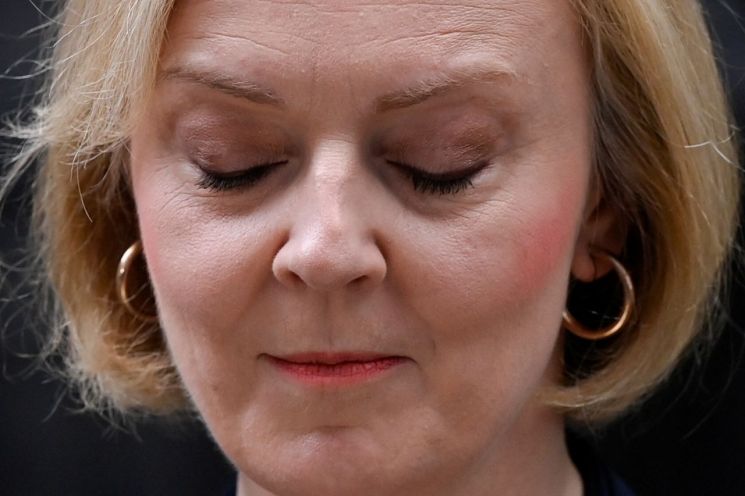 British Prime Minister Liz Truss is announcing her resignation statement at 10 Downing Street, the Prime Minister's residence in London, on the 20th (local time).
 Photo by Reuters
Truss: The First Casualty of the High-Interest Era
The Wall Street Journal (WSJ) diagnosed that Prime Minister Truss's resignation serves as a reminder of how narrow politicians' room for maneuver has become in an era of high inflation and high interest rates. Over the past decade, the era of low inflation and low interest rates allowed governments to increase spending and accumulate debt, but with the end of this era, the accumulated debt has boomeranged, causing political and economic instability. WSJ cited the UK as a prime example, explaining that the UK's government debt-to-GDP ratio has risen from 80% before the COVID-19 pandemic to 100% currently.
Due to economic activity contraction caused by COVID-19, supply chain disruptions, and inflation triggered by the Ukraine war, ruling parties have increasingly lost elections recently. In Germany, Australia, and Sweden, governments have been replaced through elections after 20, 9, and 8 years respectively, and the US Democratic administration faces a looming defeat in the midterm elections scheduled for the 8th of next month.
WSJ analyzed that regardless of who succeeds Truss, fiscal conservatism will dominate the UK for the coming years.
Sunak and Johnson in the Running for Successor... Decision Expected as Early as the 24th
The selection of the successor is expected to conclude as early as the 24th. Bloomberg reported that the Conservative Party is likely to raise the bar for candidates to end the severe political turmoil. According to the Conservative Party's 1922 Committee's nomination rules, candidates must be endorsed by more than 100 fellow MPs by the 24th deadline. Considering there are currently 357 Conservative MPs, up to three candidates may emerge.
Major British media anticipate a fierce three-way contest for the next prime ministership. The likely showdown is between former Chancellor Rishi Sunak and Conservative Party House of Commons Leader Penny Mordaunt, who competed with Truss, but the possibility of former Prime Minister Boris Johnson's return is also mentioned.
Bloomberg raised the possibility of former Home Secretary Suella Braverman, who submitted her resignation the day before and pressured Truss to resign, entering the race. However, newly appointed Chancellor Jeremy Hunt is reported not to be running.
The final candidate nomination will be narrowed down to two through preliminary rounds and online party member voting, with the next prime minister (who will also serve as party leader) expected to be decided by the 28th at the latest. However, if only one candidate meets the registration requirements, that candidate will be elected on the 24th without further procedures.
© The Asia Business Daily(www.asiae.co.kr). All rights reserved.

















